
Puppy Problems 3: Winnie Eats Too Much
Winnie’s Woes – Winnie eats too much …
Written from Winnie’s point of view

Winnie in her basket
That was a lovely lunch. I really enjoyed the crunchy bits and the soggy meaty stuff. I feel quite full so perhaps I’ll have a snooze whilst Claire is upstairs before our next walk. She’s shut me in the kitchen so I guess she might be a while.
Oh, what’s this – Claire has left the door to the pantry open. I’ll just put my nose next to that crack in the door. Oh … that smells nice … mmm, smells like those delicious biscuits we have on walks. I love those.
I better just leave them alone. She probably wouldn’t like it if I go in there. The door is usually closed – I’ve checked several times …
I’ll go and have a lie down. Put the thought of extra biscuits out of my mind.
Bored …
Bored and slightly peckish …
Hmmmmm …
Now I don’t feel so tired, I just want to have a peek at those biscuits.
Wait, what’s that noise? Is it Claire? She’s coming down the stairs! Oh no she isn’t. She’s just walking around upstairs, on the phone …
I’ll just have a look at the biscuits. I’ll just shove this door aside with my nose. Ow, that didn’t work, paw then. Yes, that’s better. Mmm, the biscuits, they do look yummy. I know I’ve just eaten but it’s a long time until tea time and I do get hungry in the afternoon, especially after our walk …
I’m sure she won’t mind, or notice, if I just have a few, just a couple of nibbles.
They’re so delicious! I can’t stop eating. Maybe I should just try and eat as many as I can before she comes downstairs. Hmph-munch-yum-dee-hmh-lish-hmp-usss!
Oh dear! My tummy hurts! Oh my goodness, look at it, it’s huge. Ooowwww, oh it hurts so much. I’ve eaten far too many biscuits. Almost half the bag is gone! And on top of my lunch. Crikes, she won’t fail to notice that. Oowwww. Whine whine …
Winnie, are you okay?
Oh, cuddles. Careful, my tummy hurts … whine whine
Oh no, she looks confused, she’s patting my tummy.
Winnie … blah blah blah, biscuits …
Oh no, she’s seen the open door! Oh please don’t find the bag … oh she has, and she’s looking at me again … oh dear, she looks upset … please don’t tell me off!
Winnie … .blah blah blah blah blah
Oh more cuddles, and stroking. Oh now she’s picked me up. Where am I going?! The garden? Oh, OK, I guess maybe she wants me to go to the toilet … trouble is I don’t feel like doing one yet … Oh my poor tummy!
Whine whine, pitiful whining …
Note from Claire: Poor Winnie was only doing what little golden retrievers do best – eat! I thought I’d closed the pantry door and I’d also left her biscuits at a silly level so she could get at them too easily. Her tummy eventually went back down again, but it was a bit like waiting for Pooh Bear to get thin again when he got stuck in Rabbit’s front door.
Breeder’s advice:
Young puppies will be extremely inquisitive and you must be one jump ahead. Some things could even lead to the death of your puppy – chocolate for instance. Overeating dry food could (on rare occasions) cause the stomach to bloat and if it then twists, you have a real emergency on your hands. Two courses of action can be taken: either invest in child proof locks or simply keep anything edible on a high shelf and – possibly – in a “chew proof” container.
Pat Thomas bred her first litter in 1971 and has bred Border Collies, Irish Setters, Cavalier King Charles Spaniels, Papillions, Labradors and, of course, Golden Retrievers.
Although Winnie is not yet in season most of her litter is booked. This is usually the case, although too many of one sex can be a problem. As a Kennel Club Accredited Breeder, Pat has free access to the Kennel Club website and if she have any puppies not sold, she puts them on there. However, mostly the pups are sold by word of mouth and families returning for a second, third and even a fourth puppy.
Part 1: Winnie discovers digging is not a popular activity!
Part 2: Winnie Eats a Shoe

Have you read the bestseller The Puppy that came for Christmas … A true story that has appealed to dog lovers and non-dog owners alike – it is both truly heart warming and heart wrenching.
Recommended Links:
Anythingdogz – an excellent website owned and run by Lisa Evans, an In Balance reader
Helpful Holidays offer holiday cottages in the West Country that welcome dogs. See their Helpful Holidays website.
Jane Eyre – Major New Film – Giveaway Copies of Penguin Classic

Penguin Classic - Film tie-in
The Penguin Classic Jane Eyre is the tie-in book for the major new film directed by Cary Fukunaga to be released next Friday, 9 September.
Starring Mia Wasikowska, Michael Fassbender, Jamie Bell and Judi Dench it promises to be an exciting version of a wonderful story.
Orphaned Jane Eyre undergoes a baptism of fire – from suffering the cruelty of her coldhearted relatives to the harsh regime at a charity school. Emerging from these experiences a fiery heroine, Jane challenges inequality and the hypocrisy of her keepers. But the strictures of her upbringing are a thing apart when faced with her love for the brooding Mr Rochester and the secrets of his dark past.
Bronte’s controversial proto-feminist classic has had over eighteen film adaptations. Cary Fukunaga, the director of this 2011 versions, says ‘I’m a stickler for raw authenticity, so I’ve spent a lot of time rereading the book. Other adaptations treat it like it’s just a period romance, and I think it’s much more than that.’
Radical in its time for its depiction of women and its challenge to accepted class standards, Jane Eyre has attained enduring significance for combining these controversial issues with a classic love story.
Charlotte Bronte (1816-55) was the eldest sister of novelists Emily and Anne Bronte. Jane Eyre appeared in 1847 and was followed by Shirley (1848) and Villette (1853). In 1854 Charlotte Brontee married her father’s curate, Arther Bell Nicholls. She died on 31 March 1855 in Haworth, Yorkshire, and The Professor was posthumously published in 1857.
This is one of our all-time favourite books and are so looking forward to seeing the new film version.
•••••••••••••••••••••••••••••••••••••••••••••••••••••••••••••••••••••••••••••••••••••••••••••••••••••••••••••••••••••••••••••
 GIVEAWAY DETAILS
We have three copies to give away to In Balance readers
To enter the draw send an email to editorinbalance@me.com with Jane Eyre – Cary Fukunaga’s new film in the subject box and your full contact details in the text box
Make sure your entry reaches us by latest 5 October 2011
Only one entry per household
Grow Nasturtiums for Natural Health

Nasturtium © S Chesterman
Tropaeolum majus also known as Indian Cress
Nasturtiums are bright – see Google page of pictures. They range through yellow-orange to fiery red annuals. This is a plant for which the phrase ‘getting the most out of a plant’ really rings true. Growing nasturtiums is easy. All parts are edible – the flowers, leaves and seeds.
You can plant nasturtium seeds in a bed, border, to climb against a fence, or in containers and hanging baskets. Nasturtiums are easy to grow, in full sun or partial shade. They prefer moist, well-drained poor to ordinary garden soil; too rich a soil results in a profusion of lush green leaves but this is at the expense of flowers. The climbing, trailing and dwarf varieties readily self-seed or the seeds can be gathered and started in pots in the greenhouse.
Good introduction to natural history for children
They’re great for children to plant, not only as the largish seeds are easily held by small fingers but they are fairly quick to germinate and grow. And if you show children how to sow lettuce and radish seeds beside the nasturtiums, there’ll be benefits, both for the plants’ health and the children’s knowledge.
Buds, flowers, leaves and seeds are all edible and quick to pick, contain vitamin C and, belonging to the Cruciferae (mustard) family, also contain a type of mustard oil, benzyl isothiocyanate, with a peppery taste. This oil is not only very useful in salt and pepper-free diets, but possesses antifungal properties and impedes the growth of bacteria and viruses.
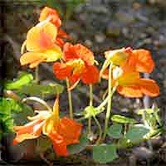
Nasturtiums © Pintail
Originating in Bolivia and Columbia, seeds were brought to Europe from Peru by Spanish conquistadors in the 16th century and hence became considered a symbol of conquest and victory.
Nasturtiums are planted in the spring, once the danger of frost is over. They can be used not only for decoration in the flower garden but also amongst vegetables, as a companion plant for radishes, whilst their pungent smell can be utilised by careful siting, to repel or attract pests.
Use nasturtiums as a natural repellent
Woolly aphis can be repelled from apple trees by planting nasturtiums around the base of the tree, or by spraying affected branches with an infusion made from the whole plant, while a few nasturtiums near tomato plants and broccoli can deter whitefly. On the other hand, blackfly find the smell attractive, so adding a few nasturtiums near broad beans will help to lure them away to the nasturtiums, subsequently nipping off any attacked parts. When frosts appear, the stems can be chopped up and added to the compost heap.
In natural medicine, fresh leaves can be used for combating infections of the urinary tract and the respiratory system.
Using nasturtiums as a natural remedy
Juice from leaves (liquidised and strained) can be of benefit as a remedy for coughs and bronchitis, while liquidising and straining the fresh leaves and stems produces a liquid which will ease skin irritations and painful muscles, and act as an antiseptic for wounds.
Dried seeds can be powdered for use as a mild laxative; or crushed to a pulp, then sandwiched between two layers of muslin or cheesecloth, with a plate above and beneath and placed over a pan of boiling water to produce a hot poultice to bring spots and boils to a head.
The naturally occurring sulphur in the plant can be utilised to make a hair and anti-dandruff lotion. Place one large handful of leaves and a cup of vodka in a wide-necked screwtop jar, cover and keep in a warm place for two weeks, shaking the jar once a day. Then strain it repeatedly until a clear lotion is produced and apply it to the scalp with a cottonwool pad, once or twice a week, ensuring no lotion enters the eyes.
Recipes for nasturtiums
In the kitchen, the flowers will look attractive while adding texture and flavour to food. Those flowers with a long spur at the base, have a drop of sweet nectar giving a sweet/sour flavour. When picking, if you find tiny, black, pollen beetles on the flowers, put the stems in water, cover the whole with a brown paper bag, place, preferably outside, in a dark spot (away from the wind), to allow the beetles to drop off and go elsewhere. Nasturtium petals can be added to omelettes and cream cheese for extra flavour, while petals or the whole flowers can be scattered over lettuce for salads. As an additional salad ingredient, wash some leaves, pile on top of one another, and then roll up, slice into strips and toss in a vinaigrette
Make the vinaigrette from
• 2 tablespoons oil
• 1 dessertspoon vinegar (half the normal quantity due to the strong flavour of the nasturtiums)
• salt and pepper, adding fresh seeds, whole, or crushed with a fork
To pickle the seeds for use as mock capers, pick the seeds on a dry day, wash and then soak them for 12 to 24 hours in a brine of 57g (2oz) salt to 570ml (1 pt) water. Drain and then put them in small jars, filling to 13mm (1/2 inch) of the top. Cover them with cold spiced vinegar in the proportions 570ml (1pt) vinegar, 6 peppercorns, 2 bay leaves and 2 teaspoons salt, or for a more spicy result, replace the bay leaves with a slice of horseradish root, 1 clove and 2 tarragon leaves. Seal the jars and try to keep them for 12 months before using.
For a salt and pepper-free diet, ripe nasturtium seeds can be ground and kept for use in tightly-stoppered bottles. This was done during World War II but for different reasons – pepper was very expensive and sometimes unobtainable. Adding a little salt will improve the flavour.
Among other recipes, the pickled seeds can be added to martinis; relish can be spread on the leaves, then rolled up and loosely tied with a long-stemmed flower – try a relish of cream cheese, chopped walnuts and raisins, or mix tuna, parsley and mayonnaise. Or for a different effect, large flowers can be stuffed with a teaspoon of the cheese or tuna relish.
Add up all these reasons and I think you’ll agree that nasturtiums are certainly well worth growing and utilising.
Sìne Chesterman’s interest in gardening and botany started at an early age with her own patch in her parents’ garden, and learning which plants were natural healers. Brought up with old and tested remedies, and gardening methods, now termed ‘organic’, she still practises natural ways of pest control.
Busy – The In Word

Rush, rush, rush © Pintail
What does it mean, to be busy? We’ve always been busy, children, garden, job, house cleaning, it helps when your partner sorts the bills, the car and all it involves, and anything that we don’t want to get into. And why not? They don’t want to get into nappies, dog poo, washing the laundry, cleaning the windows, cleaning the loo, generally.
So division of chores is good … And getting the kids involved, meaningfully, is good too. So why are we still so busy, even though there is some sharing out? Why do we have less time for being close to people? Because we like being busy. We like achieving things, gettings things done. That’s the easy bit. What is not so easy is getting along with people. They can be awkward, not agree with you, point out uncomfortable facets of your personality, ignore you, forget you, and those who are completely themselves tend to be selfish and go their own way, after all you can be awkward, disagree with them, point out the facets of their character you don’t like.
Another aspect of ‘busy’ is there is more to choose from. There are more people doing those things and you want to be part of that group. Part of the gang. When we were newly married in the 1960‘s it was comforting to be part of our group, everyone was roughly in the same boat, mortgage, demanding job, impending parenthood, trying out recipes, making our own beer – what a competition that was! Competitiveness was everything actually, I remember when the men made scones to prove they were as good as the girls, they weren’t really. I remember too a custard making competition that was fearfully skewed in favour of what we were used to rather than taking on a new texture and real vanilla! However Bird’s Eye did lose a few fans that day.
I can remember races in Austin Sprites and MG Midgets round country lanes, the girls screaming with laughter and the boys putting their foot hard down to get round the bends. The roads were quieter then, the cars were less powerful. We were lucky, nobody got hurt.
We took risks, we didn’t take drugs. We drank, we didn’t carry knives. We were young. We were happy. We were high spirited. We were normal.
Most of us had had a sound education. We had jobs. We could pick and choose jobs too – there were more jobs than people to fill them. Immigrants were encouraged to come to do the work we didn’t want to do. We donated to charities especially those in Africa.

Oxford Street, London © Pintail
So what’s changed? In 2011 we are more. The population has increased. The roads are busier. The popular message until recently was shop ‘til you drop. The throwaway society. We are consumers. We like spending money. We resent it when we have less to spend.

Apple Store Regents' St, a palace of consumerism © Pintail
So how do we differ from the hardcore rioters? I don’t count those silly enough to get caught up in the excitement of damaging property and policemen. I’m talking about those who are disaffected, resentful, envious, without those values we care about, who didn’t get caught.
What percentage of society are they? Very small percentage actually. But they have always been there. It’s just that the number, not the percentge, has escalated with the increase in population. And our attitude has a lot to do with it. Ignoring those who could do with a bit of support. Not encouraging a tolerance of difference, sharing our good fortune – not just money, but experience.
And, we could be less casual and tolerant of our influential leaders who are so lacking in empathy. In the past they have publically displayed all the characteristics of the rioters, yet they were described as high spirited – just as well they had cash to cover their trashing.
Duplicity cannot be tolerated. We must make that clear to our politicians. We need leaders who can be recognised as good examples, no matter what.
Care Home Fees: How to avoid being wrongly charged
 None of us like the thought of our parents becoming frail and needing full-time care. For many families, though, it’s inevitable and it can put immense strain on everyone involved.
When Angela Sherman’s parents both developed Parkinson’s Disease in their early 50s, she could never have foreseen the nightmare journey they were all about to embark on. 20 years later her parents were in full-time nursing care with the added complications of dementia, stroke and cancer.
“My parents had some savings, and so I simply assumed they’d have to pay for their own care. No one told me otherwise. At that point the care fees were about £4,500 per month for both of them, and I knew that I’d have to think about selling the family home to pay for it. It was heartbreaking.”
Because Angela’s parents had savings, few people in any ‘authority’ seemed willing to help her with information or advice, and her parents’ local authority (local council) were keen to close all their files. When this happens it leaves families in a black hole, not knowing what to do or who to talk to – and that can often be the hardest thing.
It was only when Angela saw a TV programme about NHS funding for long-term care that she started researching what funding is actually available.
“Before you go into a care home,” says Angela, “the first thing you’re usually asked is how you’re going to pay for it. Social Services (your local council) will do a means test, and if you have savings or assets over about £23,000 (depending where you live in the UK), you’ll be told you have to pay all the costs of your care.
“This is the wrong way round. If you have significant health needs – and most people in a nursing home have health needs – it’s the NHS that should assess you for fully-funded NHS care, also known as NHS Continuing Healthcare. Social Services should not be making this decision. If you’re in a residential home, you may also require as assessment for NHS funding, depending on your health needs.”
The confusion arises with the difference between ‘social’ care and ‘health’ care. In the UK social care is means-tested, but health care is free at the point of use. Just because you’re elderly doesn’t mean the law has changed. We all pay tax to fund the NHS, and the NHS in return provides us with healthcare – no matter what our age.
“Most people are completely unaware of this,” states Angela, “and the various authorities involved don’t exactly publicise it. The devastating result is that tens of thousands of elderly people every year in the UK lose their homes and everything they’ve worked for, to pay for care they’ve already paid for through taxation.
“Being forced to pay for health care in the UK does not comply with the law. As my parents’ power of attorney, I decided to challenge the NHS on this and I pursued two cases against it – one on behalf of Mum and one on behalf of Dad. My point was that the NHS was illegally stripping my parents of all their assets to pay for care which they had a right to receive as UK taxpayers. It took me three years and a huge amount of time, tears and stamina – but eventually I won both cases.
“By that time my parents had paid out £160,000 on care fees. The NHS was forced to repay over £100,000 and pay all future fees. It can be hard to win a case like this. I am one of very few people to have done it – not just once, but twice – and at the same time. A solicitor friend was a welcome sounding board for me, but essentially I fought the battle myself – and other people can too.
“The whole process left me exhausted, but I feel glad to have had the stamina and drive to do it. Both my parents died at the end of 2009 and, after I’d taken some time to recover, I decided that my experience could help other families. That’s why I set up Care To Be Different.”
Care To Be Different makes available to families all the knowledge and insider insights Angela gained during her dealings with the NHS, and her guidance and advice now helps people step-by-step through the whole process. The website is packed with information and there’s also a range of practical guides people can purchase for a small fee. You can also book a telephone advice appointment with Angela to help you move forward with your own specific situation.
“I’ve ‘been there and done it’, as it were – and now I can save people huge amounts of time and stress and give them a much better chance of securing NHS funding for care fees. I wish I’d had all this information when my own parents first went into care!”
For information and advice about care fees and long-term care visit www.caretobedifferent.co.uk or call Angela Sherman on 01908 582231.
 Care to be Different is led by Angela Sherman and it grew from her experience having two parents in full-time care for several years, learning the ins and outs of the care system and understanding how it really works in practice. She also challenged the NHS to provide free Fully-Funded NHS Care (known as NHS Continuing Healthcare) for both parents – and won.
Watch her TV interview about NHS Continuing Healthcare on our YouTube channel.
Alternatively, read the interview transcript.
We have written a review of a book entitled The Care Homes Guide – South East England which you might find useful.
Val Reynolds Brown, Editor

London Sketchbook a pictorial guide book – Winners
 We had six copies of this beautifully illustrated guide book to London to give away to readers of In Balance Magazine
The winners of the draw are:
G Coleman, Romford S Collinge, Blackpool A Baldan, Southend V Fieth, Welwyn Garden City K Krogulec, Nottingham J O’Neill, Shepperton
Congratulations and good luck in the next Prize Draws.
Val Reynolds Brown, Editor
Open Air Fitness in Welwyn Garden City

Meeting up in Parkway WGC © Pintail
Drivers and passersby could be forgiven for thinking the army has arrived on Saturday mornings on the main boulevard in Welwyn Garden City! Instead an army of fitness enthusiasts meet up for an hour’s highly organised activities.

Enthusiasts © Pintail
Essentially Regiment Fitness run a circuits class based on military fitness drills with energetic warm up activities, scrambling through a camouflage net, dragging tyres, constructing an ‘armoured gun’ from tyres, metal drums and a log and barging through a couple of ‘heavies’ with foam pillars!
Steven Nodwell, a Welwyn Garden City resident who is serving in the British Army, founded the company a year and a half ago.

They are not resting! © Pintail
These photographs were taken at a Welwyn Garden City Saturday class made up of all ages and levels of fitness.
The Welwyn Garden classes have been going for a few months – there are three classes a week: Saturday morning, Tuesday evening and Thursday evening. Around 15-20 join each session.
Exercise sessions are held at seven locations all over Hertfordshire and Bedfordshire. For details go to the Regiment Fitness website or call 01582 658569

Getting ready to scramble under the net © Pintail
Val Reynolds Brown, Editor
Photography © Pintail
Now’s a Good Time to Gather Herbs to Dry

Marigold petals, make a delicious tea
Wandering round the garden today I picked several bunches of herbs to dry for use during the winter months.
I tie the stalks together and place upside down in a paper bag, tieing the top loosely, but with a loop for hanging. They are then hung up on nails in the garage where they will stay for a few weeks until they are quite dry, then crumbled and placed in an air tight jar. We quite like the aroma that comes from the dried stalks and put them on the top of the wood burning stove to lightly scent the room. They can burn so put them on a pyrex dish or similar. Or you could keep them for the next barbecue …
Marjoram can be used for teas as can marigold petals which can relieve stomach aches
There’s nothing nicer than tea made from your own mint. We have a particularly strong one that makes excellent tea. It’s useful too for lamb, as is rosemary.

Rosemary
Sage is a bit strong for tea, but good to help digest fatty meat like pork and goose. Bay leaves are always useful to add to a bouquet garni.

Sage
We grew tarragon this year as an experiment but we haven’t used it at all so it will go into the compost bins later next month.
My all time favourite is verveine, it smells just like sherbert lemons and always makes my mouth water at its memory. A tea made with it is absolutely delicious, needs just a little sweetening, and is an excellent drink before bedtime as it does seem to induce sleep.

Verveine

Fennel
There are still some Nigella seeds to ripen so we picked them all and put them in a carrier bag hung from the garage beams. They will shake out in a week or so. We use them in meat dishes and sometimes in cakes.
Fennel seeds can be used to make tea, although we prefer to eat them when they are plump and green which is about now.
There is still enough time to cut some bunches of lavender to add to our clothes cupboards and we will keep some seeds for flavouring our favourite shortbread. Alys Fowler has a great recipe in her book The Edible Garden. Now there’s a gardener I admire.
Do you dry herbs? Why not let us know and we’ll write about it in the mag.
Charlotte Yardley
Gardening Adviser
Bohn Swimwear – Problem-Solving Swimwear Range For Women

Sarah Bohn
Earlier this year we ran a feature about Sarah Bohn who set up UK Swim Store, an online women’s swimwear shop offering branded swimwear for women of all shapes and sizes. But now Sarah has taken things further to provide women with stylish quality confidence-boosting swimwear, by creating her own cover-up swimwear range! We caught up with her recently to find out more …
So what was the thinking behind the Bohn Swimwear range?
The branded swimwear we stock has been great for so many women. By offering swimwear in larger sizes and with various body shaping/support options, ladies of all shapes and sizes have managed to find swimsuits which enable them to feel happy and confident whilst swimming.
But what about those women wanting more coverage? The standard swimsuit is still far too revealing for a lot of women to feel comfortable – legs, bottom, arms, back etc can all be on show, and for some women that’s a deterrent to their swimming.

Idyllic swimming - Isles of Scilly © Pintail Media
And cover-up swimwear was the answer?
Well, over the years we’ve stocked a few items that offer more coverage – for example, swim jammers – and they’ve always been very popular. I’ve heard from a lot of women who’ve loved the extra coverage. So why not have a range of cover-up swim separates that women can mix and match to get the right level of coverage for their own specific requirements?
What’s in the Bohn Swimwear range?
The current range is made in classic black, and comprises: ankle length swim leggings, three quarter length swim leggings, ladies’ swim jammers, a swim skirt, short sleeve swim top, and long sleeve swim top. Quality and durability are important – I wanted the Bohn range to be able to compete with the Speedo and Maru we stock, so it’s designed in a material that will not degrade in the pool and has a Sun Protection Factor of 50+. The fabric, which is proper swimwear material, also does not absorb masses of water and is quick drying, so you can jump in and out of the pool without taking half the pool with you!
Have you had any feedback from customers?

Varicose veins
Yes, loads! Sales have been great, and there have been lots of emails from women thanking me for giving them back the confidence to swim, which has been so lovely. The market for cover up swimwear is broader than I’d ever imagined. We are selling to Muslim women, women with scarring, women with unsightly veins, women self-conscious of their cellulite, more mature ladies … I’m blown away by some of the feedback we’ve been receiving, it’s beyond anything I’d hoped for.
Here are some testimonials from very happy Bohn Swimwear customers:

Bohn Three Quarters Swim Leggings
I have not been swimming for many years as I am embarrassed by the veins and marks on my legs. I bought a pair of Bohn 3/4 length leggings in April and wear them under my swimming costume. I have now joined a gym and swim regularly – thank you. (Beverley)
I ordered and received a pair of Bohn Swim Leggings. I have had psoriasis quite badly on my legs for the past four years. Before that, I was swimming every week. I am now a mum of five, and had never swum with my kids in a swimming pool. I was using a wet suit for the summer, but the sea is too cold to swim in winter time. BUT NOW … I have been swimming with my children twice this week already. What a difference, I didn’t feel selfconscious at all. A very big thank you for giving me a part of my life back I never though I would. I really can’t thank you enough.(Laraine)
I had an accident recently, and am very selfconscious about showing off my scars in the pool … however, I found your site, put the order in and am over the moon – I can go swimming again.(Catherine)
I purchased the Bohn three quarter length swimming leggings and they have had a huge impact on my life. I love swimming, particularly in the sea, but I used to shy away from it as I didn’t like to wear a regular swimming costume. With the leggings, I am far less self-conscious and have been enjoying frequent swims. They’re comfortable, good quality and actually rather stylish. I’ve been wearing them both over my swimming costume or with just a bikini top and have had many people admire them. I’d highly recommend them, particularly for anyone who’s that bit body conscious like me. (Pam)
I absolutely love the Bohn 3/4 swim leggings. I am quite slim but I have really bad cellulite on my thighs and with these leggings I can now go swimming with my six year old and not worry about my cellulite and I can run on the beach without seeing the tops of my legs. Hurray and thank you. (Lisa)

Bohn long sleeve ladies' top
Being a very cold-blooded person I was absolutely thrilled to be introduced to UK Swim Store’s Bohn long sleeve ladies swim top. I love going to my aqua class but the prospect on a cold and frosty morning was one that I always had to brace myself for! Now I feel warm and comfortable with a close fitting black top that I can wear in or out of the water. (Margaret)
I am very pleased with your Modesty Cover Up Swimwear, as before last year I had never ever been in a pool in my life, and after purchasing one of your tops and leggings, and at fifty years old, I am taking part in Aqua-fit and signed up for some swimming lessons. (Loonat)
Sarah has plans to expand the Bohn Swimwear range over the next twelve months so there will be more pieces to choose from and in more colours. We wish her every success in her mission to transform women’s swimwear.
Val Reynolds, Editor
 In Balance