
Puppy Training Problems Solved 2: Winnie Chews a Shoe …

Winnie
Winnie’s Woes: The diary of a golden retriever learning about life
A Seven Part Series with a bittersweet final episode
What a lovely walk that was, I feel quite worn out. I’ll just flop here on the kitchen floor, it’s so lovely and cool.
I’d better have a drink. Oh great, Claire’s topped it up for me. What is she doing anyway? She’s going into the pantry, perhaps for some doggie treats …
Winnie, shoo.
Oh, I don’t think I’m supposed to go in there. And she doesn’t have any treats either. Although she has left some toys out for me. I’ll have a sleep and then play.
Yaaaawwn. The house in quiet. I wonder where Claire is?
She’s shut me in the kitchen. That means she’s gone out. I think I’ll play with those toys she left out. Oh, hang on. What’s this?
Oh, my, it smells amazing. It’s all chewy and leathery. What are these dangly things for? They chew up really well. And this bit at the bottom has mud and stuff on. It must be a new kind of toy – thank you Claire!
I’ll just chuck it around the kitchen a bit, this is so much fun!
What happens if I growl at it and pretend it’s an animal? Ha! this is brilliant. Grrr, gotcha.
Wo-ow, I-I-f I sh-sh-ake my he-ad li-ke th-thi-is it starts to fall apart … !
I’m taking this to my bed to give it a proper good chew. Now that the stringy bits have come out and the bottom is hanging off I can really get at it properly…
What’s that noise? Is Claire home? Yay! I’ll meet her at the back door and show her what I’ve done with the lovely new toy she gave me – she’ll be so proud of me!
Look Claire – I’ve chewed it all up!
WINNIE!!! Blah blah blah, naughty girl.
Oh no, I’m being told off again … she didn’t want me to eat that toy after all … why did she leave it in the kitchen for me then? And what’s a shoe…?
Claire Price, Winnie’s owner
Breeder’s advice:
The obvious comment is don’t leave anything that you don’t want chewed within reach of a puppy. Slippers, shoes and underwear smell strongly of YOU and will be very enticing to a little one. Be sure to provide toys which can be safely chewed and never chastise the puppy for something he did earlier. He can only associate the present moment, not the past.
Winnie’s Woes Part 7 – Winnie Moves On
Winnie’s Woes Part 6 – Winnie Learns about Children
Winnie’s Woes Part 5 – Winnie’s friend Henry learns not to eat stones
Winnie’s Woes Part 4 – Winnie learns about other dogs
Winnie’s Woes Part 3 – Winnie Eats too much
Winnie’s Woes Part 2 – Winnie eats a shoe
Winnie’s Woes Part 1 – Winnie finds digging is not a popular activity!
 Have you read the bestseller The Puppy that came for Christmas … A true story that has appealed to dog lovers and non-dog owners alike – it is both truly heart warming and heart wrenching.
Recommended Links:
Anythingdogz – an excellent website owned and run by Lisa Evans, an In Balance reader
Helpful Holidays offer holiday cottages in the West Country that welcome dogs. See their Helpful Holidays website.
Interested in Gardening? Like some seeds?

Gazania Tiger Stripes
I attended the annual Thompson & Morgan press event this week when we were shown 33 new flower seeds, 54 new vegetable seed introductions, many new young plants – including a massively flowered dahlia ideal for both borders and patio pots – and fruit plants … 2012 is going to be a great year!
I was impressed by the vegetable planting in containers, it’s amazing what they have grown in pouches – imagine a full grown courgette plant hanging on a wall or a post! Dwarf beans, the list goes on and all so easy to harvest. You can have a kitchen garden on your patio! There were good frame supports for patio containers so you could grow peas, mangetout, beans, whatever … Very exciting.

Growing beans in a pouch!
We were given numerous packets of seeds of the new introductions and as I have many duplicates I am happy to send them to our readers free of charge. Just send a stamped addressed envelope to
In Balance Magazine, 50 Parkway, Welwyn Garden City, Herts AL8 6HH
with either Veg or Flower, or both if you would like either, written on the back and we’ll forward them on a first come first served basis. You’ll have to be quick though!
Here are just some of the new flower and vegetable seeds that caught my eye and I will be trying next year. They will all be available online from September and in the Thompson & Morgan 2012 Autumn catalogue.
Lettuce Lettony – a ball of a lettuce, mildew resistant, sweet tasting
Herb Basil Crimson King, special trial price 99p a packet
Cucumber Crystal Apple – incredible taste, golfball size, absolutely no bitterness
Swiss Chard Fantasy F1 Hybrid – excellent taste, spring and summer harvesting
Tomato Bajaja – this is prolific plant, capable of producing up to 700 fruits! Small juicy red fruit 8-10 grams in weight No sideshoots Broad bean de Monica – looked fab and gives high yield
Courgette Sunstripe F1 Hybrid, eager to try this, has a good pedigree
Dwarf french bean Laguna – a new one to try, we love these beans

Calendula Fruit Twist
Calendula Fruit Twist – a range of citrus colours
Hollyhock Halo Mixed good against a wall
Poppy Pink Fizz – this is so pretty with its frilled petals and seeds are edible
Chrysanthemum Polar Star – strikingly attractive
Californian Poppy Peach Sorbet – gorgeous

Phlox Moody Blues
Phlox Moody Blues – this will be a good filler for the borders
Some of the plants available include two really stunning verbascums, blue lagoon and Clementine – a gold blossom, they will look fabulous together. Do explore the plants T&M offer, there will be some real stunners for next year.
And the fruit … We were knocked out by the apricot and patio trees, and dare I say a new strawberry – Sweetheart. I tasted the fruit – excellent … Will have to have some of those. And the raspberry Valentina – unusual apricot pink coloured – heavy cropper, upright canes, virtually spinefree, again must have some!
If you are keen on gardening and want some inspiration do try to get to the Open Days this weekend – open 10 to 4pm both Saturday and Sunday – I’m certain you will not be disappointed.
Val Reynolds Brown Editor
www.ourfrontgarden.com is the website we write about the ongoing renovation and care of a front garden in a garden city
Lost in the Forest of my Garden

Bronze fennel, mallow, lavender
Every winter I study gardening books and magazines, determined that the coming summer will be different from previous ones. The area which I like to think of as my herb garden will be recognisable as such, and the remainder of the garden will be in cunningly designed drifts of planting, colours and shapes artfully selected so as to complement each other. While still maintaining the unstructured look that I prefer, I’ll ensure that each plant knows its place and stays there, leaving me room to get between them for essential weeding and maintenance. This year, I’ll be in charge.

Fennel, eryngium and verbascum
And every year the same thing happens all over again. In March, desperate for spring to begin, I stand outside staring at the ground, brown, bare and depressing – even worse than usual this time due to the extreme cold of last winter. I remind myself that nature will perform its usual tricks and perennials will appear as if by magic out of nowhere, while other plants will suddenly double in volume. But even so, there needs to be some selective new planting to fill these huge gaps. So, very disciplined, I plant just a few small plants and sigh when I see how large the gaps around them are still. In April, seeing that not much appears to have grown, I conclude that my memory has played me false, and desperately move clumps of the tougher perennials from elsewhere to hide the gaps.
But then when I pay my usual early morning trip to inspect the garden, I see that at last things are happening; plants which I’d thought had died off during the winter are putting out new growth. Amazingly, a couple of things which had “died” two years ago have been reincarnated with amazing vigour, and I spot several plants which have just arrived, apparently overnight and by their own volition; I certainly didn’t plant them as I haven’t a clue what they are! And a few days later there are more, and then even more.

Rosemary, lavatera, verbascum, hard geranium
And now in July you could almost get lost in my tiny garden. Self-seeded bamboos, golden angelica, bronze fennel and mauve verbena bonariensis have taken over and form a thicket standing six feet high. Marjoram and mint have grown into bushes, joining large clumps of prickly eryngium to form an almost impenetrable barrier, behind which lavender, rosemary and pink lavatera romp away. A solitary runner bean plant is growing into the overhanging ceanothus, raising the prospect of the sight of bean pods suspended among blue flowers. On a sunny day, bees are everywhere; at night it feels and smells like being in a wood.
Tidy it most certainly is not, in fact you could describe it with justification as messy. A friend kindly pronounced it “very lively”, and it’s undeniably full of life but who’s in charge this year? Not me, that’s for sure … maybe next year …
Janet Harmer Contributing author
www.ourfrontgarden.com is the website we write about the ongoing renovation and care of a front garden in a garden city
Keeping Wasps under Control in Your Garden

Common wasp on allium flower
It’s the season of picnics, eating outside, with jam sandwiches, lollies, ice cream … and wasps!
Now we like wasps, they do an excellent job of hunting out grubs on our garden plants, especially the cabbages. However they are a real menace by the end of July onwards. As the supply of grubs dries up when they metamorphose the wasps are suddenly are more interested in sweet things. They also forage for pollen and nectar and specially like the onion flowers.
We solved the problem with a Waspinator in our garden a couple of years ago and thought it might be useful to give the details again this summer.
It all started with the Victorians who thought of hanging up a dark grey bag that wasps see as a wasp nest and they keep away – they know they will be attacked by the occupants.

Waspinator handing from pergola beam
Instead of making our own bag, we bought a Waspinator and it is now very seldom we have a wasp in the vicinity of our patio table – we hang the Waspinator in the pergola beams over the table. The manufacturer claims the Waspinator clears an area of around 6 metre radius.
When the plums and greengages are coming up for picking we hang the Waspinator nearby which seems to keep the wasps away and there is less chance of our grasping an unseen wasp on a plum, which we have done and don’t want to repeat the experience. The nearest we can come to describing the sensation is like that of having a red hot needle stuck into you. Not at all nice and worrying if you have an allergic reaction.

Honey bee on allium flower
We take the Waspinator with us when we go on picnics, holiday, anywhere we eat or drink outside. We filled it with bubble wrap to keep its shape – we could have used a balloon! Easy to put up, easy to take down and store ready for next year.
The Waspinator is available from Amazon
… And here’s a link to the Waspinator website that gives real insights into the nature and habits of wasps, very informative.
Val Reynolds Brown, Editor
www.ourfrontgarden.com is the website we write about the ongoing renovation and care of a front garden in a garden city
The Puppy that came for Christmas …
 This true story will appeal to all dog lovers, and others, as it is truly heart warming and heart wrenching.
Megan Rix and her husband decided to take on a puppy for six months to train for people with disabilities. What Megan didn’t realise was just how deeply they would fall in love with the sweet natured puppy and how much of a wrench it was to give it back six months later. They then took on another puppy, Freddy, and fell in love again and were broken hearted when he too was moved on for further training.
Then, one Christmas, little Traffy came along …
This is a book we couldn’t put down and are sure it will be a bestseller in no time.
Published by Michael Joseph/Penguin, paperback £6.99, available from Amazon
You may be interested in our new seven part series about training Winnie by her owner Claire.
New Survey throws up Fascinating Insights into Family Life
Do these findings line up with your family experience?

What does the body language tell you?
Three quarters of all important family decisions are now made by women, a study found:
- Women decide what a couple eats
- Where they live
- When they have children
- Where they go on holiday
- How to spend their money
By contrast men are only involved in decisions about what car a couple buys.
Women are also responsible for 85 per cent of day to day family decisions from
- what they do with their spare time
- what they eat for dinner
- what time they go to bed
- and even how high they have the heating

Brussel flowers from Marks and Spencer, surprisingly tasty
The research on behalf of Ginsters, which has just launched a series of new TV adverts entitled ‘We need to talk … about Ginsters’, consulted 3,000 couples anonymously about their relationships and who took the most responsibility for family decision making.

An Italian chocolate mousse
Larry File, a spokesperson at Ginsters said: “It seems men are no longer the domineering head of the family and they know it. We were surprised by how honest and open men were about their lack of say in their day to day lives. But most men didn’t seem to mind having to ask permission before doing things.” Nearly two thirds said that they rely on their partner to decide what and when they eat and nearly half admitted they asked permission before eating certain foods.
Men took no responsibility at all for how healthy they were, leaving their diet and choice of food up to their partner. More than half of men even consulted their partner before having a drink, with three quarters asking her before eating unhealthy food. Sixty per cent of men admit that their partner has complete control over when and how frequently they have sex.

Celebrating the Dutch Queen's Day in Trafalgar Square
Women take the responsibility for running the house and ensuring that chores and work gets done and also take primary responsibility for making decisions about the children. They are most likely to choose the names of children as well as what clothes they wear and where they go to school.
Larry said: “Men reported to trust their partner’s advice above all others. So it makes sense that they would want to consult with them before taking a decision. The idea of a man heading up the house is a thing of the past with most couples agreeing that the woman is now the key decision maker. Women are now more likely to be consulted before their partner makes any important decision and likely to get their way.”
The survey also revealed that women used a range of tricks to persuade their partner to take their advice and get their own way. Women were most likely to try and use their sexuality by flirting and wearing skimpy clothing whereas men tried to butter their partner up with treats like food or chocolate. Most men admitted that they had less success at getting their own way with their partner.
Does this line up with your experience? Want to comment?
Val Reynolds Brown, Editor
Forced Rhubarb – First fruit of the year
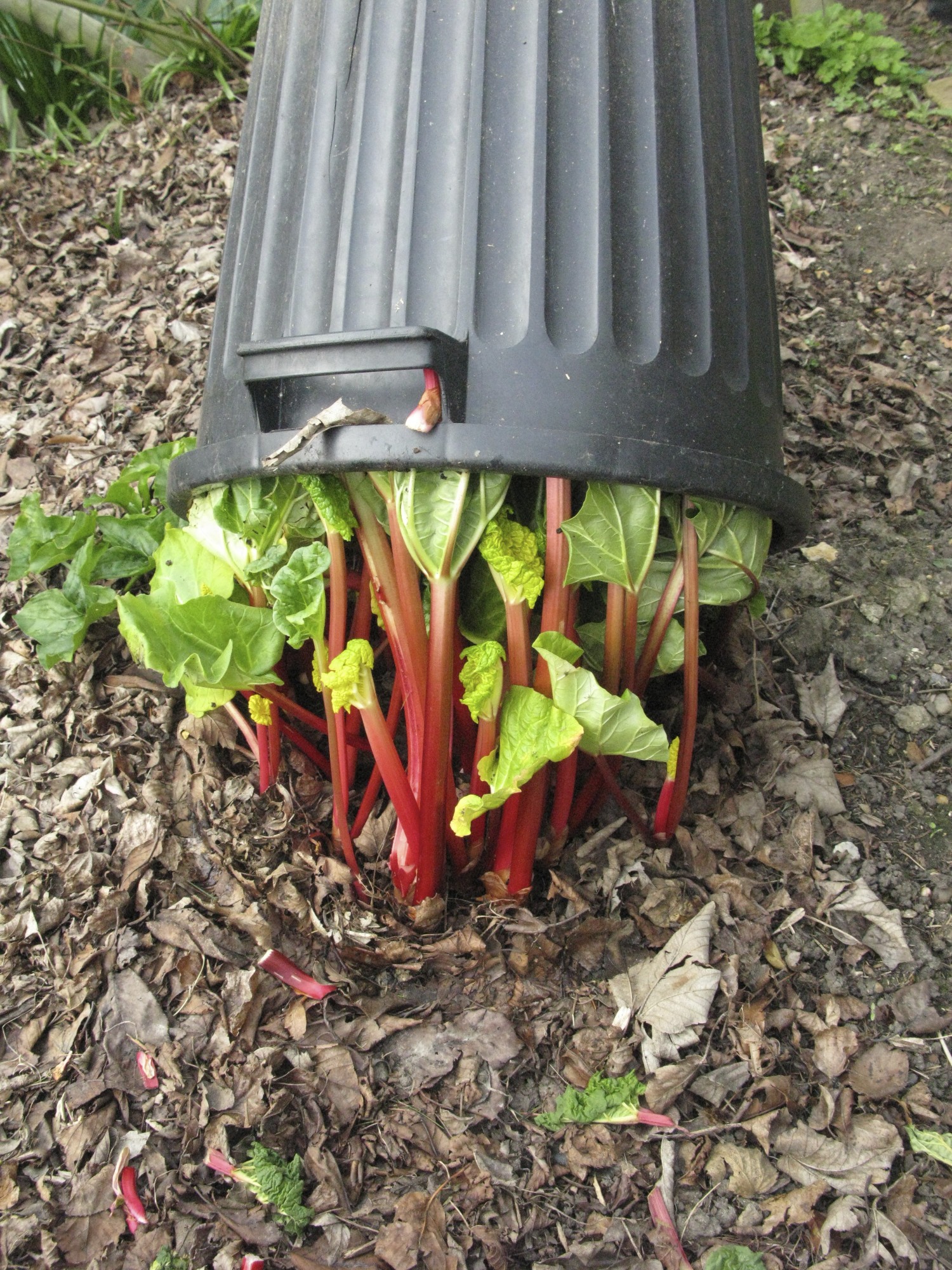
Forced rhubarb ready to cut
It’s so unbelievably easy to get juicy, sweet rhubarb so early in the year. And yet we do it, every year. We just place an old plastic dustbin over the new shoots when they appear in early spring and a few weeks later hey presto there’s rhubarb to pick.
We generally get too much at a time so it is cooked with a little sugar and stored in the freezer ready for later use. Great with yogurt, on cereal, with ice cream. We made some delicious wine one year, it was a beautiful pink colour. We do bottle some, best for us in the smaller jars, a whole kilo jar tends to languish in the fridge for far too long. Anyway as it has a high oxalic acid content it’s best not to eat rhubarb for extended periods. Once a week is probably wiser. We generally go for crumble or pies, with a generous amount of ground ginger to give it that little extra zing.
We have no idea which variety of rhubarb we have, we think it’s been in this garden since the 1930s. But good plants can be purchased from Thompson & Morgan, here is a link to their comprehensive rhubarb catalogue page.
Val Reynolds Brown, Editor
The Sun is Shining in the Sky …
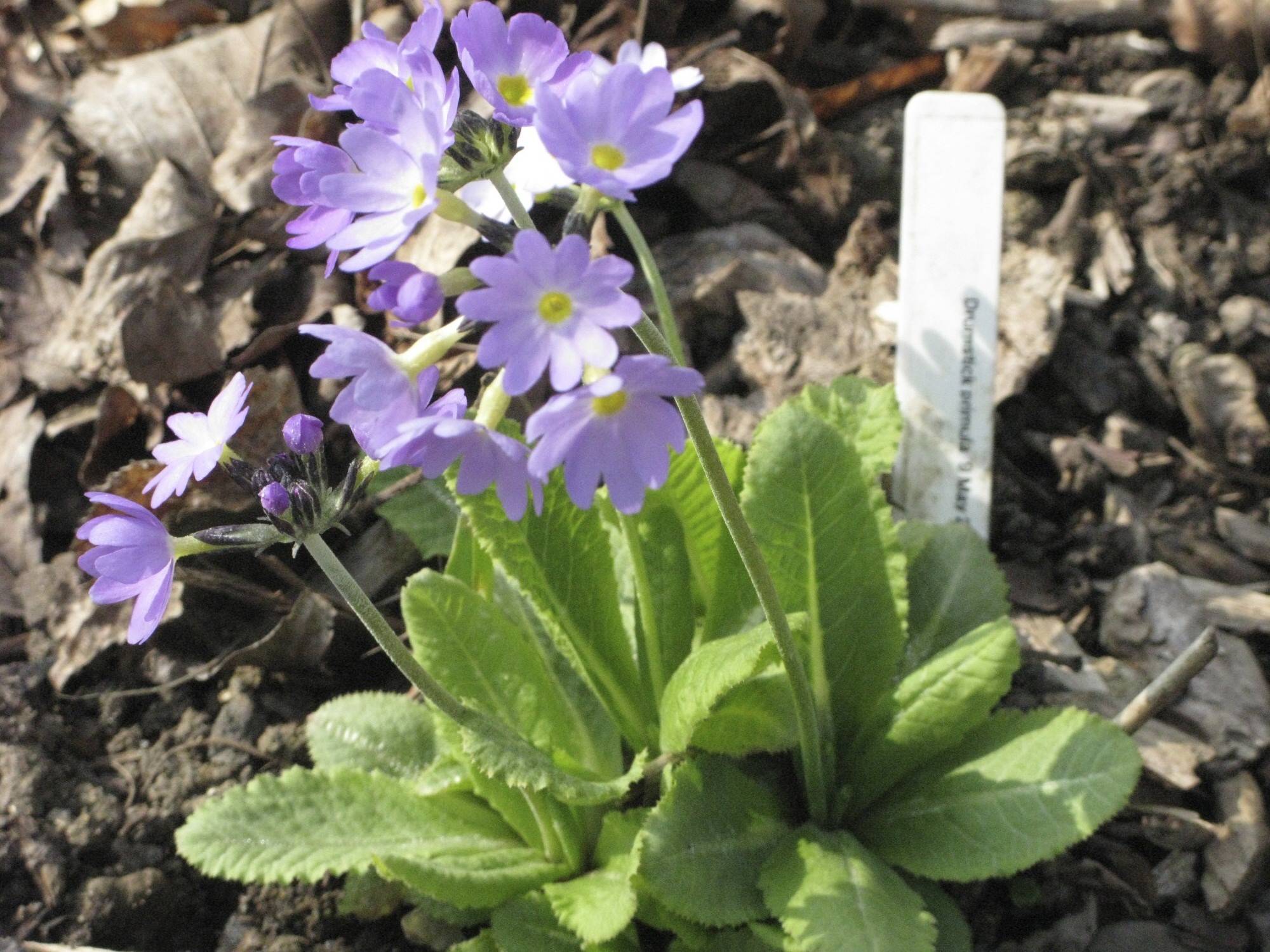
Drumstick primula, sown May 2010
The sun is shining in the sky and it’s seed time! The most exciting time in my gardening year. The anticipation, the joy, the expectation. But then there is the labelling … I have so often sown the seed and not bothered to write a label thinking I won’t forget that particular tray.
Wrong! I have often forgotten and some seeds haven’t received the attention they need, especially those that take more than a month to germinate.
That’s all in the past. This year I have a labelling machine. A Brother P-touch GL200 and a wondrous machine it is too!
A dream machine it is a computerised, battery run labeller. Lightweight and so portable I can do the labelling in the garden if I want. In fact though, I generally print out the labels before I go into the garden, much easier to prepare the labels before I get my fingers muddy.
I can’t say enough good things about it, and so far, touch wood, I can’t think of anything negative. The labels are rainproof, humidity proof, fade proof, heat and frost resistant, can be on coloured tape. I can choose the typeface which can be small, medium or large, on a long or short strip. It has a built in date and time clock. You get to see the text before you print on a small screen, and it can be neatly cut. All I do is make sure I have enough plant sticks to add the label to! Easy. If you’re interested in the specification go to www.brother.co.uk/gl200
Actually I can think of a negative, the price of the replacement tape is a bit steep. But honestly the machine is so useful I can tolerate that, just.
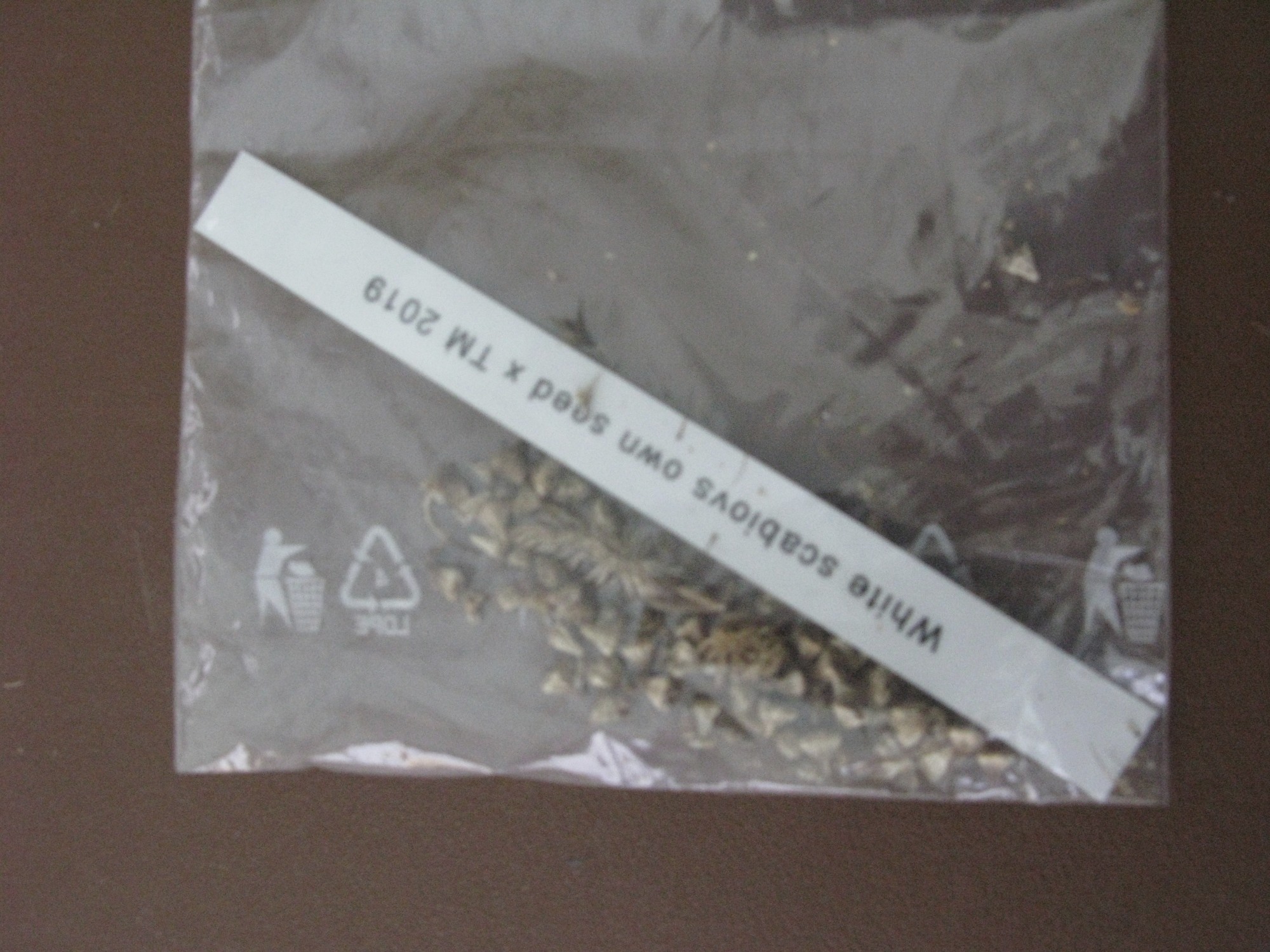
Seed collected 2011
One of the uses I have put it to is to add an appropriate label inside the numerous plastic bags of seed I have collected last year. That way I know what those funny looking seeds really are this year and the label is ready to go. What joy!
My husband uses it for labelling his filing folders and I have used it for all kinds of jobs around the house and elsewhere – even the little plaque on a fence post giving the website address for our front garden!

Label weathering well
It is one of those gadgets I really wouldn’t be without.
RRP £27.55, available on Amazon Brother P-Touch Label Printer

Kate Campbell, Gardening editor
We have a Brother P-touch GL200 to GIVEAWAY to an In Balance reader. To enter the draw send an email to editorinbalance@me.com with Brother P-touch GL200 in the subject box and your full contact details in the text box. Entries to reach by latest 25 April 2011. One entry per household.
How to Grow Gladiolus Callianthus or Acidanthera – Beautiful Scent Beautiful Flowers
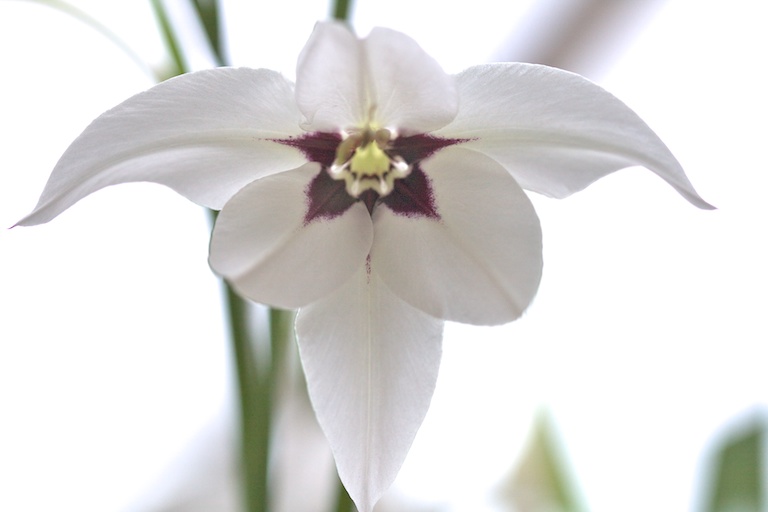
Last summer we were delighted and surprised with the beautiful scent and beautiful flowers of the gladiolus callianthus, now more usually referred to as acidanthera. Also known as Abyssinian gladiola and sword lily, acidanthera, pronounced ass-ih-dan-ther-ah, plants are tender and grown from corms.
We planted ours in April in a pot. If you want to plant Acidanthera in the ground choose a site that gets the afternoon sun and near a path, that way you will notice the scent as you pass.

Hoverfly drinking Gladiolus Callianthus nectar
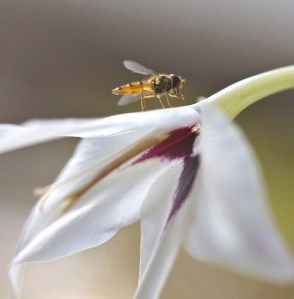
Hoverfly resting on Gladiolus Callianthus
When ours flowered in mid July we brought the pot into the conservatory out of the wind and strong rain. Each long leafed plant produced about ten white flowers, each with a beautiful scent that filled the room. They attracted innumerable hoverflies who fought for a place on the long perfumed stamens. Once there they were very reluctant to move and other hoverflies darted and hovered waiting for their turn, or not, when there was an amusing dogfight to watch.
The swordlike leaves are about 24 inches tall with blossoms that filled the conservatory with a beautiful scent.
Growing these bulbs really didn’t take much effort, we put 6 corms to a depth of about 5 inches in a clay pot in a soilless compost for the conservatory. The plants are low maintenance, to produce the most flowers the plants do appreciate a regular feed.
Next year we’ll put some in pots for the conservatory and others in the front garden in pots but plunged in the soil. They will need support of some kind, we’ll probably use some unobtrusive metal rings you can buy from any garden centre or even B&Q. The pots will be easy to remove once the flowers have gone over and later when the leaves have died away the bulbs can be dried and stored in a paper bag in a cool but not frosty place during the winter with a note in the diary to get them out and planted by latest mid April*. I have read some gardeners successfully leave the bulbs in the pot kept in a frost free greenhouse, bringing the pot out once the danger of frost has passed.
These plants originate from East African mountains, between 4,000-8,000 ft, mainly found in grassy areas and amongst rocks, which perhaps give them the protection from frost they need.
The gladiolus callianthus bulbs, generally available in the spring, were supplied by Avon Bulbs, Avon Bulbs Ltd, Burnt House Farm, Mid Lambrook, South Petherton, Somerset, TA13 5HE, Tel: (01460) 242177
*By the way, we completely forgot to lift and store them last autumn … luckily Avon Bulbs still have some of sale so we’ll plant some more in April.
March 2015 Just been to Aldi where they are selling packets of 30 bulbs for 99p – what a bargain! Was so excited I bought 3 packs … can’t wait for the summer and their heavenly scent. I have to say everything I have bought in the plant and seed sections has always gone well for me, from olive trees to lavender bushes, from wild flower mixtures to bonsai plants. Would love to hear if that has been your experience.
Val Reynolds Brown, Editor
Plants Galore!

Lemon Basil
Some years ago I came across a packet of Lemon Basil seeds from Thompson and Morgan – my favourite seed supplier since 1970! – that I have to confess had been ‘loitering’ in my seed box for some time, four years in fact! As I had a bit of space in my tiny greenhouse, I thought I would see if they germinated, expecting a few to come up which would be very useful for salads. To my great surprise the whole seed tray bounced into life and I had so much basil I had to give much of it away! Recipes and more information is here.
With that experience in mind I decided to go through the T&M catalogue looking for herbs that I could grow to add to salads, even if they didn’t grow to full size they would add a variety of flavours. Most herbs are available at very reasonable prices and with germination rates generally pretty high it’s a win win situation!
Most recently I have successfuly sown

Basil
Outdoor Basil This gave an excellent germination and again found I had so much I had to give many plants away. I kept some indoors and others in the kitchen garden. I love picking a leaf or two and eating it when I’m wandering around looking for weeds to pull up.
Borage, the young leaves have a cucumber taste and widely used in salads and the bright blue flowers look wonderful in drinks, or salads. At the end of the season the plant can be added to your compost. It does get a bit untidy but I can forgive that characteristic as it attracts so many bees and other insects, it is a joy to see it thriving.
Coriander This can be sown direct in the ground. However it is useful to sow some in pots to keep indoors for year round fresh leaves to add to salads, salsas and Asian cuisine. Another flavour indispensable TO the adventurous cook.

Chervil
Chervil Used in French cooking to flavour fish dishes, sauces and soups, is a familiar taste of France. Can be grown in pot on the windowsill for all year fresh leaves.
Summer Savory this comes highly recommended from Bob Flowerdew who waxes lyrical about its effect on broad beans! Try it chopped and mixed with melted butter. Thompson & Morgan suggest adding it to breadcrumbs to coat fish, added to soups and stew – said to be magnificent!
Endive not often found on sale here in the UK, is easy to grow from seed. Easy too to grow it as salad leaves.
Other seeds I have successfully grown for the kitchen garden this year are globe artichokes, beetroot, parsnips, carrots, lettuce, sugar snaps, french beans, courgettes, leeks, pumpkin, outdoor melons – the jury is out on these they are not growing very quickly and I wonder whether they will flower and produce mature fruit, they are protected by a cloche to keep the heat in and the wind out.
I have grown many plants to attract insects. French marigolds, calendula, I have allowed the parsley to go to seed for insects to feed on, poached egg plant, nigella, and alfalfa to dig in as a green manure. Red clover has been sown for the same reason.
I have also used odd spaces to grow flowering plants for the main garden, for instance escholtzia, chrysanthemum daisies, scabious, sweet peas and I have experimented with unusual plants, for instance cucumelon.
It will be some weeks before I know which plants are worth keeping and which seeds are worth sowing next year. As always the gardener in me is constantly adding, subtracting and repeating plants, always aiming at perfection. Ever hopeful!
Val Reynolds, Editor In Balance Magazine
 In Balance