
WHY PEOPLE MISS FLIGHTS

Watching the flight information board
The most common reasons and some practical advice to help ensure you catch your flight
Travel website missedaflight.com has carried out research to find out the most common reasons why travellers miss their flights and provide some helpful hints and tips on how to avoid the most common reasons for missing a flight:
Problem: Mis-read and mis-spelt documents
SOLUTION: On receipt of your documents check the name, spelling and flight details are correct.
Problem: Flight schedule changes
SOLUTION: Check your latest paperwork for any changes. Remember the times on the ticket will be written using the 24 hr clock.
Problem: Traffic delays caused by road accidents and road works or engineering works on railways
SOLUTION: Check with the RAC and AA for any delays, accidents or engineering works that may affect your route and if need be find an alternative route.
Problem:
Denied permission to travel due to incorrect passport or expired passports.
SOLUTION: Review your passport in advance to ensure it still has six months to run after your return to the UK. Also remember to pack your passport in your hand luggage.
Problem Essential medication needed urgently but packed in the hold luggage which has been checked–in
SOLUTION: If your bags do not join you on the aircraft you run the risk of missing your flight. Make sure any prescribed medication is packed in your hand luggage just in case you need it before the flight departs. Most airports have a chemist but they may not stock your particular prescription.
Problem Too late to check-in
SOLUTION: Add more time – Airports are big and somewhere you might not be familiar with. Never under estimate your timings, make sure you have left plenty of time to get from the airport car park, (which may require a transfer service) to the terminal, and into the correct check-in zone. Remember there may be a queue at check-in. Make sure you know which terminal as some airport have more than one and airlines can also fly out of more than one terminal.
Problem Not allowing enough time to get to the departure gate once checked-in
SOLUTION: Airlines are requiring their passengers to arrive at the gate for their flights earlier than in the past. Plan on getting to the gate at least 30 minutes before your flight departs and remember some gates can be as much as 25 minutes away from the main retail area. If you’re late they won’t wait.
Problem Flights not connecting
SOLUTION: Connecting flights are the most difficult to negotiate. If there is no nonstop flight, then build extra time into your itinerary for the connection. Don’t take the connecting flight that gives you just 45 minutes to change planes at a busy airport; instead, ask for a 2 to 4 hour layover to make the connection. You may not be able to do this online, instead call your travel agent or the airline directly. Please remember if you have bought two separate flights your connection is never guaranteed.
Having missed your flight first speak to the airline to find out what you need to do. If they can get you on a later flight get in touch with your hotel to make sure they don’t give away your room.
Next contact your travel insurer to let them know the situation and find out if you are covered for any additional costs you may incur as a result of missing your flight.
Airline companies vary in the way they will treat your booking if you miss your flight. A good idea is to visit the forums on the internet.
Our experience has been to always have decent insurance cover. Finding that insurance will take time and effort. In the long run it is not expensive and could save you a deal of trouble and extra expense. Reputable insurance companies will give you an emergency phone number to call – just remember to take it with you!
Have you had a bad experience? Want to tell us about it? Or, have you had a good experience? Tell us about that too!
Val Reynolds Brown, Editor
Perfect Travel Guides when Visiting Sweden
 The DK Eyewitness Travel Guides never seem to let you down. These glossy, full colour books are a must for travellers who focus on the culture of cities as they are easy to navigate and packed with information. Indeed, so much is there that you will probably notice things you’ve missed on the flight home!
  Step up the Rough Guide series, less a factual list of objects in museums and hotels and restaurants listed in order of price; more a traveller’s musings to be shared with future travellers. The Rough Guide to Sweden has, by nature of its content, only a section on Stockholm, but it complemented my other guide book well. And it had far lengthier exposes on other elements of Swedish life and culture which made for great reading and gave a far greater insight on the Swedish way of life.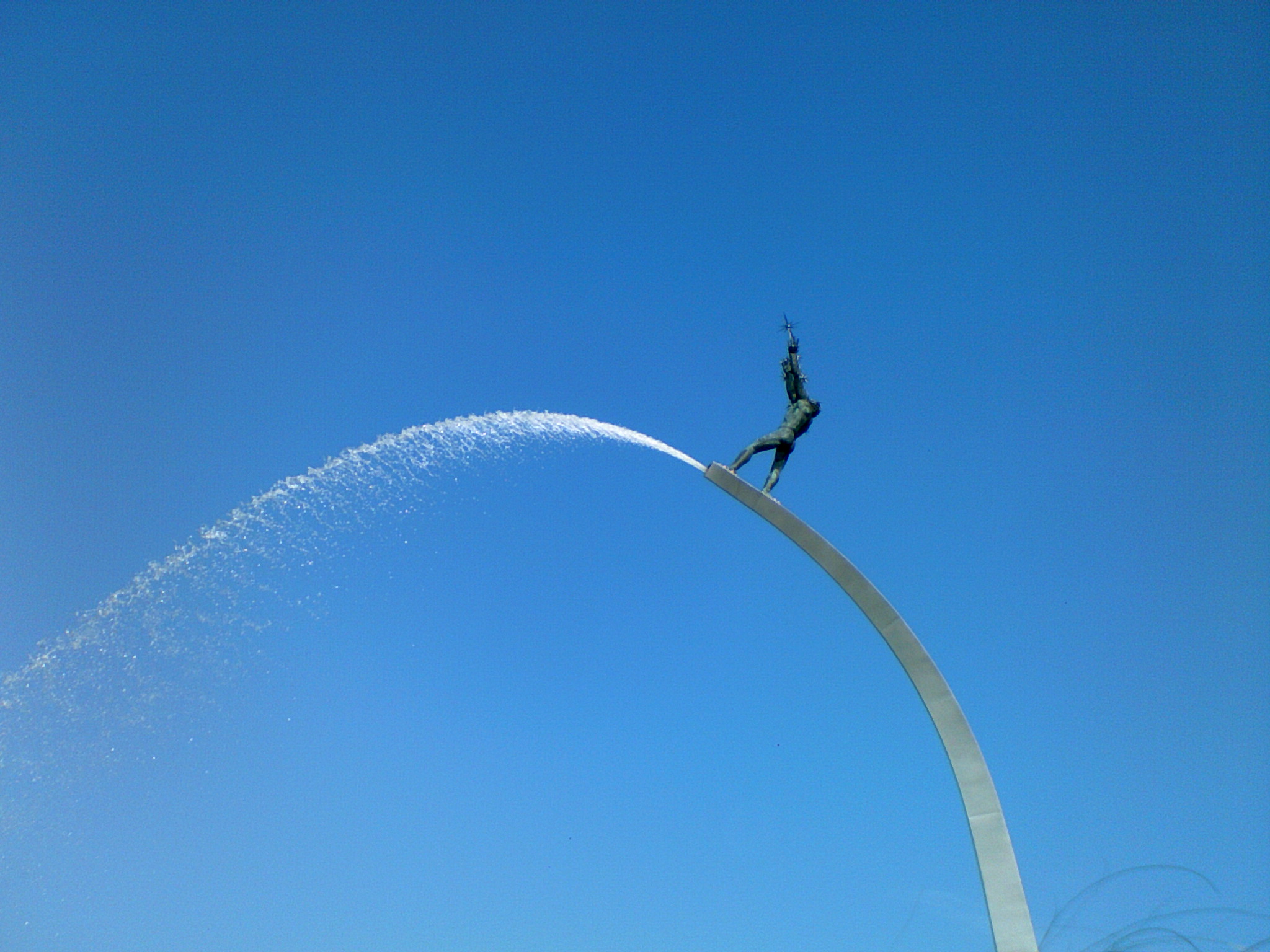
Arc Fountain by Carl Milles, Stockholm Estuary © Jeannette Nelson
 Arts Critic A bit of a culture vulture, Jeannette enjoys art exhibitions, cinema and classical music, but her main interest is the theatre. For several years she ran theatre discussion groups for which her MA in Modern Drama together with teaching skills stood her in good stead. She prefers to concentrate on the many off West End and fringe productions as well as that real treasure of the London theatre scene, the National.
Art in Clay Outdoor Exhibition – Hatfield House, Hertfordshire
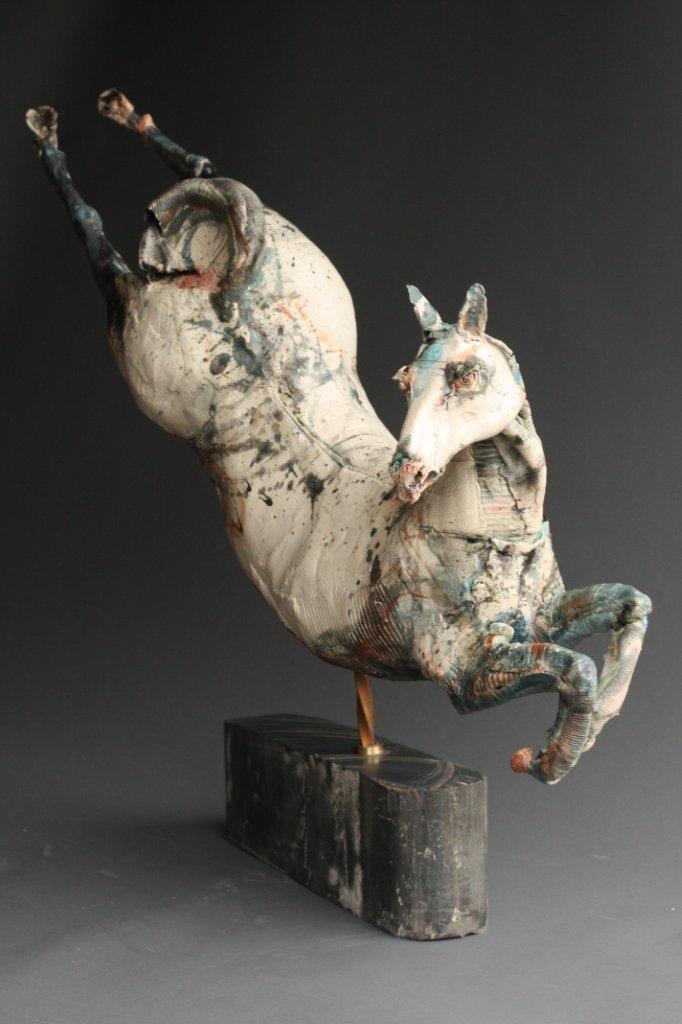
Ostinelli & Priest
This has to be one of the most interesting and fun outdoor art exhibitions we have visited. There is always a really friendly atmosphere – all the potters and ceramicists are very approachable and interested to talk to visitors.
Details for the 2013 show are on http://www.artinclay.co.uk/
The range and diversity of the work of British potters is well known and this show always has lots to admire and be attracted to. Some work is just so out of the box it’s a joy to behold!
Children are of course very welcome, there is plenty of space for them to run around and enjoy themselves and the opportunity to make clay pots.

- A young boy tries his hand at making a pot on the wheel
We put together a slideshow of the 2008 show – if you would like to have a look click here.
The 2011 exhibition underlined The Japanese Earthquake which had a disastrous effect on the world famous pottery town in Japan called Mashiko. The town had over 400 pottery workshops many of which have collapsed together with kilns, houses and the town’s museums. Bernard Leach met Shoji Hamada when he was studying pottery in Japan and became lifelong friends. They helped each other with the development of their potteries.
Catherine Thom, daughter of a Northern Ireland potter whose work was strongly influenced by Bernard Leach and Japanese pottery, is an international classical guitarist, and recorded a cd to raise funds for the Japanese Disaster Fund. Catherine gave three concerts on each of the three days of the Art in Clay exhibition – all non-ticket donation events.
Art in Clay is a great event for pottery lovers and the organisers are offering Two for the Price of One entry fee on all three days of the show.
For even more information and regular up-dates see the News page.
Val Reynolds, Editor
…………………………………………………………………………………………………………………..
Authorised by Andy McInnes, Exhibition Organiser
Henry Moore Exhibition 2011

Moore's signature on sculpture plinth
Henry Moore at Hatfield and at Home
Could Moore be compared to Marmite? His work is so huge, so enigmatic, so smooth, so in your face, that many find it too much. Others love just those features. It seems you either love it or hate it. That was the concensus when I did a quick verbal survey before a visit to the Moore at Hatfield open air exhibition that has attracted thousands of visitors this summer.
Some of the questions I asked:
Are you familiar with Moore’s work – About 70% had seen at least one sculpture, many abroad
How would you describe his work – Chunky, smooth, fun, weird, creepy, ugly
Do you know how he made some of the work – Most didn’t but were interested to hear about Perry Green where you can join in free workshops for children, young people, adults and families.

Hill Arches, 1973 Bronze Length 550 cm
When I visited the exhibition I asked several visitors Is there any one piece you like best of all? My favourite answer was the child who said she loved Hill Arches because it was smooth and she liked lying on it, not something encouraged by the exhibition organisers, but inevitable I guess!
A reclining Toltec–Maya figure was the original influence on Moore’s sculpture – Chac Mool stone statue at Chichen Itza site, Yucatan Peninsula, Mexico which you can see in his very early work.
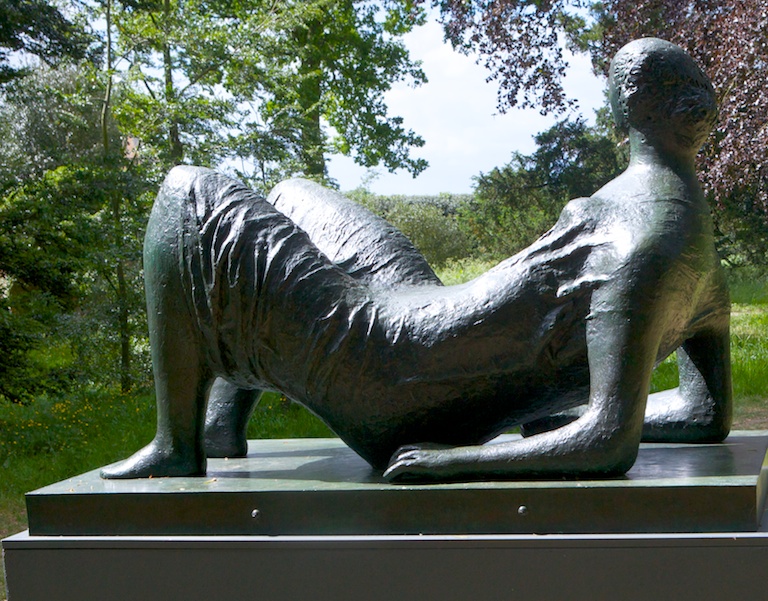
Draped Reclining Figure 1952-3 Bronze Height 157.5 cm
The Hatfield setting is big enough to take fifteen massive pieces. Every piece has at least one seat to sit and contemplate the work, just as Moore always wanted.
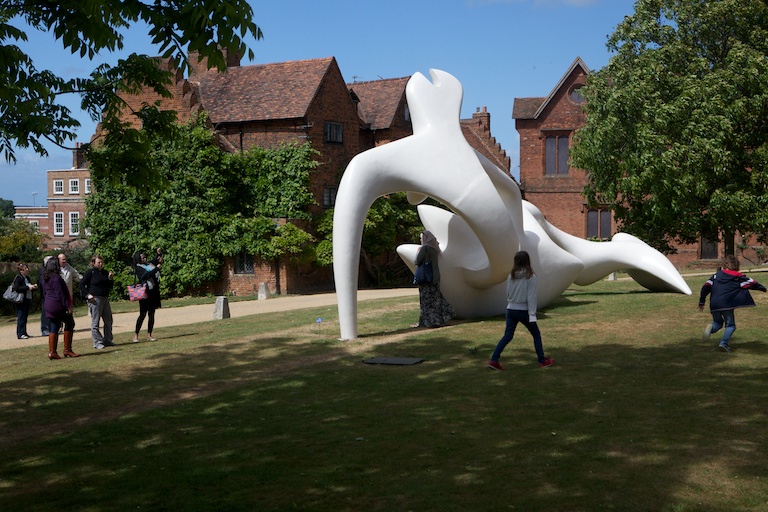
Large Reclining Figure, 1984 Fibreglass Length 900 cm
The huge historic buildings at Hatfield are certainly big enough to contain the work rather than be overwhelmed.
He was especially pleased with the siting of the Two-Piece Knife Edge next to the House of Lords, placed right next to a path and seats.
He was once asked by his niece why his works had such simple titles and he replied: All art should have a certain mystery and should make demands on the spectator. Giving a sculpture or a drawing too explicit a title takes away part of that mystery so that the spectator moves on to the next object, making no effort to ponder the meaning of what he has just seen. Everyone thinks that he or she looks but they don’t really, you know.
There is an excellent Wiki page about Moore that includes many well known pieces. One photograph shows the panorama created in the Ontario Museum.

Locking Piece, 1963-4 Bronze Height 290 cm
A visiting teacher from Vancouver said it was not possible to take photographs or touch the exhibits in Ontario and was delighted to be able to have the opportunity to get a real feel for Moore’s work at Hatfield and excited about visiting the Perry Green permanent exhibition.
Although interest in Moore has diminished since his death, Perry Green, his home in Hertfordshire, has a popular outdoor exhibition with 25 outdoor works on display. When I visited everyone seemed to be loving the whole experience, I certainly smiled at some of the pieces. The children especially liked some hollow copper pieces that made satisfying noises and big enough to play hide and seek in.
This hugely successful sculptor – he was paying million in tax in 1970s – left a legacy that continues to delight and intrigue.
One suggestion I have is to make available for sale small reproductions – to scale – I would love a collection of miniatures to handle, admire and contemplate.
Moore at Hatfield is open until 30 September – ideal for picnics and lots of room for children to run and play in!
Hatfield House is just 20 miles from central London and only 16 miles from Moore’s former home at Perry Green, Herts – The Henry Moore Foundation.
Moore at Perry Green visitor season runs from 1 April 2011 – 30 October 2011. It has a newly-refurbished pub dining room, The Hoops Inn, and a new exhibition in its gallery, Henry Moore Plasters. There are 70 acres of outdoor sculpture as well as the artist’s house and studios, carefully restored.
Val Reynolds Brown, Editor
Good Health – The Influence of Sitcoms & Drama Series
Good health and its maintenance concerns most of us, although it seems women take the greatest interest. This was graphically highlighted in a recent survey of couples that found men took little or no responsibility at all for how healthy they were, leaving their diet and choice of food up to their partner. Amazingly more than half the men consulted their partner before having a drink and three quarters asked her before eating unhealthy food which would seem to indicate some awareness of the importance of good health but a preference for relying on their partner’s advice.
So where do women go to build up that bank of knowledge they need to keep their family healthy. Well, family, magazines, friends, the web, but it seems the most influential are tv sitcoms and drama series where scriptwriters take on topical health issues, based on contemporary medical research and findings. And it would seem we take them seriously, rather than regarding them as fiction, thereby getting positive health messages across effectively.
With the most popular TV drama series with powerful plotlines in the US off air during the summer EverydayHealth, one of the most comprehensive and accessible health websites we have found, looks at next season’s content and questions the general view of the unhealthiness of mindless tv soap addiction.
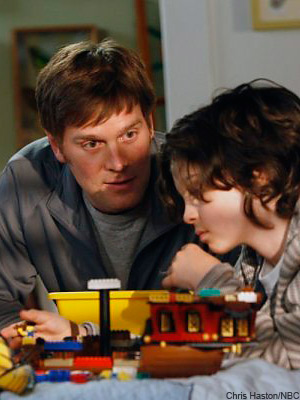
Parenthood
PARENTHOOD is an NBC drama with humour grounded by the difficulties of parenthood and the next series includes a father confronting his son’s emotional issues the son having been diagnosed with Asperger’s syndrome, a mild form of autism. By the way if you are interested in one of the most inspiring accounts we have read do have a look at Look Me in the Eye written by John Elder Robison. A compulsive read.

Army Wives
ARMY WIVES on ET on Lifetime, focusses on a very fit and seemingly healthy wife who receives a diagnosis of diabetes. This is particularly topical in the light of the huge increase of diabetes in the Western world.

The Big C - Showtime
THE BIG C Showtime puts a young woman in the limelight, chronicling her way of dealing with a diagnosis of melanoma with just a year to live. Who hasn’t been touched by someone with cancer and wondering how they would cope with a similar diagnosis?
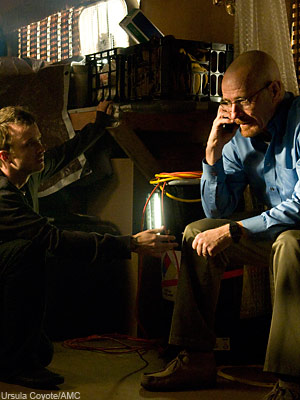
Breaking Bad
BREAKING BAD, an AMC drama, relating how a high school chemistry teacher reacts in an unconventional and fearless way to provide money for his family when he dies.

Glee
A musical drama by Fox, GLEE, has two storylines, one that develops the character playing a student with Down Syndrome at McKinley High School, the other explores the mental illness of one of its teachers. Two storylines with strong human interest threads. This is the show that had Gwyneth Paltrow as a feisty teacher last season.

The United States of Tara
UNITED STATES OF TARA, another Showtime drama, portrays a character with dissociative identity disorder (DID), once known as multiple personality disorder one of the lesser known afflictions .
Val Reynolds Brown, Editor
Learning to Live with Asperger’s Syndrome: A Real Life Story
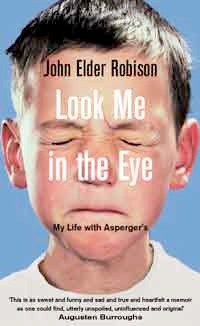 Does it make you feel uneasy if someone you are talking to avoids looking at you, direct eye to eye contact?
Is that learned behaviour on your part, or instinctive? Most psychologists would say it was learned, that you had experienced it before and been puzzled and made some assumptions – they are uncomfortable with you, they are guilty of something and they don’t want to look at you for instance.
But what of the person who is avoiding the eye contact? Do they have something to hide, or are they simply not wanting to make any kind of contact with you? Are they painfully shy?
John Elder Robison has written an account of his life from when he realised he was different from other people. Unable to make eye contact or connect with other children and by the time he was a teenager his odd habits – an inclination to blurt out non sequiturs, behave obsessively – and earned the label social deviant.
I found this book hard to put down and spent most of a day and evening reading it cover to cover. I have come across people who displayed some of the behaviours described by Robison, who was eventually identified as having Asperger’s syndrome at the age of 40 and who eventually was able to work hard to communicate and be able to socialise with greater ease.
This fascinating book, a New York Times bestseller, mixes ascerbic wit with painful honesty, wry humour and clarity. It should help to break down some barriers to understanding the behaviour of anyone within the autistic spectrum. More importantly I think it should help anyone with Asperger’s syndrome to manage their interactions with their peers and society in general better and be more able to successfully survive the slings and arrows that life throws at us all.
Published by Ebury Press, 2008, available from Amazon Look Me in the Eye: My Life with Asperger’s

Life Modelling: Up Front and Personal

Dawn, sculpture, David Evans FRSBS, in Parkway, Welwyn Garden City
A lighthearted feature that manages to get under the skin of life modelling and provides a rare glimpse into the courage and humour of an experienced model
How do you think you’d feel if you woke up on the first day in a new job, knowing that one of the first things you’d have to do when you got there would be to take off all your clothes?
Well, I can tell you that I didn’t feel very well at all.
I couldn’t believe that I’d committed myself to something so unimaginably appalling. But there was no escape now; I had to go through with it.
Looking back at that day some ten years down the line, my reasons for applying to the local art college for work as a life model don’t look very convincing, but at the time it seemed like a good idea. Having been at home caring for children but otherwise master of my own time for many years I couldn’t face returning to office life; all the gossiping and office politics and having to wear tidy little suits and smart shoes – but a job of some kind was becoming a financial necessity. The idea of being an artist’s muse, spending time with a wild but profoundly fascinating being who would share his deepest thoughts with me as I posed, draped in silken cloths and lying on a velvet chaise longue, had an undeniable appeal. It certainly beat the hell out of the prospect of being on a till in Tesco.
What never entered my mind was that the average model spends his/her time mainly in front of classes of up to thirty strangers. And what I didn’t know was that the local art college, far from occupying the gracious old building I’d envisaged, had been rehoused in a semi-derelict office block, with icy draughts from broken window panes and the dust of ages still lying on the floor.

Sculpture in Vienna
I was lucky. Taking pity I imagine on the pale and trembling middle-aged woman before him, the tutor in charge assigned me to a class of adults doing a part-time degree course, so at least I was spared the added horror of facing hordes of 18 year olds. The students couldn’t have been kinder, introducing themselves and having a friendly chat to help me relax, but the fateful moment couldn’t be put off indefinitely. I was shown the corner of the room, roughly screened with a tatty old piece of cloth, in which I was to undress. By this stage a sense of complete unreality had set in, but it wasn’t enough to calm my thundering heart. As I emerged clothed in my huge dressing gown, I still nursed the crazy hope that perhaps it was a mistake; that they didn’t really need all my clothes off. But they did. And I was shown to a rickety old wooden chair, and asked to sit down.
Nothing at all had prepared me for what came next, which was the total, unnerving silence of intense concentration as fifteen pairs of eyes zoomed in on me, and my cellulite. It was so quiet I was sure they could hear my heart thudding. As the morning wore on, and some kind soul brought me a cup of coffee, I slowly started to calm down a bit, though relaxation was short-lived once drawing after drawing began to be stuck up on the surrounding walls! Wherever I looked, there I was.
By mid-afternoon I was actually relaxed enough to start to feel a bit dozy at times. The sounds which were to become so familiar, the soft scratchings of charcoal on paper mingling with the background hum of traffic and the gentle drizzle outside, calmed my frazzled nerves and a sense of achievement began to creep in.
Feel like trying it for yourself?
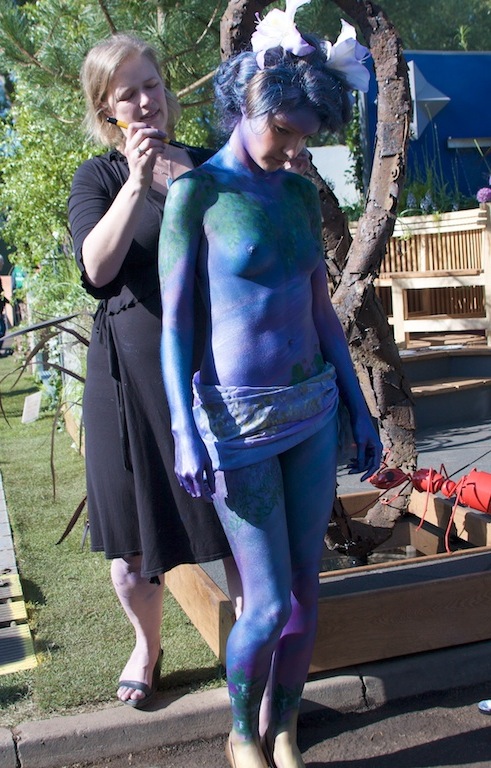
Painting a model at Chelsea Flower Show
Bear in mind that the myths about the pay really are myths, you’d be far better off financially working almost anywhere else. But there’s no doubt that it can give you a tremendous sense of empowerment, as well as a tiny stake in posterity. In just a few homes, my image will be gazing down from the wall for years to come. Cellulite included.
Keeping in Shape
Like most models I want to keep in shape, after all I need my body to earn money, so I joined a Zumba class as I find the gym boring and am too lazy to push myself very hard when I’m there. Zumba definitely helps with the modelling to be reasonably fit. However, for some classes a very slim and muscular model would be ideal so students can see clearly the skeleton and muscles. In others the more Rubenesque models are popular. I also practise yoga, which is popular with a lot of models as it helps keep the body flexible.
The Register of Artists’ Models is a useful starting point for anyone interested in this kind of work and gives a clear indication of rates of pay.
The author’s name has been withheld for personal reasons
Do you have a story you’d like to tell in all honesty but would prefer to remain anonymous? We can guarantee that anonymity … so do get in touch
All photography © Pintail Media
Why not follow In Balance on Twitter?
View from the Stalls – London Theatre 2011

Dominic West in Butley
That’s not to say that the West End never hosts a gem of a play; it’s really a question of winkling them out. Happily there is at least one to regale us playing currently: Simon Gray’s Butley at the Duchess Theatre. Well staged and admirably acted, notably by Dominic West playing the eponymous anti-hero, this play may be celebrating its fortieth anniversary but its rather bleak theme of the disintegration of a rather unpleasant man is, perhaps unfortunately, timeless.
 Another not to be missed performance (though I have yet to see it) must be Simon Callow Being Shakespeare at the Trafalgar Studios. I witnessed this actor reading all of Shakespeare’s sonnets many years ago and it was mesmerising – his one-man-show promises the same. But instead of paying £45 for your seat, try lastminute.com/theatre – they are offering the seats for £20 + £1 booking fee. Try this before opening night though, my pessimistic view of what theatregoers want may be wrong in this instance and then the discounted tickets will disappear!
Vanessa Redgrave in Driving Miss Daisy
Mark Rylance will reprise his star turn in Jez Butterworth’s Jerusalem which was sold out during the original run and was one of the best plays I saw in 2010.
 will open at the Adelphi Theatre in November. This hits the spot for the Christmas outing of the season. I saw it at the National a couple of weeks ago it had people rolling in the aisles. Whatever it costs, this is real value for money!
 Jeannette Nelson A bit of a culture vulture, Jeannette enjoys art exhibitions, cinema and classical music, but her main interest is the theatre. For several years she ran theatre discussion groups for which her MA in Modern Drama together with teaching skills stood her in good stead. She prefers to concentrate on the many off West End and fringe productions as well as that real treasure of the London theatre scene, the National.
Online Shopping is Greenest … unless you walk! + Voucher Giveaway
Shopping online with a home delivery service is twenty four times ‘greener’ than a car journey to the shops¹

Delivery from Goodness Direct
Makes sense. One vehicle for lots of addresses, rather than every household burning its own petrol.
Of course, taking the bus is preferential (you have to get out of the house some time) but it can still be more eco-friendly to have your shopping delivered to your home – leaving you more time to do the things you like.
If you shop with Goodness Direct you’ll find even more ways to go green. They have thousands of ethical goods on their shelves, whether it’s organic foods, eco-cleaning products or earth friendly cosmetics.
It’s an Aladdin’s cave of natural products and ethical goodies. There’s fairtrade foods, cruelty free toiletries, natural baby products, organic fruit and veg and special diet foods. It makes shopping a breeze.
So paint each and every day a little more green with GoodnessDirect. Plus, online orders over £35 ordered online are delivered free to anywhere in the UK.
WIN A VOUCHER WORTH £35 to spend at the Goodness Direct website
We have a prize voucher £35 worth of GoodnessDirect shopping vouchers to give to one lucky In Balance reader! Using the form below enter the prize draw and be in with a chance of winning your first GoodnessDirect home delivery FREE!
Entries, limited to one per household, should reach us no later than 15 July 2011.
17 7 2011: Update: The winner was Pauline Gibson of London
Val Reynolds Brown, Editor
¹Green Logistics paper: Carbon Auditing the Last Mile: Modelling the Environment Impacts of Conventional and Online Non-food Shopping; J. Edwards, A. McKinnon and S. Cullinane, 2009


Regain Balance after a Stroke
The first time Chris came across a wobble board was when he was attending physiotherapy at the local hospital following a severe stroke. He found it a real challenge but after a few weeks could see a distinct improvement in his posture and with that more confidence to walk without a stick. This is what he has to say:
After my stroke, I had to attend physio rehab classes to regain my sense of balance, among other things, and I found I had extreme difficulty balancing; the physio had a home-made wobble board, made of ply, and I remember commenting that this would be ideal for practice at home.
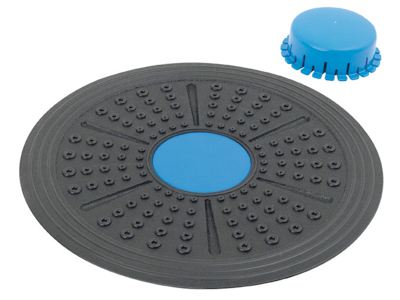
Home4physio Wobble Board
Then we found the Home4physio Wobble Board. This wobble board is adjustable for height; the adjustment is intended to provide a slight increase in difficulty, once some profiency has been attained. This exerciser would be ideal for anyone with weak core muscles (calves thighs, back), plus those with a poor sense of balance. It is small and easily stored away, when not required. My wife and I are both using it just for fun, balancing on one leg – this is not as easy as it sounds – just try closing your eyes!
* * * * *
The Home4physio wobble board is designed to aid the recovery of balance following injuries to feet, ankles, knees, hips and would benefit anyone or any age – many athletes and sportsmen and women use them in recovery and physiotherapists generally have one in their armoury. We use ours for general balance and flexibility maintenance – and it works!
In the elderly especially there is a certain look of vulnerability in those with poor balance and stability. Using the wobbleboard helps to regain confidence through improved strength. Flexibility and coordination can be improved without impact damage.
The home4physio wobble board has two height levels, easily adjustable. It comes with clear instructions for use and the exercises for improving sitting and standing are not extreme – with regular practice they will make a big difference.
More details on www.physiosupplies.com, or call the sales helpline, M-F 9am-5pm on 08700 545 050.
UPDATE – apparently the Wii Ski device is very good for strengthening balance – we’ll write about it once we have had some practice
Christopher Johns, Contributing Author
 In Balance