
Cancer, Positive use of Raw Goat’s Milk
This feature, first published in 2002, was lost when an earlier version of the In Balance Magazine website was irretrievably corrupted. We recently rediscovered the feature on an archive website and decided to republish.

Goat © Pintail
A diagnosis of cancer and its subsequent remission were what made Natalia Markelova, a 49-year-old divorcee set out on the road to establishing her the goat farm in Togliatti, Russia, and ultimately receiving national accolades for her work as a businesswoman
When a friend organised a visit for me to someone whom I would end up referring to as ‘the goat woman’, I expected a tough wizened old goat farmer. Instead, I met a large, plump woman with friendly cornflower-blue eyes, a halo of silver-grey hair and a gentle smile.
Natalia explained that she had been diagnosed with uterine cancer and subsequently decided to refuse conventional chemotherapy. Instead, she embarked on an intense research programme concerning the medical benefits of drinking goat’s milk. Convinced she was on the right track, she doggedly stuck with her preferred self-treatment of drinking goat’s milk only to find that her cancer was in remission.
Inspired by her own self-cure, and because the only way to obtain goat’s milk in this city of almost a million people was to own a pet-goat, she vowed to set up a goat farm with a view to producing milk for fellow sufferers of cancer and other ailments.

Goat herd France © Pintail
Thirty eight of Natalia’s goats produce 110 litres of milk every day. This doughty woman has the help of four workers, two of whom work at a time on one of two shifts. Milk is sent to kindergartens, hospitals and orphanages. After a tour of her the barn where the female goats were separated from the male goats and the bleating kids, Natalia explained that once her illness had been diagnosed she cut out cow’s milk altogether and switched to goat’s milk. Since the day she was told that she had only six months to live, she has now extended her life by another seven years.
She believes that as a society we need to be closer to nature and more in tune with its benefits. Indeed, judging by her close companions: a nervy toy poodle, a sleepy black cat, a fluffy white cat, and the fact that she says she knows all her goats by name, it is evident that she practices as she preaches.
It took her three years to start the farm from scratch and fulfil the promise once given to her pet goat: “I will help others as you helped me”. Natalia has visited nine states in the USA to learn about goat farming and to import specific breeds that were superior to native stock. She has also visited goat farms in the UK. She has been elected the leader of the Russian Goat Farmers’ Association which she helped to found.
I asked her what her thoughts were on receiving a diagnosis of cancer. “I was afraid for three days at first, but then decided that I was not going to accept the diagnosis and that I would find some way to fight it,” she says, adding that her three children had been her main motivation for staying alive. “I wanted to prove to them that there is nothing in life that can take you out of life’s saddle, if you are not prepared to get out if it first, yourself.”
Natalia explained that scientific research showed that goat’s milk takes 15 minutes to be digested in contrast with cow’s milk which takes some 45 minutes. Goat milk is also said to be the only product that helps rid the body of metal products. She also believes that it helps to kill allergies in children, and helps to calm ulcers.
I asked her if when she received her diagnosis, she changed her diet in any other way. “I eat anything I want, in addition to all goat products including meat, milk and cheese.” Regarding other cases where goat’s milk cures cancer she referred me to the work of Dr Bernard Jensen PhD, an American physician who was diagnosed with cancer at age 35 but who went on to cure himself with goat’s milk and lived to the ripe old age of 96. She is a devotee of his book: ‘Goat milk magic’. (This book is still in print Ed.)
She then takes out a thick file filled with letters which she tells me are from people who say how they have been saved by goat’s milk. Natalia suggests that if someone has cancer, she would advise them to read up on the healing benefits of goat’s milk and then make their own decision about whether or not to use it.
Contributing authors: Martine Self and Anna Garmash, martine.self@ntlworld.com
Editor’s Note:
Growing interest in alternatives to cow’s milk is reflected in the availability of pasteurised goat’s milk now widely available in UK supermarkets.
There is a proliferation of goat’s cheese from France, especially sourced by Tesco. Some goat’s cheeses are made from unpasteurised milk.
A huge amount of information was discovered in a general search on Google using unpasteurised goats’ milk.

British Goat Society
The British Goat Society has an interesting website – You can call them on 01626 833168
Other In Balance features relating to cancer:

More Autumn Activities – Making Jelly and Jam

Blackberries
I can remember our mother telling us ‘If you get out there and fetch some blackberries, I’ll make some jelly’. We returned hot, scratched and with purple fingers. It was worth it though when we had the luscious jelly on bread and butter. We were also given it in a warm drink by the fire before we went to bed on cold winter nights. Yum. It was such a strong memory that when I was offered a cutting from a thornless blackberry I was over the moon.
A most undemanding plant, the himalayan blackberry was easy to get to grow well and now needs very little attention apart from cutting out dead fronds after fruiting and tieing in new growth. We have had more than 40lbs this year – possibly reflecting the generous dose of manure we gave it last winter. We decided to make blackberry jelly using the Certo recipe, which takes 3lbs of berries. The longest bit is the straining through a jelly bag that takes ages but resisting the impulse to squeeze it is hard the resulting jelly is worth it, clear and delicious, melting sensually in the mouth.
EATING AL FRESCO – Picnic time is any time!

Punting on The Cam © Pintail Media
It’s always picnic time when the sun’s out, the river looks enticing and we’re in a hurry!
We grabbed a couple of packs of pate*, a french loaf, butter in a tub, some paper plates, a sharp knife**, something refreshing to drink, plastic cups and we were off.
Off to Cambridge for a break – why not? It’s the start of the term and yes there’ll be visitors galore, but it’s always possible to find a grassy spot on the river bank and have a great time with friends, gossiping, remembering times past, dreaming of good times to come. That’s the atmosphere we find whatever the weather.
It feels so good with the sun warming your bones on a cool autumn day, lounging on the grass, drinking in the view, admiring, or not, the prowess of the punters. We always feel better after a break away from the desk. Of course it doesn’t need to be Cambridge … Anywhere quiet and green with something to focus your attention on is good. Great for reducing blood pressure – frequent breaks from the pressures of publishing are a must for us.
We took some Castle MacLellan pates. Three of us had tried them previously. Here are our preferences, each marked out of ten, ten being the top mark.
Mushroom with garlic and thyme – 9 – memorable, would buy this regularly
Salmon with lemon juice and horseradish 9 – excellent, would definitely buy it if we saw it in the supermarket
Duck with bramley apple jelly 7 – good but not outstanding
Crab with lemon juice and Galloway mustard – 6 – good but not outstanding, perhaps more mustard would give it more of a bite
Chicken pate with Scottish heather honey – 5 – needed more of a bite to make it memorable, bacon perhaps, or garlic, personally we added some lemon juice when we had it on toast and in a sandwich.

Punting on The Cam © Pintail Media
Castle MacLelland products are available at Waitrose, Nisa, Coop/Somerfield, Spar, Booths and also in Sainsbury and Morrisons (crab only), Asda (Scotland stores only) as well as independent stores throughout the UK.
The Crab is on special offer in Sainsbury’s reduced from £1.25 to just £1 from 31 August to 20 September – four days left!
**Sharp knife is needed to open the seal on the pate packs.
Val Reynolds Brown, Editor
Borage – Borago Officinalis – Amazing Versatility
Discover the amazing versatility of this popular herb
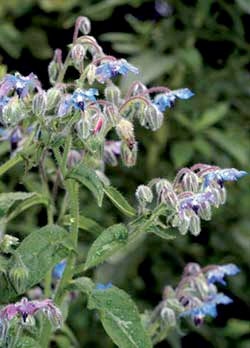
Borage
Glance at a borage plant and you’ll see a sturdy erect plant, covered with short, stiff, prickly, silver-white hairs that shine in the sun and large, oval, pointed, darkish-green leaves. But lift up a flower (they’re inclined to droop down) and reveal the beauty of the superbly formed, bright blue, star-shaped flowers of five petals with a central cone of deep purple-black anthers.
Native to regions of North Africa, the Middle East, the Mediterranean and Central Europe, and brought to Britain by the Romans, it’s also to be found in the temperate regions of North America.
The name borage could originate from the Celtic ‘barrach’, a man of courage. Certainly, Celtic warriors drank borage wine and used the plant dye to paint their bodies before running naked, into battle. Ancient recorders Dioscorides, Pliny and later the Elizabethan herbalist, John Gerard, all have mentioned the marvellous effects of the plant on mind and body, dispelling melancholy and inducing euphoria. In medieval times it was used as a tonic to lift the heart and spirit, promoting bravery on the jousting field. To quote an old saying, “Ego Borage gaudia semper ago,” I, Borage, bring always courage.
In the lands bordering the Mediterranean, its name is spelt with a double ‘r’, perhaps from the Italian ‘borra’ or French ‘bourra’, hair/wool, noticeably covering the plant.
Though an annual, it readily seeds itself, the four brownish-black nutlets opening to reveal black seeds. Seed sown in March and covered well with soil, germinate to maturity very quickly, usually in two months. Alternatively, the plants can be propagated by division of the rootstock in the spring, or by cuttings of the shoots pushed into sandy soil in a cold frame in the summer or autumn. The preferred soil seems to be moist, loose, stony, with some sand and chalk in it, in a sunny position. Yet borage is often found in heavier soils and partial shade and frequently on waste ground.
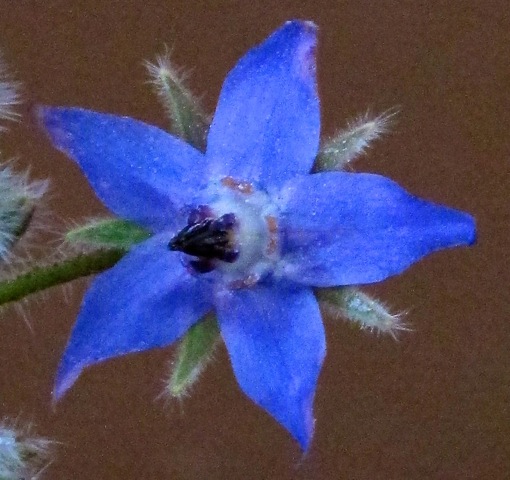
Borage flower, close up © Pintail Media
Within a garden, the 30-60cm (1-2ft) plants may be sited in the herb patch or as companion plants with strawberries. Bees love the sweet nectar in borage flowers, converting it to superb honey (hence its nickname ‘bee bread’), whilst also pollinating the strawberry flowers. And growing borage among tomato plants can improve the flavour of the tomatoes. Borage is also attractive in a window box or centrally in a hanging basket surrounded by shorter plants, so the beautiful drooping clusters of flowers will be visible from a lower angle; a central cane support may be needed. In mild, sheltered conditions, the plants may be in flower until November. Some plants produce white flowers, while others can start off pink and turn blue.
The leaves must be picked dry, when the sun has dried the dew and as the plant is coming into flower. Strip off each leaf singly, discarding any with marks on them. Some people find it necessary to wear gloves when handling borage as occasionally it can cause skin dermatitis. In the home, dried borage flowers can be added to potpourri.
Medicinally, borage can be utilised as a diuretic, demulcent and emollient. Its high saline mucilage content makes it a good diuretic, aiding the functioning of the kidneys. Its anti-inflammatory properties can help internally soothe bronchitis, catarrh, feverish colds, dry rasping coughs, pleurisy and rheumatism.
In France it is used to treat some pulmonary problems and fevers, increasing sweating and so removing toxins from the body via the skin and urinary system. Its high calcium and potassium salts can help reduce temperature when taken as a hot infusion. Use 30g (1oz) of fresh leaves (dried if fresh are not available), and infuse for five minutes in 600ml (1pt) of boiling water. Then strain it and drink three to four wineglassfuls a day, adding honey if preferred sweeter. Whilst treating a cold, Mességué recommends using borage in foot- and hand-baths.
The above infusion also can be of help as a gargle for sore throats and laryngitis, and as a mouthwash for stomatitis and bleeding gums.
A poultice can be made by placing crushed leaves and flowers between two plates over a pan of boiling water – the plates will get hot. This poultice can be bandaged lightly on inflamed or irritated skin, on sores and wounds and used for arthritis and gout, renewing it when cold, until some relief is felt. Or a lotion can be made from equal quantities of borage juice and water.

Borage flower, close up © Pintail Media Version 2
Borage tincture, 5ml (1tsp) taken three times a day, can act as a tonic for stress, and be used for countering the effects of steroids and after steroid therapy. This has been backed up by modern research confirming that borage stimulates the adrenal glands (the organs of courage), to secrete adrenalin.
Making a pulp of the fresh leaves and drinking 10ml (2tsp) of juice, three times a day, can help with problems of depression, grief or anxiety. Instead of Evening Primrose Oil, capsules of Borage Seed Oil can be taken daily for some cases of eczema, hay fever and rheumatoid arthritis. Research has indicated that massaging borage oil into the cold, bluish-white fingers caused by Raynaud’s disease may help alleviate the pain The oil may assist in cases of menstrual irregularity, irritable bowel syndrome and even as a first aid for hangovers. Remember though, what may benefit one, may not another and as a medication, it should not be used indefinitely but for short periods at a time.
As an external application for annoying spots, equal quantities of borage, dandelion and watercress juice can be mixed to form a lotion (freshly made each time), left on the spots until completely dry, and then washed off, repeating the process a few times. Borage also can be used as a facial steam for very dry, sensitive skin and there are commercial products on the market such as Starflower Body Lotion and Borage Seed Oil.
Leslie Kenton’s Healing Herbs Paperback edition published by Vermilion (Random House), London, 2002. ISBN 0-091-88428-4
The Herbal Health and Beauty Book by Hilary Boddie. Published by Optima (Little, Brown and Company (UK) Ltd, 1994 ISBN 0-356-21030-8 contains herbal remedies for health problems such as dizziness and laryngitis, as well as beauty treatments for the face, feet and hair.
New Herb Bible by Caroline Foley, Jill Nice and Marcus A.Webb. Published by David & Charles, Devon, 2002. ISBN 0 7153 1363 0
A Handful of Herbs by Barbara Segall, Louise Pickford & Rose Hammick. Published by Ryland Peters & Small, London, 2001. ISBN 1-84172-109-3 combines the notes of a horticulturalist and a food writer, illustrated with suitably refined photos;
Sìne Chesterman
Sìne’s interest in gardening and botany started at an early age with her own patch in her parents’ garden, and learning which plants were natural healers. Brought up with old and tested remedies, and gardening methods, now termed ‘organic’, she still practises natural ways of pest control.
Tropical Fruits Giveaway – Are you a Winner?


The winners of the Tropical Fruits Giveaway are:
K Bolton, Wilts
N Clifford, London
L Jeffs, London
K Christodoulou, Herts
S Darby, London
D Johnson, Devon
H Izzard, Manchester
C McLeary, London
D Criscuolo, Surrey
D Hilliard, Powys
Not a winner? Perhaps you didn’t include all your contact details. Two entries drawn didn’t include postal details so we had to draw again.
Why miss out on future giveaways we will be offering soon … books, skincare, tickets to shows … Just click on the Sign me up! box at the bottom of the righthand column
Miró the Surrealist – Major Retrospective 2011

Approach to Miró the Surrealist - Major Retrospective Tate Modern 2011
The major retrospective of Joan Miró the Surrealist at Tate Modern 2011 comes to an end on Sunday, 11 September.
Renowned as one of the greatest Surrealist painters, working in luxuriant colour, Miró worked in a rich variety of styles. This is a rare opportunity to enjoy more than 150 paintings, drawings, sculptures and prints created across six decades of an extraordinary career.
Give yourself at least two hours to take in this exhibition, I went round twice, using the audio commentary. I came out rather over ‘Miróed’ but completely in awe of his range of artistic styles. Overall I looked at The Farm for the longest. It has such a story to tell, I could have looked at it for hours and even then found something new to see.
This really was intended as a must-see exhibition by Tate Modern and for once I agree. If you can squeeze in a visit this weekend I think you won’t regret it.
The last exhibition tour on Saturday is at 12.15 for just 15 visitors. This costs £5 plus of ticket £15.50, concessions £13.50. The exhibition closes on Sunday. You can Book online or call 020 7887 8888.
Rosemary A Herb for Health

Rosemary © Pintail Media
Will Shakespeare knew rosemary. The plant that is! In ‘Hamlet’, Ophelia states the long-held belief “There’s rosemary, that’s for remembrance.”
It’s now known that antioxidants in rosemary help prevent aging in cells and aging is associated with memory loss. Pregnant women may be advised to avoid large doses as a medicine in case it induces abortion – but otherwise it’s a beautiful-smelling, super-tasting safe herb.
Respected as a holy, magical and healing plant, one legend maintains the original flowers of rosemary turned from white to blue when the Virgin Mary spread the Christ-Child’s linen, or her own cloak, to dry on a rosemary bush. (Actually the flowers vary in colour, blue, pink or white, depending on the species and variety). In some areas it’s said to bloom at midnight on Old Christmas Eve, 17th January, (though usually later on, in the spring).
Another gardening anecdote relates it growing well not only for the righteous but for a woman who rules her husband and household. To stop gossip, some husbands removed the root so the bush died! Greek scholars, sitting exams, wore garlands of rosemary, believing it helped mental concentration by improving blood flow to the brain. Since the thirteenth/fourteenth centuries, rosemary has been known worldwide as ‘Queen of Hungary’, after the Hungarian Queen was certain her paralysis (maybe gout or rheumatism) had been cured by ‘Hungary water’. This was probably produced by macerating rosemary flowers and flowering tips for a month in alcohol, then straining through fine muslin and taken medicinally in 1 tspn doses.
As a symbol of fidelity in love in Elizabethan times, flowering sprigs were woven into the bridal wreath; bridesmaids, groomsmen and wedding guests were given sprays of rosemary tipped with gold and tied with coloured ribbon, while at the wedding feast, sprigs of rosemary were dipped into the wine before the bridal pair had a drink, to ensure happiness and love. New Year guests were given rosemary plus an orange adorned with cloves. At funerals, to denote the deceased would not be forgotten quickly, rosemary was included in wreaths, and small sprays carried by the mourners, were strewn on the coffin as it was lowered into the ground. A sprig of rosemary fastened to a doorpost, was said to ward off witches and stop snakes entering, while rosemary attached to clothes, offered protection from evil spirits, witches, fairies, thunder, lightning, physical injury, assault, and the plague. Judges wore a sprig to defend themselves from being infected by those brought before them. As for incense, if unavailable, rosemary was burnt. There’s a recipe for rosemary incense in ‘Leslie Kenton’s Healing Herbs’ (see Notes below).
Rosemary originated in areas bordering the Mediterranean, appreciating the full sun and close proximity of the ocean; hence its name from the Latin, ros and marinus, dew of the sea. Popular in monastic gardens, it was brought over the Alps to northern Europe by the first Christian monks.
In Britain it should be treated as a half-hardy perennial, tolerating a poor but benefiting far more from a well-drained soil. Pinching out the tip of the main shoot will encourage side growth – it can grow up to 2 metres (6ft). Dwarf varieties grown in pots, have the advantage of being easy to transport indoors for the winter. Propagation is by seeds, cuttings or layering. Cuttings, best taken from a woody shoot in late summer, will need protection from frost and cold winds while young.
Fortunately rosemary can be harvested fresh all year round but if not possible, it can be dried. If flowering tips are to be dried or frozen, cut the sprigs when the flowers are open. To dry the leaves, pick the sprigs before flowering, and hang them in a warm (not above 40°C/104°F), airy place, away from direct sunlight. Don’t leave them hanging up for ages or they’ll become tasteless and gather dust. Better, use a flavour-sealing, quick dry method – spread them on a tray covered with muslin, place it in the warming drawer of a (used!) oven or an airing cupboard and leave for a few days until they are dry but still green. Then they can be stored whole, wrapped in paper, in a drawer or dry, dark larder or the woody stems discarded and the leaves placed in dark-glass bottles.
As said at the start, rosemary is a safe herb. Germany’s ‘Commission E’ (conductors of the first comprehensive study of herbal medicine) found that drinking rosemary leaf infusions helped problems with upset stomachs, indigestion and appetite loss, while the external use of infusions and oil could ease circulatory complaints and rheumatism. Rosemary essential oil has potent antioxidant, antiseptic and antimicrobial abilities.
Some old remedies may at first seem strange (such as to prevent giddiness by combing hair daily with a comb made of rosemary wood), but research is frequently confirming our ‘wise’ past knowledge of plants. Gerard in his ‘Herbal’ of 1636 recommends the distilled water of the flowers, drunk morning and evening, as a mouthwash/breath freshener, while nearly a hundred years later, boiling cider with a sprig of rosemary for 15 minutes and drinking it at bedtime, was remedied for increasing sweating to reduce a cold.
Nasal congestion can be eased with this homemade chest rub (though not if the skin is broken, sore or sensitive). Pour boiling water over a handful of rosemary flowers and leaves, leave for 25 minutes and then strain. Transfer the contents of a small jar of vaseline into a heatproof bowl placed in a saucepan of boiling water. When melted, add the rosemary infusion and simmer for 20 minutes, stirring well. Remove from the heat and when cool, stir in 8 drops of oil of rosemary, stirring again before applying to the chest. (Don’t store this in a fridge).
For those suffering from asthma, see if this infusion can help, taken each morning during a bad spell; a pinch each of rosemary, orange flower water and thyme in a cup of boiling water.
Could rosemary be of help in the treatment or delay of Alzheimer’s disease? Rosemary contains compounds that will retard the breakdown of acetylcholine, a neurotransmitter (brain chemical) playing a key role in cognition and reasoning. As these compounds can be absorbed through the skin, regular use of a rosemary shampoo, either a commercial one or rosemary tincture added to a herbal shampoo could prove beneficial.
The pain of neuralgia may be eased with an infusion of combined rosemary leaves, lavender flowers and lime blossom, or the infusion used as a compress, placed warm on the affected area. Even a little sprig of rosemary placed inside the mouth may help.
For someone who has fainted, one or two drops of rosemary essential oil on a tissue or a handful of leaves crushed into a ball, held under the nostrils can help to revive, backed up with an infusion of 1 or 2 tsp of crushed leaves in a cup of boiling water.
An infusion of 2tspn of dried rosemary per cup of boiling water can bring relief from pain, including pre-menstrual symptoms, or place 56g (2ozs) of rosemary in a muslin/cloth bag and leave it in the water when running a bath. Likewise, rosemary added to a footbath is great for tired, swollen feet.
Rosemary oil can be purchased or made at home, to use eg for massaging onto painful joints and bruises. Pour a cupful of olive or almond oil over two handfuls of rosemary leaves in a jam jar, cover with a piece of muslin or cheesecloth secured with a rubber band and leave for 2 to 3 weeks on a sunny windowsill. Then strain it into small screw top jars and store it in the dark.
An ointment which may soothe eczema, skin irritations and rheumatism is easily made by melting in an enamel pan, 1tbsp rosemary oil with 4 tbsp white petroleum jelly. Stir it well and then put in small jars and cover when cold.
Aromatherapists use essential oil of rosemary in a massage during treatment for depression, whilst a morning drink of rosemary infusion can also be beneficial. However, if suffering from high blood pressure, rosemary must be avoided in aromatherapy treatment as it stimulates circulation.
Extracts of rosemary are often found in proprietary soaps, perfumes, toilet waters and hair preparations. As a hair treatment, since massaging the scalp stimulates the circulation, helps decrease dandruff and encourages hair growth, massaging using one part rosemary oil to two parts almond (or olive) oil, can promote healthy hair and even a better memory. And a rosemary infusion as a final rinse can benefit dark, dull or oily hair.
There’s a useful decoction recipe for puffy eyes in The Herbal Health and Beauty Book (see Notes below), while the New Herb Bible (see Notes) includes rosemary in recipes for an antiseptic mouthwash, a soothing bath oil, a skin cleanser, a scrub, a tonic and a soap. To refresh skin that is sensitive and dry, try applying twice weekly, a hot compress of rosemary and mauve flowers.
Within the home, small bags made from muslin or cheesecloth and filled with dried rosemary, can be placed in clothes drawers to help deter moths while providing a fragrant smell. Or make a little herb pillow containing rosemary, cloves and nutmeg. Rosemary was one of the herbs used in tussie-mussies (nosegays), needed in the Middle Ages to hide bad smells, but also believed to protect the holder from disease as well as being presented as declarations of love, (rosemary for remembrance). Fresh sprays of leaves and flowers in a vase, in a herb wreath or a pot-pourri can help cleanse the air and provide perfume, while burning rosemary sprigs outdoors can keep insects at bay. Rosemary essential oil can be added to furniture polish and to wax or oil when making candles.
Before fridges and freezers were invented, rosemary was placed with meat so to some extent its antimicrobial properties could help preserve the meat. The aromatic, pungent leaves are used, fresh or dried, with lamb, beef, chicken, pork and fish, while the flowers and chopped young leaves can be added to salads. Rosemary is contained in the Herbes de Provence seasoning blend. It adds flavour to grilled meat, barbeques, ratatouilles, sauces, etc; to mushrooms, soup, soft cheese; to biscuits and jam, as well as to fruit-cups and mulled wine. (It’s one of the herbs used in vermouth). Using fresh sprigs allows them to be removed easily before serving. Additionally, bees feeding on rosemary, produce excellent honey. For an easy-to-make rosemary, garlic and pepper oil, look in ’A Handful of Herbs’ (see Notes).
And how about trying my recipe for
ROSEMARY AND CHEDDAR SCONES (Makes 20-30 depending on the cutter size) 340g (12oz) self-raising flour
Salt and pepper
40g (1oz) butter or margarine
1 level 5ml tsp dried rosemary
100g (3oz) grated cheddar cheese
1 beaten egg
140ml (1pt) milk
Preheat the oven to 230°C (450°F, Gas Mark 8)
In a bowl, mix together the flour, salt and pepper, rub in the margarine and then add the rosemary and cheese, mixing well.
Stir in the beaten egg (reserving a little for brushing the tops), and then the milk.
Again mix well. Roll out on a floured board until 1cm thick. Cut into rounds, place on a greased baking sheet, brush the tops with the beaten egg and if you like, sprinkle extra grated cheese on top. Bake for 15-20 minutes.
Leslie Kenton’s Healing Herbs Paperback edition published by Vermilion (Random House), London, 2002. ISBN 0-091-88428-4
The Herbal Health and Beauty Book by Hilary Boddie. Published by Optima (Little, Brown and Company (UK) Ltd, 1994 ISBN 0-356-21030-8 contains herbal remedies for health problems such as dizziness and laryngitis, as well as beauty treatments for the face, feet and hair.
New Herb Bible by Caroline Foley, Jill Nice and Marcus A.Webb. Published by David & Charles, Devon, 2002. ISBN 0 7153 1363 0
A Handful of Herbs by Barbara Segall, Louise Pickford & Rose Hammick. Published by Ryland Peters & Small, London, 2001. ISBN 1-84172-109-3 combines the notes of a horticulturalist and a food writer, illustrated with suitably refined photos; includes ideas for scented candles, a wreath of herbs, a recipe for rosemary and garlic flavoured pizza/bread, the use of rosemary for finishing touches to a dining table, for adding perfume and decoration to a room, even for adding perfume to writing ink.
All the books are linked to the Amazon website for easy ordering.
Sìne Chesterman
Sìne’s interest in gardening and botany started at an early age with her own patch in her parents’ garden, and learning which plants were natural healers. Brought up with old and tested remedies, and gardening methods, now termed ‘organic’, she still practises natural ways of pest control.
Grow Nasturtiums for Natural Health

Nasturtium © S Chesterman
Tropaeolum majus also known as Indian Cress
Nasturtiums are bright – see Google page of pictures. They range through yellow-orange to fiery red annuals. This is a plant for which the phrase ‘getting the most out of a plant’ really rings true. Growing nasturtiums is easy. All parts are edible – the flowers, leaves and seeds.
You can plant nasturtium seeds in a bed, border, to climb against a fence, or in containers and hanging baskets. Nasturtiums are easy to grow, in full sun or partial shade. They prefer moist, well-drained poor to ordinary garden soil; too rich a soil results in a profusion of lush green leaves but this is at the expense of flowers. The climbing, trailing and dwarf varieties readily self-seed or the seeds can be gathered and started in pots in the greenhouse.
Good introduction to natural history for children
They’re great for children to plant, not only as the largish seeds are easily held by small fingers but they are fairly quick to germinate and grow. And if you show children how to sow lettuce and radish seeds beside the nasturtiums, there’ll be benefits, both for the plants’ health and the children’s knowledge.
Buds, flowers, leaves and seeds are all edible and quick to pick, contain vitamin C and, belonging to the Cruciferae (mustard) family, also contain a type of mustard oil, benzyl isothiocyanate, with a peppery taste. This oil is not only very useful in salt and pepper-free diets, but possesses antifungal properties and impedes the growth of bacteria and viruses.
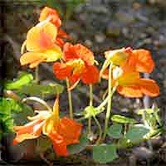
Nasturtiums © Pintail
Originating in Bolivia and Columbia, seeds were brought to Europe from Peru by Spanish conquistadors in the 16th century and hence became considered a symbol of conquest and victory.
Nasturtiums are planted in the spring, once the danger of frost is over. They can be used not only for decoration in the flower garden but also amongst vegetables, as a companion plant for radishes, whilst their pungent smell can be utilised by careful siting, to repel or attract pests.
Use nasturtiums as a natural repellent
Woolly aphis can be repelled from apple trees by planting nasturtiums around the base of the tree, or by spraying affected branches with an infusion made from the whole plant, while a few nasturtiums near tomato plants and broccoli can deter whitefly. On the other hand, blackfly find the smell attractive, so adding a few nasturtiums near broad beans will help to lure them away to the nasturtiums, subsequently nipping off any attacked parts. When frosts appear, the stems can be chopped up and added to the compost heap.
In natural medicine, fresh leaves can be used for combating infections of the urinary tract and the respiratory system.
Using nasturtiums as a natural remedy
Juice from leaves (liquidised and strained) can be of benefit as a remedy for coughs and bronchitis, while liquidising and straining the fresh leaves and stems produces a liquid which will ease skin irritations and painful muscles, and act as an antiseptic for wounds.
Dried seeds can be powdered for use as a mild laxative; or crushed to a pulp, then sandwiched between two layers of muslin or cheesecloth, with a plate above and beneath and placed over a pan of boiling water to produce a hot poultice to bring spots and boils to a head.
The naturally occurring sulphur in the plant can be utilised to make a hair and anti-dandruff lotion. Place one large handful of leaves and a cup of vodka in a wide-necked screwtop jar, cover and keep in a warm place for two weeks, shaking the jar once a day. Then strain it repeatedly until a clear lotion is produced and apply it to the scalp with a cottonwool pad, once or twice a week, ensuring no lotion enters the eyes.
Recipes for nasturtiums
In the kitchen, the flowers will look attractive while adding texture and flavour to food. Those flowers with a long spur at the base, have a drop of sweet nectar giving a sweet/sour flavour. When picking, if you find tiny, black, pollen beetles on the flowers, put the stems in water, cover the whole with a brown paper bag, place, preferably outside, in a dark spot (away from the wind), to allow the beetles to drop off and go elsewhere. Nasturtium petals can be added to omelettes and cream cheese for extra flavour, while petals or the whole flowers can be scattered over lettuce for salads. As an additional salad ingredient, wash some leaves, pile on top of one another, and then roll up, slice into strips and toss in a vinaigrette
Make the vinaigrette from
• 2 tablespoons oil
• 1 dessertspoon vinegar (half the normal quantity due to the strong flavour of the nasturtiums)
• salt and pepper, adding fresh seeds, whole, or crushed with a fork
To pickle the seeds for use as mock capers, pick the seeds on a dry day, wash and then soak them for 12 to 24 hours in a brine of 57g (2oz) salt to 570ml (1 pt) water. Drain and then put them in small jars, filling to 13mm (1/2 inch) of the top. Cover them with cold spiced vinegar in the proportions 570ml (1pt) vinegar, 6 peppercorns, 2 bay leaves and 2 teaspoons salt, or for a more spicy result, replace the bay leaves with a slice of horseradish root, 1 clove and 2 tarragon leaves. Seal the jars and try to keep them for 12 months before using.
For a salt and pepper-free diet, ripe nasturtium seeds can be ground and kept for use in tightly-stoppered bottles. This was done during World War II but for different reasons – pepper was very expensive and sometimes unobtainable. Adding a little salt will improve the flavour.
Among other recipes, the pickled seeds can be added to martinis; relish can be spread on the leaves, then rolled up and loosely tied with a long-stemmed flower – try a relish of cream cheese, chopped walnuts and raisins, or mix tuna, parsley and mayonnaise. Or for a different effect, large flowers can be stuffed with a teaspoon of the cheese or tuna relish.
Add up all these reasons and I think you’ll agree that nasturtiums are certainly well worth growing and utilising.
Sìne Chesterman’s interest in gardening and botany started at an early age with her own patch in her parents’ garden, and learning which plants were natural healers. Brought up with old and tested remedies, and gardening methods, now termed ‘organic’, she still practises natural ways of pest control.
Now’s a Good Time to Gather Herbs to Dry

Marigold petals, make a delicious tea
Wandering round the garden today I picked several bunches of herbs to dry for use during the winter months.
I tie the stalks together and place upside down in a paper bag, tieing the top loosely, but with a loop for hanging. They are then hung up on nails in the garage where they will stay for a few weeks until they are quite dry, then crumbled and placed in an air tight jar. We quite like the aroma that comes from the dried stalks and put them on the top of the wood burning stove to lightly scent the room. They can burn so put them on a pyrex dish or similar. Or you could keep them for the next barbecue …
Marjoram can be used for teas as can marigold petals which can relieve stomach aches
There’s nothing nicer than tea made from your own mint. We have a particularly strong one that makes excellent tea. It’s useful too for lamb, as is rosemary.

Rosemary
Sage is a bit strong for tea, but good to help digest fatty meat like pork and goose. Bay leaves are always useful to add to a bouquet garni.

Sage
We grew tarragon this year as an experiment but we haven’t used it at all so it will go into the compost bins later next month.
My all time favourite is verveine, it smells just like sherbert lemons and always makes my mouth water at its memory. A tea made with it is absolutely delicious, needs just a little sweetening, and is an excellent drink before bedtime as it does seem to induce sleep.

Verveine

Fennel
There are still some Nigella seeds to ripen so we picked them all and put them in a carrier bag hung from the garage beams. They will shake out in a week or so. We use them in meat dishes and sometimes in cakes.
Fennel seeds can be used to make tea, although we prefer to eat them when they are plump and green which is about now.
There is still enough time to cut some bunches of lavender to add to our clothes cupboards and we will keep some seeds for flavouring our favourite shortbread. Alys Fowler has a great recipe in her book The Edible Garden. Now there’s a gardener I admire.
Do you dry herbs? Why not let us know and we’ll write about it in the mag.
Charlotte Yardley
Gardening Adviser
Real Fruit Drinks – no added sugar – Just the job for the Picnic Basket
Latest Tasting News
We’ve just tried a range of fruit drinks that contains no added sugar, just 100% natural ingredients, and which helps to fulfil your five a day diet. And very good they are too!
 You can choose between still or gently sparkling flavours, we loved the sparkly Cloudy Lemon and the still Orange and Mango. The Cranberry and Pomegranate appealed to the older teens and the younger kids loved the small cartons. The grownups appreciated the good, solid feel of the glass bottles, recyclable.
Where to buy? Supermarkets and you will see them in Costa Coffee shops and in Orchid pubs and restaurants.
So what’s the story behind this range of drinks?
Founded by three friends who had all worked together at Coca Cola, Dave Wallwork, Chris Wright and Steve Cooper created the company with the simple aim of making gorgeous tasting, healthy soft drinks, and to have fun while doing it.
 Feel Good by name and Feel Good by nature, the company’s ambition is to spread ‘feelgoodness’ throughout everything it does; whether that’s developing a brand new range of drinks packed full of the good stuff, making drinkers smile with their marketing activities, or giving each team member five extra ‘feelgoodness’ days off each year to help out a charity that means something to them!
Globally, Feel Good Drinks can be found in no less than 12 countries including Hong Kong, Finland, France, Holland, Sweden, Denmark, Greece, Norway and Ireland – and this number is growing all the time!
Enjoy some feelgoodness for yourself! Visit www.feelgooddrinks.co.uk or the doodling website www.feelgooddoodle.co.uk to get your creative juices flowing!
PS If you can’t get enough mango do try some dried fruit from Tropical Wholefoods, available in all good health food stores, Oxfam stores, Fairtrade shops and catalogues and of course at our favourite online supplier GoodnessDirect We love ’em! And we are giving some packets away click here for info
 In Balance