
Real Fruit Drinks – no added sugar – Just the job for the Picnic Basket
Latest Tasting News
We’ve just tried a range of fruit drinks that contains no added sugar, just 100% natural ingredients, and which helps to fulfil your five a day diet. And very good they are too!
 You can choose between still or gently sparkling flavours, we loved the sparkly Cloudy Lemon and the still Orange and Mango. The Cranberry and Pomegranate appealed to the older teens and the younger kids loved the small cartons. The grownups appreciated the good, solid feel of the glass bottles, recyclable.
Where to buy? Supermarkets and you will see them in Costa Coffee shops and in Orchid pubs and restaurants.
So what’s the story behind this range of drinks?
Founded by three friends who had all worked together at Coca Cola, Dave Wallwork, Chris Wright and Steve Cooper created the company with the simple aim of making gorgeous tasting, healthy soft drinks, and to have fun while doing it.
 Feel Good by name and Feel Good by nature, the company’s ambition is to spread ‘feelgoodness’ throughout everything it does; whether that’s developing a brand new range of drinks packed full of the good stuff, making drinkers smile with their marketing activities, or giving each team member five extra ‘feelgoodness’ days off each year to help out a charity that means something to them!
Globally, Feel Good Drinks can be found in no less than 12 countries including Hong Kong, Finland, France, Holland, Sweden, Denmark, Greece, Norway and Ireland – and this number is growing all the time!
Enjoy some feelgoodness for yourself! Visit www.feelgooddrinks.co.uk or the doodling website www.feelgooddoodle.co.uk to get your creative juices flowing!
PS If you can’t get enough mango do try some dried fruit from Tropical Wholefoods, available in all good health food stores, Oxfam stores, Fairtrade shops and catalogues and of course at our favourite online supplier GoodnessDirect We love ’em! And we are giving some packets away click here for info
Puppy Training Problems Solved 2: Winnie Chews a Shoe …
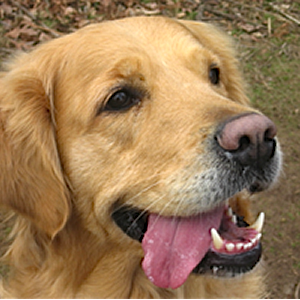
Winnie
Winnie’s Woes: The diary of a golden retriever learning about life
A Seven Part Series with a bittersweet final episode
What a lovely walk that was, I feel quite worn out. I’ll just flop here on the kitchen floor, it’s so lovely and cool.
I’d better have a drink. Oh great, Claire’s topped it up for me. What is she doing anyway? She’s going into the pantry, perhaps for some doggie treats …
Winnie, shoo.
Oh, I don’t think I’m supposed to go in there. And she doesn’t have any treats either. Although she has left some toys out for me. I’ll have a sleep and then play.
Yaaaawwn. The house in quiet. I wonder where Claire is?
She’s shut me in the kitchen. That means she’s gone out. I think I’ll play with those toys she left out. Oh, hang on. What’s this?
Oh, my, it smells amazing. It’s all chewy and leathery. What are these dangly things for? They chew up really well. And this bit at the bottom has mud and stuff on. It must be a new kind of toy – thank you Claire!
I’ll just chuck it around the kitchen a bit, this is so much fun!
What happens if I growl at it and pretend it’s an animal? Ha! this is brilliant. Grrr, gotcha.
Wo-ow, I-I-f I sh-sh-ake my he-ad li-ke th-thi-is it starts to fall apart … !
I’m taking this to my bed to give it a proper good chew. Now that the stringy bits have come out and the bottom is hanging off I can really get at it properly…
What’s that noise? Is Claire home? Yay! I’ll meet her at the back door and show her what I’ve done with the lovely new toy she gave me – she’ll be so proud of me!
Look Claire – I’ve chewed it all up!
WINNIE!!! Blah blah blah, naughty girl.
Oh no, I’m being told off again … she didn’t want me to eat that toy after all … why did she leave it in the kitchen for me then? And what’s a shoe…?
Claire Price, Winnie’s owner
Breeder’s advice:
The obvious comment is don’t leave anything that you don’t want chewed within reach of a puppy. Slippers, shoes and underwear smell strongly of YOU and will be very enticing to a little one. Be sure to provide toys which can be safely chewed and never chastise the puppy for something he did earlier. He can only associate the present moment, not the past.
Winnie’s Woes Part 7 – Winnie Moves On
Winnie’s Woes Part 6 – Winnie Learns about Children
Winnie’s Woes Part 5 – Winnie’s friend Henry learns not to eat stones
Winnie’s Woes Part 4 – Winnie learns about other dogs
Winnie’s Woes Part 3 – Winnie Eats too much
Winnie’s Woes Part 2 – Winnie eats a shoe
Winnie’s Woes Part 1 – Winnie finds digging is not a popular activity!
 Have you read the bestseller The Puppy that came for Christmas … A true story that has appealed to dog lovers and non-dog owners alike – it is both truly heart warming and heart wrenching.
Recommended Links:
Anythingdogz – an excellent website owned and run by Lisa Evans, an In Balance reader
Helpful Holidays offer holiday cottages in the West Country that welcome dogs. See their Helpful Holidays website.
Blockbuster Art Exhibitions – London UK

Absinthe, Toulouse Lautrec
When it comes to art exhibitions, the term ‘blockbuster’ is somewhat overused these days, but it surely must apply to Tate Britain’s offerings
The Degas, Sickert and Toulouse-Lautrec exhibition ran until 15 January 2006 and was filled with accessible, beautifully executed paintings. It drew on works from the eponymous painters as well as gems from lesser known or even scarcely known artists such as Bonnard, Vuillard and Warrener.
Arranged more or less in chronological order, from the 1880s to the 1900s, the works on display marked the beginning of modern art, particularly in form and composition. Some are extremely well-known, such as several of the ballet scenes by Degas, but the visitor was encouraged to see the very modernist concepts that were introduced by the artist, such as the cutting off a figure at the edge of the canvas or the horse’s head divided by a pole in the foreground of his Jockeys before the Start. These innovations give an almost photographic feel and were much tut-tutted over at the time.
The subject matter too marked a move to the modern era. The centrepiece of the exhibition is undoubtedly Degas’ L’Absinthe. Incredibly this familiar work was exhibited in London for the first time since 1893 when it caused a tremendous stir, with its two main figures drawn from Parisian lowlife looking drab, despondent and decadent. A whole room was devoted to this and just one other painting, with facsimiles for the visitor to read which draw on the ‘shock-horror’ responses of the nineteenth century critics.
The exhibition also highlighted the cross-fertilization between England and France during this period, and although it seems mainly the English that have benefited from the ideas of French artists, the influence of the somewhat underrated Walter Sickert across the Channel is well illustrated. He is often criticized for his use of dark colours, but there is a wide variety of styles in evidence here and this exhibition surely enhanced his reputation.
You may well recall another ‘trio’ of painters at Tate Britain in 2005, Turner, Whistler and Monet. It seems an exhibition of more than one great master is not a pre-requisite of gallery exhibitions (there was an exhibition devoted entirely to Constable in 2007) but they have all shown successfully the influences across borders and between styles in exhibitions that are both informative and enlightening.
This exhibition really was a feast for the eyes.
Degas, Sickert and Toulouse-Lautrec, London and Paris 1870 – 1910 ran at Tate Britain and sponsored by British Land Company PLC
Review of Toulouse Lautrec and Avril: Beyond the Moulin Rouge at the Courtauld, London UK 2011
Jeannette Nelson, Art Critic
Toulouse-Lautrec and Jane Avril at the Courtauld Gallery

Henri de Toulouse-Lautrec, Jane Avril, 1899, colour lithograph, 56x38 cm
For me, small is most definitely beautiful when it comes to art exhibitions. That’s not to say that I give the blockbusters of the National Gallery or the Tates a wide berth; on the contrary, the current exhibition of the art of Joan Miro at Tate Modern is one of the best days out in a gallery I’ve had for a long time. But perhaps that’s the point; it really needs a day out to do it justice, and it’s not helped by the fact that once you’ve bought your ticket you’re not allowed to leave for a breather and come back again. There really ought to be more thought given to this as the art would be appreciated all the more if it didn’t have to be swallowed in one gulp.
But back to the Courtauld, set in a wing of Somerset House. The temporary exhibitions are hung on the top floor and occupy a mere two rooms. Consequently, the number of artworks is limited but as befits such a prestigious institution, they are most judiciously chosen.

Original sketch for the Jardin de Paris poster next image
A few months ago I was bewitched by various depictions of Cezanne’s Card Players, and now it’s the turn of Toulouse-Lautrec to capture my imagination and the spirit of the Belle Epoque with his compositions of his friend Jane Avril.

Jean Avril at the Jardin de Paris 1893, colour lithograph
I, like so many of my student friend in the sixties, had various posters of Jane Avril and other dancers from Paris’s Moulin Rouge adorning my walls. So I was expecting the work to be familiar and indeed it was. Some of you may also remember the Athena representations of Jane Avril and also of Mlle Eglantine’s troupe.
But the exhibition is more than just an evocation of the familiar. It shows up the strong bond between artist and subject, a fact borne out by the accompanying notes which tell of their friendship and also hint at the closeness which developed because they both had to endure a physical disability. The painter had dysfunctional legs, a condition that his family took a long time to come to terms with. Jane Avril, it is believed, suffered from St Vitus’ Dance, as it was called then, which caused involuntary movements of the limbs; she found that dancing could keep this under control and so took up the profession.

At the Moulin Rouge 1892-3, oil on canvas
The real fascination of the exhibition lies in those works that are not of her as a professional but instead show her, in sketches and in fully painted works, as a rather solemn, gaunt young woman away from the stage. And the viewer is also struck by the striking modernity of Toulouse-Lautrec’s fin-de-siecle oeuvre, particularly in the effect achieved by simple lines and brush-strokes.
In the smaller of the two rooms are works by contemporary artists and more information about the professional and private life of Jane Avril. This complements Toulouse-Lautrec’s work well and helps make the whole exhibition easier to appreciate and enjoy. It runs until 18 September 2011 and the entrance ticket also includes the permanent works in the gallery, which include some stunning impressionist greats. It all makes for a delectable treat.
Opening hours: Daily 10am to 6 pm, last admission 5.30 pm
Admission Adult £6, concessions £4.50, free admission Mondays 10 am to 2 pm except public holidays, at all times for under 18s, full time UK students and unwaged. Information on Gallery Talks and Study Day see www.courtauld.ac.uk
See our review of blockbuster exhibition in 2006 Degas, Sickert and Toulouse-Lautrec
 Jeannette Nelson, Arts Critic A bit of a culture vulture, Jeannette enjoys art exhibitions, cinema and classical music, but her main interest is the theatre. For several years she ran theatre discussion groups for which her MA in Modern Drama together with teaching skills stood her in good stead. She prefers to concentrate on the many off West End and fringe productions as well as that real treasure of the London theatre scene, the National.
Photography Pintail Media

Section of At the Moulin Rouge 1892-3, oil on canvasDetail of At the Moulin Rouge 1892-3, oil on canvas

Detail of At the Moulin Rouge 1892-3, oil on canvas

Bourdelle, Porcelain mask cast from bronze of Jane Avril 1861-1929
London Sketchbook a pictorial guide book – Six to Give Away*
 As I opened the packaging of a copy of another guide to London my thoughts were, well, Not another guide to London! Surely there must be sufficient already, a fact borne out by witnessing tourists of all nationalities armed with guides of all shapes and sizes and in a plethora of languages teeming through the London streets.
But I have to say that this one is just a little different. For a start the London Sketchbook* (see below for giveaway form) looks different, a slim hardback volume in A5 format with a delightful impression of Tower Bridge and the City on the cover. It doesn’t readily sit into a niche – it’s partly a traditional guidebook, partly a guided walks book, but what makes it stand out from the crowd are the wonderful line and wash illustrations drawn by the author Jim Watson and the very personal style of writing.
 For him, creating this book seems to have been a labour of love; he first visited all the places he writes about and then set about drawing them with helpful annotations attached. The colours are really beautiful and all the people illustrated alongside the sights are smiling and happy!
As a seasoned Londoner who spends much of her time tramping through the capital’s street, there wasn’t that much the guide taught me – I have the Blue Guide to London for that, crammed with every fact and figure you could wish for. But as a guide, this little book would be excellent for a first-time visitor wanting to concentrate on the main attractions.
The ten areas broadly covered are
- Central London
- Piccadilly and St James’s
- Whitehall and Westminster
- South Bank to Fleet Street
- The City, Tower of London
- Chelsea
- Knightsbridge
- Bloomsbury and Marylebone
There is no mention of Camden Town with its famous market, Banglatown and the revival of London’s East End. These newly created latter attractions are interesting to visit but offer more a retail opportunity than a historical interest. But in my experience, most visitors who don’t know London come here with the express intention of seeing exactly the sights in this book. And in it they have quirky anecdotes as well as just enough facts to avoid knowledge overload.
It’s as up-to-date as any guide can be; I couldn’t help feeling that had it been written some time later, there would have been a mention of the city’s famous ‘Boris bikes’ because it’s just that sort of information it contains.
I’ve enjoyed browsing through it in the comfort of my own flat, but I can’t wait for my first overseas visitor (I get quite a few of them) so they can discover the wonders of London with the help of this delightful little book.
London Sketchbook is published by Survival Books and available on Amazon
To view the list of winners click here
 Jeannette Nelson, Arts Critic
A bit of a culture vulture, Jeannette enjoys art exhibitions, cinema and classical music, but her main interest is the theatre. For several years she ran theatre discussion groups for which her MA in Modern Drama together with teaching skills stood her in good stead. She prefers to concentrate on the many off West End and fringe productions as well as that real treasure of the London theatre scene, the National.
*********************************************************************
*WE HAVE SIX COPIES TO GIVE AWAY TO IN BALANCE READERS:
To enter complete the form below. One entry per household. The draw will be held on 18 August 2011 so entries will be accepted up to and including 17 August 2011.


Art in Clay Outdoor Exhibition – Hatfield House, Hertfordshire
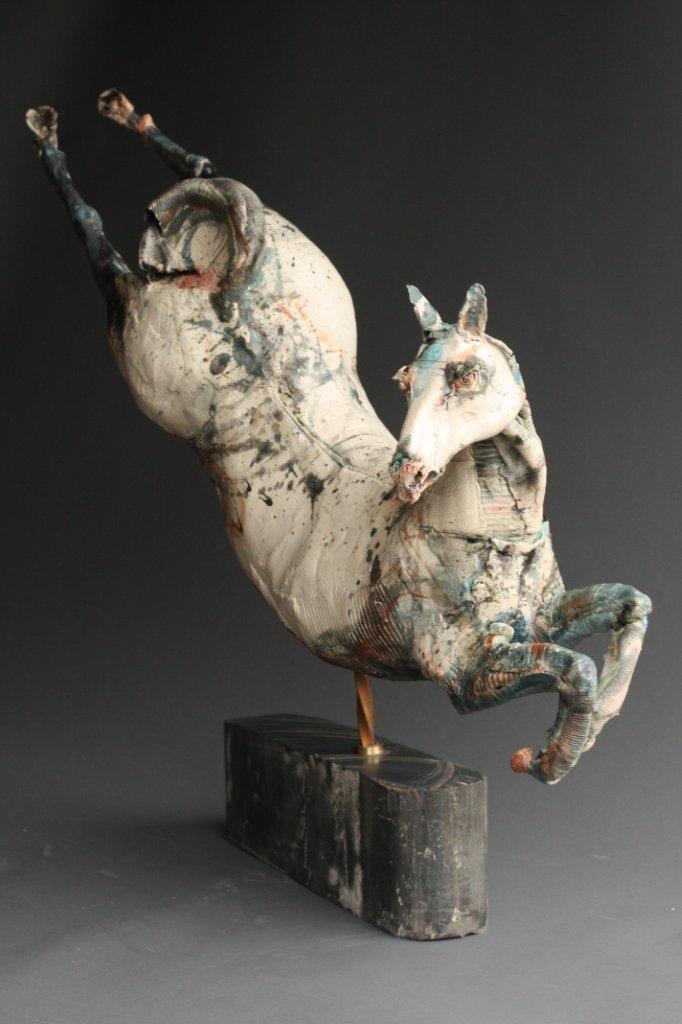
Ostinelli & Priest
This has to be one of the most interesting and fun outdoor art exhibitions we have visited. There is always a really friendly atmosphere – all the potters and ceramicists are very approachable and interested to talk to visitors.
Details for the 2013 show are on http://www.artinclay.co.uk/
The range and diversity of the work of British potters is well known and this show always has lots to admire and be attracted to. Some work is just so out of the box it’s a joy to behold!
Children are of course very welcome, there is plenty of space for them to run around and enjoy themselves and the opportunity to make clay pots.

- A young boy tries his hand at making a pot on the wheel
We put together a slideshow of the 2008 show – if you would like to have a look click here.
The 2011 exhibition underlined The Japanese Earthquake which had a disastrous effect on the world famous pottery town in Japan called Mashiko. The town had over 400 pottery workshops many of which have collapsed together with kilns, houses and the town’s museums. Bernard Leach met Shoji Hamada when he was studying pottery in Japan and became lifelong friends. They helped each other with the development of their potteries.
Catherine Thom, daughter of a Northern Ireland potter whose work was strongly influenced by Bernard Leach and Japanese pottery, is an international classical guitarist, and recorded a cd to raise funds for the Japanese Disaster Fund. Catherine gave three concerts on each of the three days of the Art in Clay exhibition – all non-ticket donation events.
Art in Clay is a great event for pottery lovers and the organisers are offering Two for the Price of One entry fee on all three days of the show.
For even more information and regular up-dates see the News page.
Val Reynolds, Editor
…………………………………………………………………………………………………………………..
Authorised by Andy McInnes, Exhibition Organiser
Henry Moore Exhibition 2011

Moore's signature on sculpture plinth
Henry Moore at Hatfield and at Home
Could Moore be compared to Marmite? His work is so huge, so enigmatic, so smooth, so in your face, that many find it too much. Others love just those features. It seems you either love it or hate it. That was the concensus when I did a quick verbal survey before a visit to the Moore at Hatfield open air exhibition that has attracted thousands of visitors this summer.
Some of the questions I asked:
Are you familiar with Moore’s work – About 70% had seen at least one sculpture, many abroad
How would you describe his work – Chunky, smooth, fun, weird, creepy, ugly
Do you know how he made some of the work – Most didn’t but were interested to hear about Perry Green where you can join in free workshops for children, young people, adults and families.

Hill Arches, 1973 Bronze Length 550 cm
When I visited the exhibition I asked several visitors Is there any one piece you like best of all? My favourite answer was the child who said she loved Hill Arches because it was smooth and she liked lying on it, not something encouraged by the exhibition organisers, but inevitable I guess!
A reclining Toltec–Maya figure was the original influence on Moore’s sculpture – Chac Mool stone statue at Chichen Itza site, Yucatan Peninsula, Mexico which you can see in his very early work.
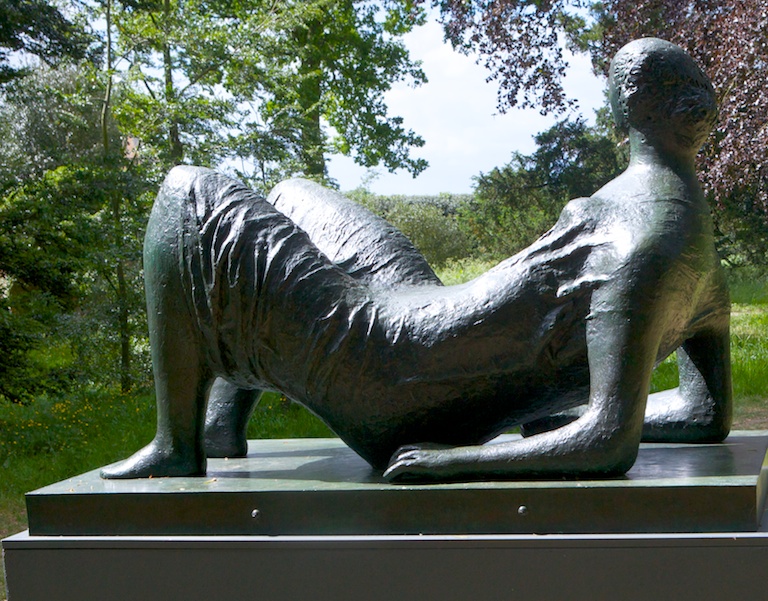
Draped Reclining Figure 1952-3 Bronze Height 157.5 cm
The Hatfield setting is big enough to take fifteen massive pieces. Every piece has at least one seat to sit and contemplate the work, just as Moore always wanted.
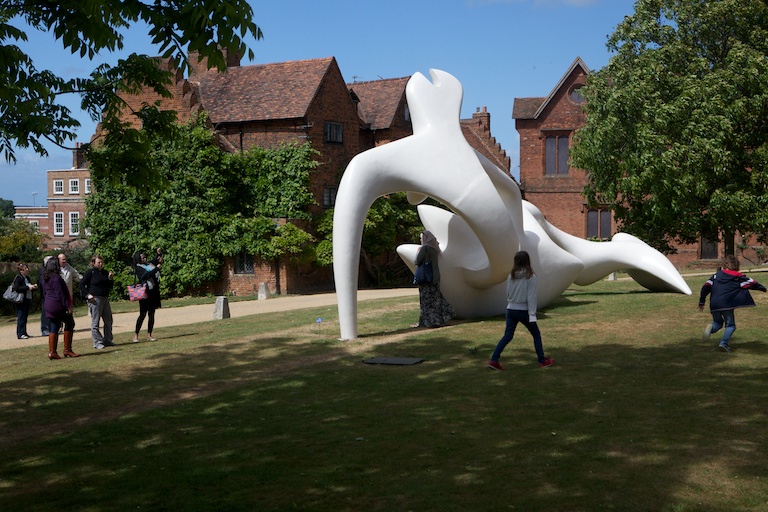
Large Reclining Figure, 1984 Fibreglass Length 900 cm
The huge historic buildings at Hatfield are certainly big enough to contain the work rather than be overwhelmed.
He was especially pleased with the siting of the Two-Piece Knife Edge next to the House of Lords, placed right next to a path and seats.
He was once asked by his niece why his works had such simple titles and he replied: All art should have a certain mystery and should make demands on the spectator. Giving a sculpture or a drawing too explicit a title takes away part of that mystery so that the spectator moves on to the next object, making no effort to ponder the meaning of what he has just seen. Everyone thinks that he or she looks but they don’t really, you know.
There is an excellent Wiki page about Moore that includes many well known pieces. One photograph shows the panorama created in the Ontario Museum.

Locking Piece, 1963-4 Bronze Height 290 cm
A visiting teacher from Vancouver said it was not possible to take photographs or touch the exhibits in Ontario and was delighted to be able to have the opportunity to get a real feel for Moore’s work at Hatfield and excited about visiting the Perry Green permanent exhibition.
Although interest in Moore has diminished since his death, Perry Green, his home in Hertfordshire, has a popular outdoor exhibition with 25 outdoor works on display. When I visited everyone seemed to be loving the whole experience, I certainly smiled at some of the pieces. The children especially liked some hollow copper pieces that made satisfying noises and big enough to play hide and seek in.
This hugely successful sculptor – he was paying million in tax in 1970s – left a legacy that continues to delight and intrigue.
One suggestion I have is to make available for sale small reproductions – to scale – I would love a collection of miniatures to handle, admire and contemplate.
Moore at Hatfield is open until 30 September – ideal for picnics and lots of room for children to run and play in!
Hatfield House is just 20 miles from central London and only 16 miles from Moore’s former home at Perry Green, Herts – The Henry Moore Foundation.
Moore at Perry Green visitor season runs from 1 April 2011 – 30 October 2011. It has a newly-refurbished pub dining room, The Hoops Inn, and a new exhibition in its gallery, Henry Moore Plasters. There are 70 acres of outdoor sculpture as well as the artist’s house and studios, carefully restored.
Val Reynolds Brown, Editor
Chelsea Flower Show 2011

Sculpture of Chelsea Pensioner a welcome sight!
The Chelsea Flower Show is always an exciting and fascinating experience and now with the emphasis on environmental concern this year’s event will highlight the many ways we can take more care of and care for our gardens and open spaces, especially in view of the ongoing drought.
Some of the trends and concerns of the general public include moving to non-powered lawn mowers and planting specifically to encourage wildlife and there will be much to see and take inspiration from this year. Many garden designers have chosen the environment and the responsibility of garden owners to help protect our green spaces.
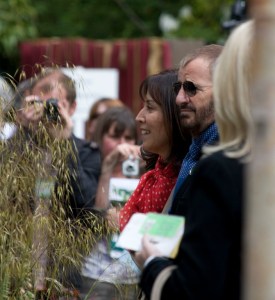
Ringo and his wife
Anyway, all being well I’ll be there on Press Day when I get to meet and interview some of the celebs who usually attend. Some are really approachable, Gloria Hunniford is always good for a quote, Ringo is usually so popular I don’t get to speak to him, Kim Wilde has always been helpful. Some are not friendly at all, surprisingly I’ve been given the brush off by Chris Tarrant and Martin Clunes. And yet one of the most friendly and surprisingly knowledgeable was David Spinks who played Keith Miller in East Enders.
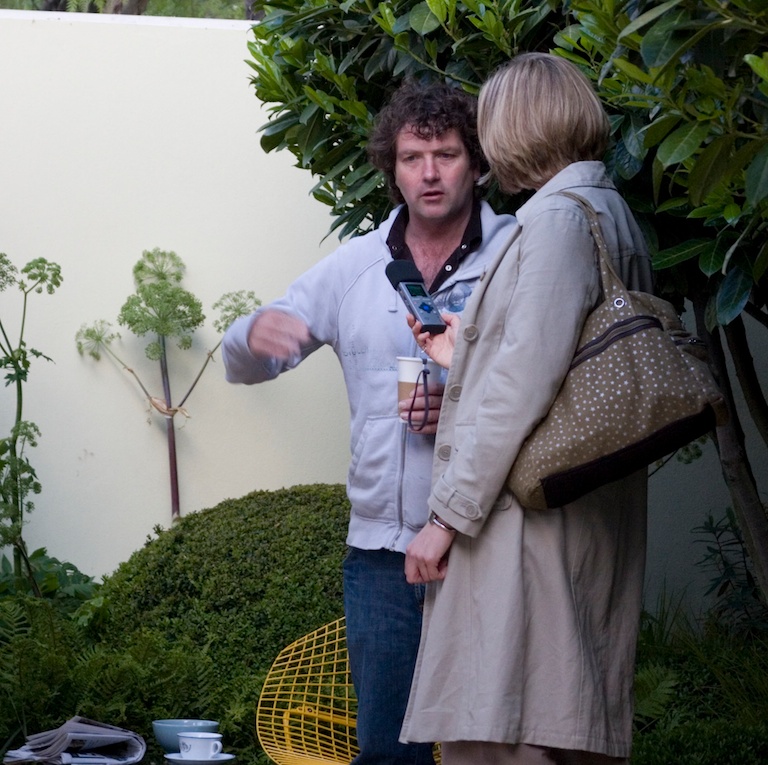
Dairmud Gavin is always friendly and willing to talk
Dairmuid Gavin is always willing to talk gardening and good for a laugh and joke.

Rachel de Thame
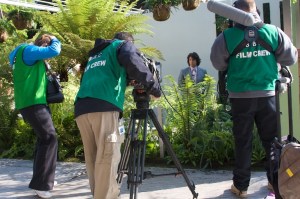
Filming Laurence Llewelyn-Bowen for the day's programme
The one celeb who is always aloof and not at all approachable is the great man himself Alan Titchmarsh, he has purposefully looked the other way whenever I have tried to take his photograph, not sure why, never been able to ask him! Maybe this year I’ll be luckier.
Press Day is a bit a slog really, we are admitted to the showground really early, it used to be 5 am, these days it’s a bit later. We have to leave by 3 pm when the Queen arrives for her personal visit, by which time I’m just about keeping upright … not the wine … just sheer exhaustion from being on my feet for ten hours without a break!
Many of you of course will be able to follow the show on BBC tv and will get a better view of many features than the visitors on foot! There is so much to see that I always seem to miss something really interesting – I get to catch up in tv programmes in the week. Even better, I’ll be able to go to BBC iPlayer for those programmes I missed, what joy! I never could fathom the CD and the DVD recorders, now I don’t have to worry, all can be viewed on my laptop, when I like and for free!
Val Reynolds Brown, Editor
By the way www.ourfrontgarden.com is the website we write about the ongoing renovation and care of a front garden in a garden city
 In Balance