
Indoor Plants – Pest Management & Pollution Control

Scented orchid
Indoor pest management includes a careful inspection before purchase and when bringing plants in from the garden. Meeting a plant’s environmental needs reduces plant stress and a healthy plant is less vulnerable to attack.
When pest control is necessary non-toxic or less toxic insecticides can offer effective control. Natural pyrethrum spray is relatively safe, synthetic pyrethrum is less desirable. A 0.2 per cent solution of mild washing-up liquid is generally an effective method of washing plant leaves. Cotton buds dipped in surgical spirit is a good way to remove spider mites, mealybugs, scale insects and aphids, although I found scale insects needed this treatment for far longer than I imagined. The only effective method I found was to lever them off with a flat ended knife.
Making your own non-toxic spray: Mix 2 teaspoons (10 ml) vegetable oil, 1/8 teaspoon (0.6 ml) washing-up liquid, 8 fl oz (230 ml) warm tap water is quite rewarding. Shake vigorously.
Not all my plants are strictly houseplants, I raise a lot of fuschias from cuttings. These are wholeheartedly targetted by whitefly so I have an ongoing fight! Now I keep them outside for the birds to take their share right up to the last possible day before frost might wipe them out.
My absolute favourite indoor plant book was written by Wolverton – Eco-Friendly House Plants: How to grow and nurture 50 houseplants to ensure you have clean, non-polluted air in your home and office. Wolverton undertook some pioneering research on clean air in space stations by the US Space Agency. You can read more about his work here.
Of the houseplants that fall into the category of eco friendly according to Wolverton a rubber plant is the most likely to be successful. Bred for toughness, it will survive in less light than most plants its size. It has a high resistance to insect infestation and is easy to grow and, very important, is especially effective at removing formaldehyde most often found in furnishings that take years to cease emitting fumes.

Weeping fig in conservatory
A ficus longifolio alii commonly known as the weeping fig, has proved to be exceptionally hardy in our conservatory. It is sited partially in the sitting room and has tolerated neglect over the past 15 years. Apparently it does like misting – now becoming a bit difficult in view of its size – almost 10 feet high. I spread polythene around and use the step ladder! It is good at removing a range of chemical vapours, is easy to grow and maintain.
Christmas and Easter cactus have the unusual property of removing carbon dioxide and releasing oxygen at night – the opposite of most plants – which makes them suitable for bedrooms. These plants often become quite large and survive for many years. Easy to propagate from cuttings and very resistant to insect infestation they make a great gift for friends.
 Source: Eco-Friendly House Plants by B C Wolverton How to grow and nurture 50 houseplants to ensure you have clean, non-polluted air in your home and office.
THIS IS THE ONE BOOK I WOULD NEVER EVER BE WITHOUT! and when my copy lent to a friend wasn’t returned I looked on Amazon and found a used copy at £2.01+£2.80 pp.
It has been recently updated as How Grow Fresh Air
Val Reynolds, Editor
Photography Pintail Photo
Attracting wild bees to your garden – Result!

Insect Hotel
I put the Neudorff Insect Hotel on 26 March and today, 29 March I saw a tiny bee crawling into one of the holes!
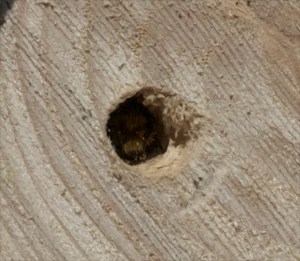
Bee crawling into hole
We have a welcome guest. How good is that! Little did I expect such a fast response.
You can read our article about attracting Mason and other bees here.
We have an Insect Hotel to give away – details on the same webpage.
Val Reynolds, Editor
Attract Wild Bees in your Garden with an Insect Hotel
It is time of year when I reinstall the bee nest boxes kept in our dry cool garage since last autumn, into the garden. I bought my nest kits some years ago from the Oxford Bee Company, which sadly is now defunct.

7 cm bee nest
The Oxford Bee nests I have are two sizes: 7 cm and 12 cm

12 cm bee nest
As the tubes the bees use to lay their eggs degrade over time and sometimes fall out and get wet, or birds pecking at the tubes make them fall out – some folk have trouble with woodpeckers – I had to search around for a website where I could get replacement tubes.
Red Mason bees use the tubes to lay their eggs and the most curious fact is that the first egg they lay emerges last? How can that be? Evolution I know – perhaps there’s some kind of chemical difference in the nectar moistened pollen used that delays development. Honey bees feed their queens 100% on what is known as royal jelly, a high protein secretion the worker bees produce from their heads, a somewhat less amount is fed to the drones, and even less to the workers.
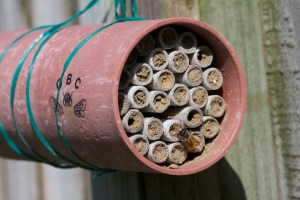
7 cm bee nest with red mason bee
This year I transferred most of the tubes from the smaller pipe to replace those gaps and degraded tubes in the larger pipe. So I decided to add some dried stalks of fennel and hollyhock that I left standing for insects to overwinter. Here is the result, a bit raggedy but useable. Another of my cunning plans – code for hopeful experiment! I use a pipe support for the pipes to rest on and then use wire to keep them in place.
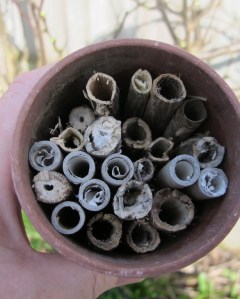
A mix of ready made tubes and dry plant stalks
When I need more I’ll make them from plastic water piping. One end would have to be blocked off to mimic the Oxford design.
In my search for replacement tubes I came across the Schwegler bee nesting box which has fascinating see-through tubes, the eggs and pollen can be clearly seen. And I found this really interesting website about bees – the drawings are delightful.
Here’s a link to info about Red Mason Bees http://www.hedging.co.uk/acatalog/Mason_Bee_FAQ.html
Here is a Google page with lots of references to Red Mason Bees.

Neudorff Insect Hotel
Our Neudorff Insect Hotel is now erected. We have placed it near the greengage tree and look forward to watching the insects inspecting it!
Helping insects find a safe haven in your garden for nesting and hibernation isn’t just good for the environment – it helps your garden, too. Ladybirds and lacewings munch greenfly and blackfly, while mason bees pollinate fruit blossoms as do lacewings.
Neudorff’s new insect hotel offers a stylish way of greening your garden. Designed to attract ladybirds, lacewings, mason bees, digger wasps, wild bees and hibernating butterflies like Peacocks, Brimstones, Small Tortoiseshells and Red Admirals, its wooden structure features different rooms to suit insects’ varying needs, such as hollowed out wood for mason bees and a central space for butterflies to seek shelter.
It’s also a great educational and instructive device that fascinates young children from age of three upwards. Great for school projects too!
For more information, visit the Neudorff site.
GIVEAWAY
UPDATE: We now have TWO Neudorff Insect Hotels to give away to In Balance readers. All you have to do to enter the draw is send an email to:
With Neudorff Insect Hotel in the Subject box and your contact details including telephone number in the text box
Only one entry per household will be accepted and must have a UK or Forces postal address.
Last date for entries has been extended to 10 June 2012.
Val Reynolds, Editor
My Gardening Gurus – Anna, Sepp and Phil

One of winter’s best features is having the excuse to sit down with a good book. And Anna Pavord, my favourite gardening guru, published Growing Food last year and it is always going to be on the bookshelf to dip into from time to time.
Anna describes different planting plans, one such is the Exuberant Potager, where she mixes flowering plants to complement the vegetables. Here she advocates areas with different plant mixes:
- nasturtiums, beans and squash
- lettuce, onions with eschscholtzia
- carrots, beetroot with marigolds, among others
In fact, a bit like my planting which is very mixed, but not so well thought out. I’m working on a plan to incorporate her ideas.
Other plans include a formal herb garden, a Mediterranean garden, a city larder for a small balcony, cottage garden, salad and herb plot, a vegetable patchwork, traditional kitchen garden, an alcholic hedge (!), and a formal fruit garden. All the plans illustrated with delightful drawings, much in the style of the Dorothy Hartley books of yesteryear. The plans are easily adapted to suitable most plots, with a bit of artistic licence. Anna is such a respected gardener, she has had a hellebore named after her, Anna’s Red.
The ‘cunning plan’ of last November was to clear all the plants from most of the beds in the back garden and cover with leaves and horse manure. The leaves to provide an airy protective covering and eventually be taken down into the earth by the worms, with the manure holding the leaves down so they don’t fly around the garden. This mulching also ensures the bluebells, that have grown in large patches and grow between and through plants, come through the leaves and can be seen and easily dug up. Well as I said, that was the plan and it has worked reasonably well, although I think some bluebells have been missed, again, so probably next year will see me digging more up. We replanted them on the periphery of the garden and down a grassy drive beside our house.
 Mulching is big in Sepp Holzer’s activities in his property in Austria. Famous for his permaculture philosophy and practices, Sepp is so down to earth and practical, it is a joy to read his book. There are web pages you can read and also videos. He writes about using pigs to clear ground before planting – so similar to Phil Drabble‘s experiences I read about many years ago.
 Both inspirational men. I would love to meet Sepp and talk gardens, sadly Phil died in 2007 at the age of 93.
Val Reynolds Brown, Editor
Revised Planting Plan for 2012 – In Praise of Plug Plants

Lady in Black - Double flowered fast climbing fuchsia
Isn’t it amazing how quickly sometimes plans have to be revised?
I’ve had to devise new plan where we will be using plug plants from established plant growers via the post for our front garden instead of growing from seed. Why plug plants? Four reasons: you know when they will be arriving, when you receive them they are well established, they take off like billyo and they have labels!
Why the new plan? With the prospect of our conservatory being turned upside down to store furniture from the sitting room and elsewhere in the house, because we are having some plasterwork and then redecoration done, I realised my seed planting plan was in peril because it’s in the conservatory where I grow all my plants from seed.
This is what is on order from: Thompson & Morgan
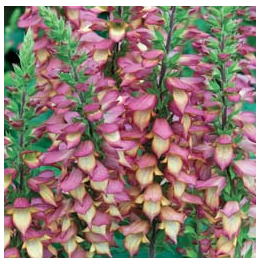
Foxglove Illumination Thompson & Morgan
- Tree lilies at the back against the wall – 6 bulbs
- Petunias Easy Wave – 36 plugs
- Fuchsia Lady in Black – 3 jumbo plugs
- Dahlia XXXL – 4 jumbo plugs – all different colours
- Foxglove Illumination – 3 jumbo plugs from the Titchmarsh Collection
 From Gardening Direct: Some beautiful scented begonias and some Monet coloured petunias for the hanging basket
From Crocus: some fabulous sweet peas
From Homebase: I’ll be getting some shamrock and some beautiful chocolate cosmos as recommended by Jo Swift.
In between these I’m going to fit in two tall supports for some sweet peas my sister will be growing for me in her greenhouse. And I’ll have to rearrange some of the existing plants, either moved into the back garden or given away.

Fabulous sweet peas from Crocus
In some ways being pushed into adapting to a new plan has been easier than planning from scratch. Having ultimate choice in daunting. All I have to do now is make sure the plants are sited so they don’t fight with each other over space nor clash in colour.
Other plug plants I’m expecting for the back garden include celery, onion, brussel sprouts, cabbage, sweet corn, beetroot – all except the onion will be grown under protective netting to keep the pigeons from guzzling the lot! The brussel sprouts I grew from seed last year have been very successful, we still have some to eat now in early February. The kale is still giving leaves to cook but the leeks are frozen solid in the ground.
So, onwards and upwards! Gardening is a joyful occupation that gives me so much pleasure and lots of challenges.
Val Reynolds, Editor
Garden – New Plants and Sundries for 2012
My favourite garden press event was held this month and try as I might I didn’t get to visit all the stands I wanted but the ones I did visit were very rewarding.
 My intention was to source plants for the front garden and give it a completely new look this year and I found some great new plants. Beautiful Monet coloured petunias for the hanging basket and scented begonias for the front of the bed from Gardening Direct, excitingly coloured sweet peas from Kings and from Thompson & Morgan for the Garden Maypoles I have been promised by Haxnicks. Jo Swift suggested white shamrock from Homebase and a wonderful chocolate cosmos that he has chosen for the Chelsea Flower Show garden he has designed for Homebase. I’ll definitely get that cosmos it’s the one plant I can’t resist – they will be available in store from March.
Although the front garden is only 26 ft x 12 ft I still felt the pressure of choosing plants in terms of height, spread and of course colour. So I was really pleased to find Plantify – an inspiring, free online garden design tool available to everyone that I will be using it to redesign the front garden.

Fairy Magnolia Blush
This year Crocus has some absolutely gorgeous new plants on offer – one in particular Fairy Magnolia Blush looks absolutely wonderful, as does the white with blue back anemone Wild Swan – if only I had a bigger garden! And the Forest Series of hepaticas look absolutely beautiful, hope I can fit some in.

Spencer sweet peas from Crocus
And just look at these sweet peas from Crocus – irresistible!
At the event I was given far more packets of seeds from Thompson & Morgan, Homebase and Kings than I could ever use so if you would like a packet or two just send a stamped addressed envelope to me. There is a range of flower and vegetable seed, if you would like one or the other, or both, just write veg and/or flower on the back of the envelope.
My grafted tomato plants grew so well last year only to be cut down in their prime by blight that I had moreorless given up on the idea of home grown tomatoes because once blight, a disease of the foliage and fruit causing rotting, is in the soil it is difficult to avoid further contamination.

Quadgrow Slim
Then I came across the Quadgrow Planter. It has four pots that sit in a reservoir of water, taking away the possibility of erratic watering. It’s possible to link it direct to a water source either mains water or a water butt. I plan on siting it on a path in a south facing part of the garden. I’m hoping that particular cunning plan will mean blight won’t get a look in with the plants getting a steady supply of water and nutrients.
I have been promised some grafted tomato plants that have two varieties on each plant! Sounds really exciting.
My Heath Robinson style protection for the brassicas worked really well last year, deterring the pigeons and cabbage white butterflies, even though the netting was not wide enough and I had to use additional netting. This year I’ll be trying out a crop cage from Greentree Products that should work much better. Easy to fix clips and netting ties sound very attractive. Greentree are also supplying a Grow Cloche to try with one of our metre square raised beds. We’re convinced this will be much better than the hoops and fleece we used last year that has gradually broken down since last autumn.
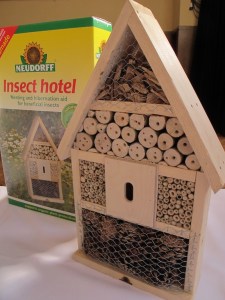
The Insect Hotel
Absolutely fascinated by insects, I was taken with the insect house from Neudorf, available on the web. One is on its way and I’m looking forward to observing what uses its 5 star bedrooms! The mason bees love a pipe filled with nesting tubes I’ve had for year and are fascinating to watch – see short video. I’m hoping for a wider range of insects this year that will give more photographic opportunities.
My gardening shoes have given me really good service for the last 17 years and I decided to replace them with a pair of Backdoor shoes. I chose ones with the bluebell print but as you will see on their website there are many other flower designs to choose from.
A range of gardening gloves were on offer and I thought it was time to replace a pair of Skoma gloves I’ve used continuously for the past three years and have seen better days. I liked them because they were flexible, wicked away perspiration, and gave me sensitivity, lacking in some gloves where you can’t feel anything. They survived frequent washing in the washing machine, but recently they have hardened a little and so I’ll be test driving three different levels of protection from Joe’s gloves – all rather brightly coloured – at least they won’t get lost in the compost bin. And a pair from Ethel Gloves, made from goatskin and bamboo, referred to as the little black dress of gardening! I have to admit they are rather stylish, I’m tempted to just use them for driving!
A rolling composter, one that be kept at ground level and pushed backwards and forwards to aerate your compost is by far the fastest way of creating compost – ready in six weeks! I’ll be trying out the Rollmix Composter and will write about how it works for us.
As you can imagine I had rather a lot to get home and was glad to reach my comfy chair by the fire, have a quick snooze and dream about the garden this year.
Val Reynolds, Editor
We love our woodburning stove

Woodburning stove
Having a wood burning stove has made the difference between a warmish room to a toasty one. We have been using oak offcuts from a local wood yard which are excellent, but as we get older we have begun to wonder whether we should install a gas fire – not less expensive but cleaner and immediate.
However, we heard of wood briquettes that are light to handle, come packaged ready to burn, sourced from virgin timber and have no additives of any kind included within the manufacturing process. All positive so far.
We tried them and they do light easily, are suitable for our multi fuel stove, open fireplaces and even log burners. They produce little ash, are low in moisture and give a very intense heat. Each briquette weighs about 1.6/7 kg. We were very impressed. We intend to stock up for next year just as soon as our woodstore becomes empty.
Have a look at their website for more interesting information and what other users have to say
We found this interesting rhyme that gives the burning characteristics of different firewoods:
Beechwood fires are bright and clear
If the logs are kept a year;
Chestnut only good, they say
If for long it’s laid away
Make a fire of Elder tree
Death within your house shall be
But Ash new or Ash old
Is fit for Queen with crown of gold
Birch and Fir logs burn too fast
Blaze up bright and do not last
It is by the Irish said
Hawthorn bakes the sweetest bread
Elmwood burns like churchyard mould –
E’en the very flames are cold
But Ash green or Ash brown
Is fit for Queen with golden crown
Poplar gives a bitter smoke
Fills your eyes and makes you choke
Apple wood will scent your room
With an incense-like perfume
Oaken logs, if dry and old
Keep away the winter’s cold
But Ash wet or Ash dry
A King shall warm his slippers by
Published in The Times, March 1929
Val Reynolds, Editor
Great Gifts – Garden Tools
Christmas is a good time to make reference to those gifts you would really like to receive! Here are some Fiskar gardening tools we have tried this year and recommend highly.
 Fiskars X17 Splitting/Felling Axe £59.99
600 mm long this is a beautifully made axe, well balanced, a nice weight and with a hand stop at the end – important for a good, accurate swing. The shaft itself has an anti-shock soft grip. The shaft is fibreglass with a good feel and easily cleaned. The blade is mortised into a tenon joint in the fibre glass shaft. The blade itself is double hardened and has an excellent safety cover with a carrying handle, or can be hung from a loop passed through to the eyelet at the end of the shaft. The fibreglass design eliminates the weakness of the older style hickory-shafted axes, where the blades becoming loose have the obvious danger of flying heads.
Fiskars X5 Trekking/Camping Axe £39.99
A light fibreglass shafted hand-axe, ideal for chopping firewood – wish I had the use of one of these when I was in the Scouts! It will do well for chopping brushwood in the garden too. Light, it is easily kept in the back pack. Comes with a neat safety cover and is easily hung up using the loophole at the end.

Fiskars Patio Broom £19.99
This broom head is absolutely excellent. The bristles are tough enough to get out weeds from between our paving slabs and does an excellent job when collecting leaves. With its QuikFit handle which you can use for other tools, it means less space is taken up in the shed and few handles to trip over! Be sure to choose the right length of handle/shaft £18.99 for you, there are several to choose from. It might be best to buy at a garden centre than on the web.

Fiskars Trowel £8.99
I was intrigued by the novel appearance of this trowel, and then sceptical. Familiar only with the metal variety, I felt sure that the lack of a metal cutting edge doomed it to failure, but I was pleasantly surprised. It performed very well in the extremely dry soil of my garden this summer, and has continued to be perfectly satisfactory so far this autumn, but due to the continuing lack of serious rainfall I haven’t been able to test it in genuinely wet, heavy soil.
Perversely, one of its good points is also a weakness. It weighs almost nothing, which has led me to forget its presence several times and throw it into the compost heap. I think it would benefit from being produced in a brighter colour as at the moment it’s only too easy to lose if it’s lying on the ground, or in a heap of weeds. (A red ribbon fed through the hanging hole would work (Ed)).
So, it’s Fiskars for us this year and for some of our friends in 2012!
Reviewed by John Reynolds, Katie Longland & Janet Hamer, contributing authors
Indoor Kitchen Waste Composter using Bokashi Bran

Bokashi bran
Who would have thought a handful of bran added to kitchen waste would provide a drain cleaning fluid/a high nutrient feed for plants – and a starter for some excellent compost.
Of course any old bran won’t have the same effect. It has to be Bokashi, a bran based material prepared with mixed culture of naturally occurring friendly micro-organisms. The waste then ferments, allowing it to be safely composted.
Wiggly Wigglers sells a bucket designed to work with the Bokashi bran. They will also regularly supply a 1 kg pack of bran that will last 3-4 months.

Bokashi bran multi order logo
We have tried this composting system and found it worked well, so much so we have bought another bucket to allow a couple of weeks for a full up bucket to mature while a second one starts to fill up.
The bucket is easy to lift and carry, we keep ours in a kitchen cupboard and once filled we take it in the garage for a couple of weeks to mature and then into the compost bins where it will decompose rapidly. Once the compost bins are full we will dig the Bokashi fermented waste into the garden where it would also decompose rapidly, releasing large quantities of soil boosting probiotic micro-organisms which nourish the soil naturally.

Bokashi bucket in our kitchen cupboard
Is it all good? Well, we did find assembling the tap device rather tricky but after a bit of a fiddle we managed it.
The tap could be longer so it could hang over a work surface to collect the fluid that builds up over time into a bigger container that the little cup provided. This fluid is the super stuff that can be used as a drain cleaner or more often used as a high nutrient plant food. In the summer we put oursinto one of the water butts where a leaky hose fed the front garden … It made an amazing difference.
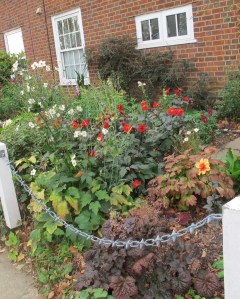
Our front garden plants loved the Bokashi fluid
We like the ease of use, the small space it takes up, having it in the kitchen where we can top it up without any bother and the absence of any smell and amazingly it takes everything bio-degradable including bones, meat, and fish skins!
Available direct from Wiggly Wigglers
Have you seen the Wiggly Wigglers Christmas catalogue? We love the apple corer and peeler – 15 seconds an apple! More …
Christmas Catalogue for Good Life Gifts

The Wiggly Team!
Wiggly Wigglers is a feel good story. Heather and Phillip Gorringe live and work at Lower Blakemere Farm in Herefordshire and while Phillip runs the farm Heather runs Wiggly Wigglers, the company that started off selling worms to compost food waste. They do live the good life, with cattle, pigs and hens, and they grow their own fruit and veg.
We bought one of the first Wiggly Wigglers composters years ago when Heather was at one of the RHS shows. We have three Wiggly Wiggler composters now, all different styles and they all work well.
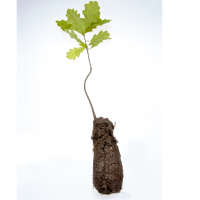
Oak sapling infused with truffle spores
Our favourite Christmas catalogue is the Wiggly Wigglers Christmas catalogue. It’s full of stuff we really want! From truffle spores infused in sapling oak trees – harvest your truffles in 5-7 years’ time, to spore infused logs to harvest your own exotic mushrooms.
Then there is the apple peeler and corer – named on the recent Channel 4 programme Stephen Fry’s 100 Greatest Gadgets as one of the top gadgets of all time. We really must have one! Processing the apples is such a messy, sticky job, but this gadget promises to make it more fun next year. Click here to see it in action.

Apple corer and peeler
There’s loads of other stuff, bird food, bird feeders, shelters – the catalogue is available by post – phone 01981 500391. However if you are cutting it a bit fine go to their website where everything is available. Remember though that date for last orders is Wednesday 21 December.
Happy Christmas!
Val Reynolds Brown, Editor
 In Balance