
Gorgeous, meaty, tasty … Cornish Pasty
Gorgeous, meaty, tasty, great pastry, a good mouthful … just some of the remarks made when we tried the Ginsters Original Cornish Pasty, no, not the chefs! – you’ll see them later!

Ginsters Cornish Pasty
Considering the recipe hasn’t changed since Ginsters set up business in 1968, the remarks are testament to its pedigree!
All ingredients used are sourced locally to ensure they are the freshest possible and Cornish. This includes the meat, the cheese, double cream and vegetables.
So, what did we try and what did we think?
We tried the Chicken and Mushroom Slice: Mm, delicious, great pastry, distinctive sauce. One of us would have liked more meat. One mum said it would be a good standby in the freezer when having a hard day and not wanting to produce something substantial for the family. We had a carrot and celery salad to go with it on a hot day, and spinach and broccoli on a cool day. We heated the slices up on both occasions. Overall the women preferred this product.
Steak Slice: Popular with the men, we thought it was a good snack. Heated up it would be a good meal with vegetables. It was very meaty and well seasoned.
Cornish Pasty: This authentic recipe went down well with the men who like a satisfying filling product. Good pastry texture, could really taste the meat, good pub grub! Great heated up and makes a good meal with vegs.
Eaten hot or cold our findings were positive enough for us to be sure to look for them on our next trip to the supermarket. They are good for on the go, to take on picnics and a great fall back if we don’t have much time to cook. In fact, the freezability of all the products made them very desirable indeed, and with the reassurance of quality ingredients they are a knockout!
We’ll be keeping a look out for other Ginsters products especially the new Cornish Bara, 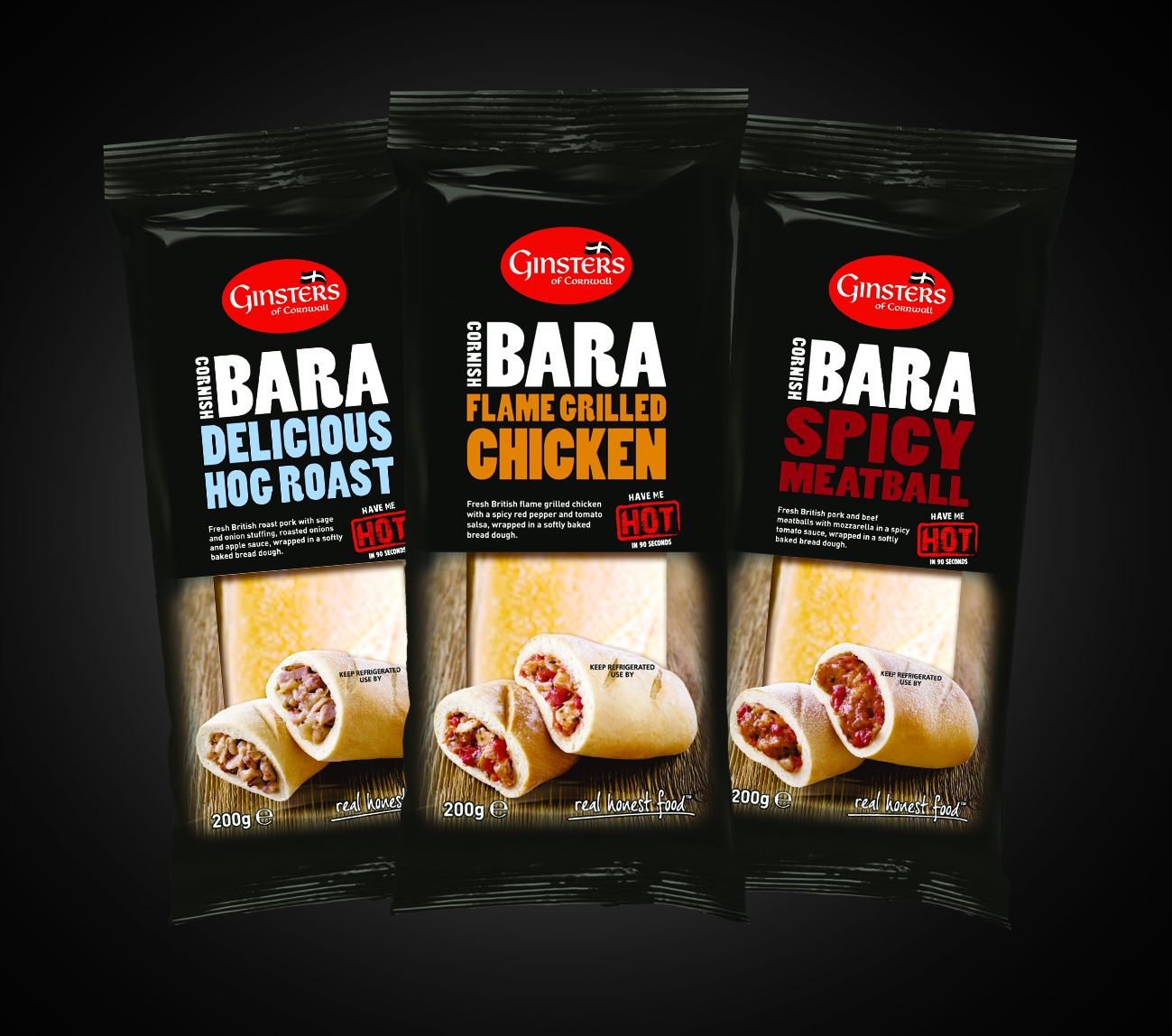 a new creation of the creative chefs at Ginsters.
A cross between a sandwich and a pasty, they are designed to be ideal for eating on the go, without any mess. Can see the kids liking these!

Toby, Graham, Stefan
More information on www.ginsters.co.uk.
Easy Potato Growing – A Delicious Treat
What a waste it felt to put the plastic bags used for the potting compost we had bought
in the dustbin, correction – plastic recycling bin. This year we are growing potatoes re-using those plastic compost bags – an idea we picked up from one of Monty Don’s Gardener’s World videos on the BBC website.
We have been keeping the bags back as they are heavy duty plastic – each bag only needs three potatoes to grow a crop – and the results are so delicious and so economical. We turn the bags inside out so they are less obtrusive and they are behind an open fence as they are not the most beautiful sight to behold. 
Here’s the latest bag we have used that contained peat-free compost. We have added some polystyrene pieces that seem to give plants added vigour. Not sure why, but it is true.
Another suggestion is to use several rubbish or gardening sacks one inside the other, more than one to get extra strength, a bit like carrying wine bottles using more than one plastic carry bags.
We’ll be experimenting with hessian sacks to see what we can grow – we got this idea from the charity Send A Cow who promote bag gardens – see the video.
Do you have an economical tip to pass on?
Val Reynolds Brown, editor
By the way www.ourfrontgarden.com is the website we write about the ongoing renovation and care of a front garden in a garden city
SOS – Save your Plants
A simple, inexpensive and no fuss solution in drought conditions
Supa Drippa taps are all that they say on the packaging!
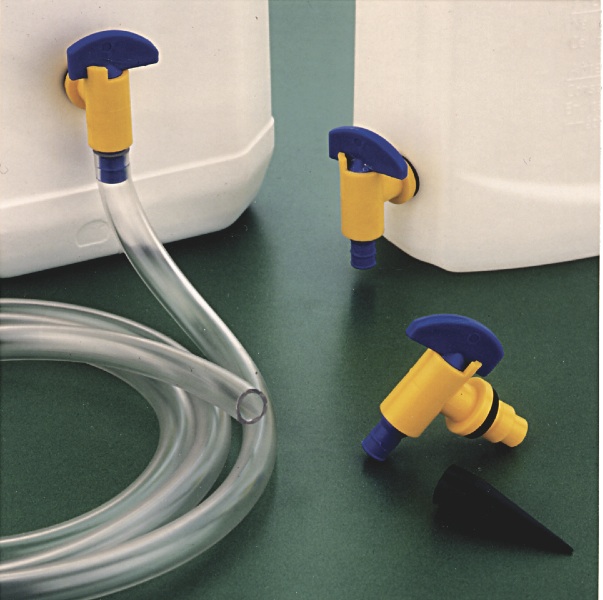 In unremitting hot weather some vulnerable plants, especially newly planted fruit trees, have needed constant attention and using discarded plastic milk bottles as water containers with a little plastic tap slowly watering plants has made a critical difference.
I’m not a huge fan of plastic milk bottles sited all over the garden but they will stay there until the weather turns to rain.
I did find the instructions a little short on detail, but got there in the end.
I had ten drippers and quickly realised why the diagram showed the bottle filled with water. Yes it means you get a bit wet when the spiker gets through the plastic, but the water gives the container much needed volume to take the pressure when piercing the plastic. The spiker gets pushed into the container and that’s when you insert the little tap.
I would like the tap to have some indication of which is the continuous flow and which is the slowest. In fact On and Off, or + and – signs would have been very helpful. As it was, I had to experiment and again got rather wet.
To relieve the pressure in the container the lid has to be left off. If you are concerned about mosquito invasion drill a couple of small holes in the lid and replace.
I found when planting out it was useful to be able to put the taps on continuous flow right next to the stems to get the plants well watered, then refilled them in situ and put the tap on very slow drip. Each plant got two litres of water, enough to carry them through for at least five days.
In the case of seedling courgettes and tomatoes the system was invaluable. It made the difference between wilting and continued growth. I also added water with fertiliser direct to the bottle when topping up. Again this is very useful for tomatoes that like lots of nutrition.
You can buy tubing to go with the Supa Drippas, useful when you want to water patio pots. I also had the idea to have a sufficiently long tube to snake round my six precious outdoor tomato plants and punch a hole where the tube meets the plant. That way I would use only one container – would have to be a two litre container, and one tap. This is an experiment in the making! I’ll try it and write about my experience.
ARE SUPA DRIPPAS WORTH THE MONEY?
Ours came from the Organic Gardening Catalogue who charge £11.95 + £1pp. At roughly a pound a tap the answer has to be yes as they are virtually indestructible and I’ll be able to use them for years. I loved the idea of reusing those plastic milk cartons too. Once I have enough 2 litre milk containers I’ll replace the 1 litre containers so when we are away for more than a few days I’ll be less reliant on the goodwill of friends and neighbours to make sure plants don’t suffer from any unexpected drought.
I have been considering using the water butts with a solar powered pump to water when we are away. The cost is fairly high and involves laying out piping with dripper attachments. Although less conspicuous than milk containers, at the moment I’m more worried about losing plants and these Supa Drippas have taken away a lot of that anxiety.
ARE THEY WORTH THE EFFORT? A resounding Yes!
1. They have made the difference between using a hose and all the economic factors that implies.
2. You can add nutrient to the water, a simple, time efficient way of adding feed direct to plants that need it. So easy to keep the water in the watering can topped up.
3. Once a plant looks like it has had enough water for a while I have moved the containers to other plants. I can see I really need about 30 containers altogether which will be a really good investment
4. The containers can be easily stored ready for reuse for the next drought.
When I put some young gerbera plants in the front garden each with its own watering container for a day they intrigued some passersby and I made some more gardening friends!
So you need more reasons to get some? OK! they are made in the UK!
We have THREE PACKS to give away. Just send an email to editorinbalance@me.com with Supa Drippa in the subject box and your contact details in the text box. Closing date 12 June 2011 – one entry per household.
Val Reynolds Brown, Editor
Sowing Tips from Experts
It’s always good coming across a commonsense, straightforward account of how to do something and here are some of the books I refer to frequently for help when getting seeds and equipment together:
 Anna Pavord – Growing Food: Eminently readable, easy to digest, beautifully illustrated with line drawings, much in the style of Dorothy Hartley. Anna gives details on a raft of planting plans. One plan I was attracted to was the Potager’s Garden where she advocates some lovely combinations of flowers and vegetables. Much in the way I grow our vegetables and fruit in fact, but she gave me some ideas of companion planting I haven’t used before.
Raymond Poincelot wrote Organic No-Dig, No-weed Gardening which I read cover to cover when I came across it some years ago. It is full of great ideas, clear instructions, and gives a clear understanding of his concept.
 Allotment Gardening: An Organic Guide for Beginners by Susan Berger is another book I have by my bedside and is regularly referred to.
 Geoff Hamilton‘s Gardeners World … is a bible I refer to frequently. He was my kind of gardener, self reliant and imaginative when looking for solutions, without going too mad on devices, but using commonsense … He gives very useful and clear instructions on how to construct inexpensive cloches.
 And then I love reading Carol Klein’s Growing your own Garden. Bliss! I can hear her voice with the enthusiasm oozing out on every page! I have met her and she is just the same in real life. A great lady!
 Trawling the Net I came across Madeleine Giddens’ website where she has put a clear and concise guide to sowing herb seeds. She gives useful links to seed suppliers and books to follow up.
I hope you find these helpful – if nothing else it is a booklist for winter reading!
Val Reynolds Brown, Editor
Forced Rhubarb – First fruit of the year
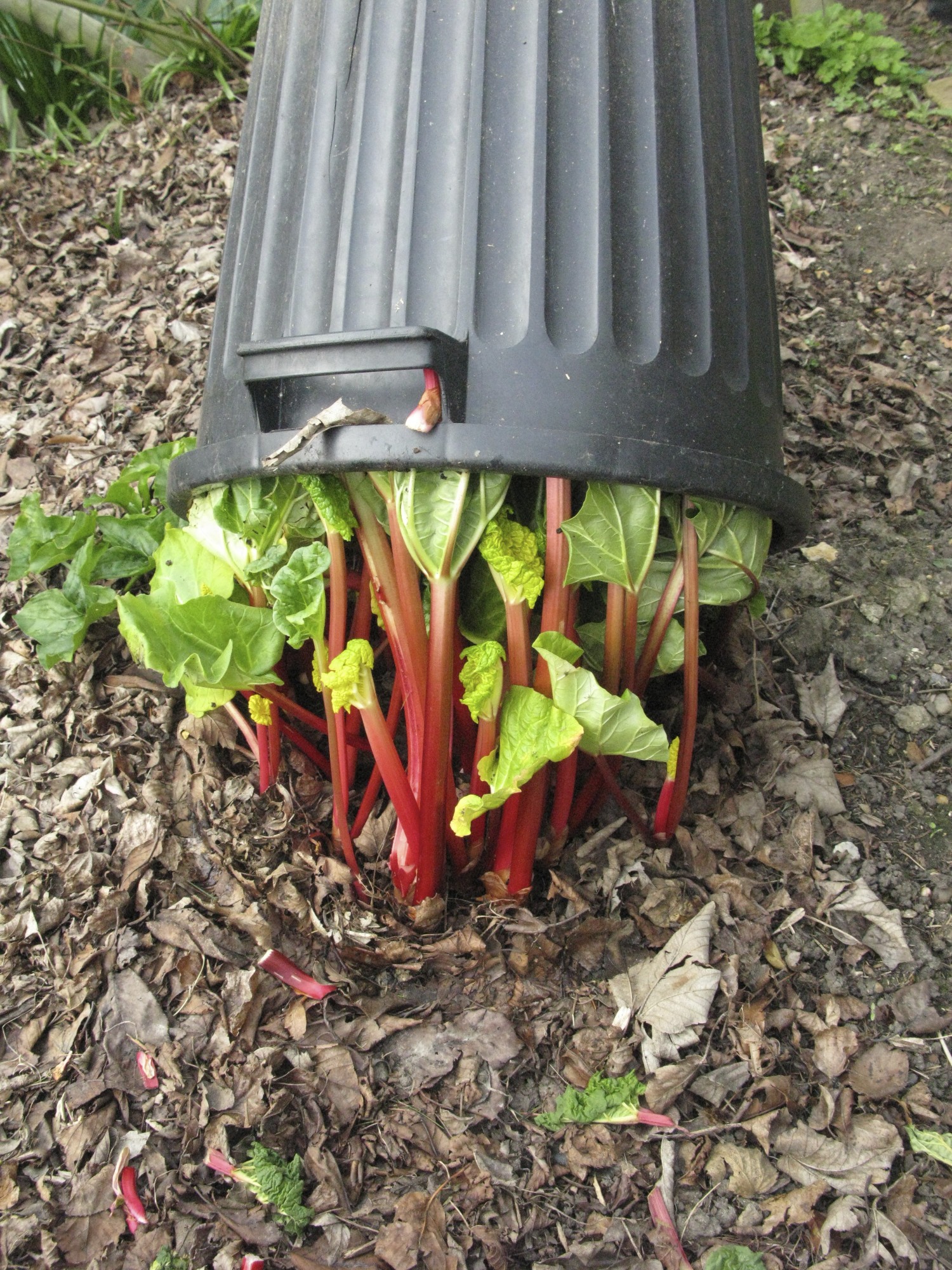
Forced rhubarb ready to cut
It’s so unbelievably easy to get juicy, sweet rhubarb so early in the year. And yet we do it, every year. We just place an old plastic dustbin over the new shoots when they appear in early spring and a few weeks later hey presto there’s rhubarb to pick.
We generally get too much at a time so it is cooked with a little sugar and stored in the freezer ready for later use. Great with yogurt, on cereal, with ice cream. We made some delicious wine one year, it was a beautiful pink colour. We do bottle some, best for us in the smaller jars, a whole kilo jar tends to languish in the fridge for far too long. Anyway as it has a high oxalic acid content it’s best not to eat rhubarb for extended periods. Once a week is probably wiser. We generally go for crumble or pies, with a generous amount of ground ginger to give it that little extra zing.
We have no idea which variety of rhubarb we have, we think it’s been in this garden since the 1930s. But good plants can be purchased from Thompson & Morgan, here is a link to their comprehensive rhubarb catalogue page.
Val Reynolds Brown, Editor
Plants Galore!

Lemon Basil
Some years ago I came across a packet of Lemon Basil seeds from Thompson and Morgan – my favourite seed supplier since 1970! – that I have to confess had been ‘loitering’ in my seed box for some time, four years in fact! As I had a bit of space in my tiny greenhouse, I thought I would see if they germinated, expecting a few to come up which would be very useful for salads. To my great surprise the whole seed tray bounced into life and I had so much basil I had to give much of it away! Recipes and more information is here.
With that experience in mind I decided to go through the T&M catalogue looking for herbs that I could grow to add to salads, even if they didn’t grow to full size they would add a variety of flavours. Most herbs are available at very reasonable prices and with germination rates generally pretty high it’s a win win situation!
Most recently I have successfuly sown

Basil
Outdoor Basil This gave an excellent germination and again found I had so much I had to give many plants away. I kept some indoors and others in the kitchen garden. I love picking a leaf or two and eating it when I’m wandering around looking for weeds to pull up.
Borage, the young leaves have a cucumber taste and widely used in salads and the bright blue flowers look wonderful in drinks, or salads. At the end of the season the plant can be added to your compost. It does get a bit untidy but I can forgive that characteristic as it attracts so many bees and other insects, it is a joy to see it thriving.
Coriander This can be sown direct in the ground. However it is useful to sow some in pots to keep indoors for year round fresh leaves to add to salads, salsas and Asian cuisine. Another flavour indispensable TO the adventurous cook.

Chervil
Chervil Used in French cooking to flavour fish dishes, sauces and soups, is a familiar taste of France. Can be grown in pot on the windowsill for all year fresh leaves.
Summer Savory this comes highly recommended from Bob Flowerdew who waxes lyrical about its effect on broad beans! Try it chopped and mixed with melted butter. Thompson & Morgan suggest adding it to breadcrumbs to coat fish, added to soups and stew – said to be magnificent!
Endive not often found on sale here in the UK, is easy to grow from seed. Easy too to grow it as salad leaves.
Other seeds I have successfully grown for the kitchen garden this year are globe artichokes, beetroot, parsnips, carrots, lettuce, sugar snaps, french beans, courgettes, leeks, pumpkin, outdoor melons – the jury is out on these they are not growing very quickly and I wonder whether they will flower and produce mature fruit, they are protected by a cloche to keep the heat in and the wind out.
I have grown many plants to attract insects. French marigolds, calendula, I have allowed the parsley to go to seed for insects to feed on, poached egg plant, nigella, and alfalfa to dig in as a green manure. Red clover has been sown for the same reason.
I have also used odd spaces to grow flowering plants for the main garden, for instance escholtzia, chrysanthemum daisies, scabious, sweet peas and I have experimented with unusual plants, for instance cucumelon.
It will be some weeks before I know which plants are worth keeping and which seeds are worth sowing next year. As always the gardener in me is constantly adding, subtracting and repeating plants, always aiming at perfection. Ever hopeful!
Val Reynolds, Editor In Balance Magazine
 In Balance