
Tutus in your Garden – Miss Huish – A Beautiful Aquilegia

Miss M I Huish, aquilegia vulgaris
Miss M I Huish, Aquilegia vulgaris, has a deep crimson flower like a Ballerina’s tutu. Perennials, aquilegias grow up to 2 feet tall and mix well with lighter foliage plants.
I found seed germinated well in May. Planted in the front and back garden around August 2011 about 2 feet apart, they are now flowering in May 2012 and expected to continue on until early June. Apparently they don’t last long as cut flowers, only 3-4 days, but they are very pretty so I’ll probably pick a few short stalks for a small table decoration.

Green Apples, aquilegia vulgaris
I sowed seed of Green Apples, Aquilegia vulgaris, at the same time as Miss Huish which had a lower germination rate. They flower initially as white blossoms gradually turning to green.
Both these aquilegia resemble a double clematis but of course nowhere as large a flower. Aquilegias do well in full sun or partial shade, being a meadow and woodland plant. They will seed freely so I’m looking forward to them migrating all over the garden.
Thompson & Morgan offer a dual pack of seeds for £3.49, 70 seeds in total, or separate packs Green Apples £2.99 for 20 seeds, and Miss M I Huish 50 seeds for £1.99.
Val Reynolds, Editor
Link to our front garden website
A Decent Read – suggestions for a quiet break
How often are you at a loss to know where to find a good book. What is a good book? To me it’s one I can lose myself in. All the angst of the day goes to the back of my mind. So a book at bedtime is a joy and pleasure. But I’m not prepared to read books that don’t satisfy my curiosity, don’t stimulate my interest, or from which I learn nothing new.
So we have decided to provide our assessment of books we have enjoyed, or not. Short, pithy asides and plaintive squeals of dismay are included, so you don’t have to waste time turning off at page ten. That’s the crunch time for us … unless page eleven beckons that tome is passed on to Oxfam, or some such charity shop where maybe someone will view our assessment with disdain and totally disagree with us!
Here are three books all read and finished and assessed by Les Tucker, our intrepid bookaholic.
A Small Circus Hans Fallada* One of the Penguin Classics ISBN 978-0-141-19655-8 *Other books by Fallada
 Do not read A Small Circus expecting a similar experience to the later Alone in Berlin. Fallada’s portrait of life in wartime Berlin is a universal tragedy which is impossible to ignore.
A Small Circus, published in 1931, is just that: a much more parochial examination of politics in a small town. It is a local eye’s view of the collapse of the Weimar Republic (Germany’s first democracy) leaving a situation ripe for the rise of National Socialism, and subsequently, the promotion of Hitler.
The book is not a dry history. It is full of sardonic humour, as pompous local officials tussle over bribes and ill-gotten gains. Outside the little town, the country is spinning off its axis, but a greedy bunch of politicians and journalists seem not to care.
The greater proportion of the novel is written in dialogue, so there is no authorial voice. In many ways, this worked to Fallada’s advantage, as his breakthrough novel received praise from both sides of the political spectrum. It appeared as if he was not taking sides, although a modern reader might beg to differ.
A Small Circus may not make you laugh very often, but it might have you nodding with agreement at the portrayal of human foibles and frailties.
Noughties Ben Masters Published by Penguin ISBN 978-0-241-14526-5
 Ben Masters’ novel is helpfully divided into three sections, entitled; “Bar”, “Club” and “Pub”. My advice to the reader would be to stay in the Bar !
Imagine a dodgy episode of Skins combined with a literary pub quiz and half an episode of Morse chucked in for good measure.
This is Oxford, but beyond the colleges, overheated young things are drinking themselves into oblivion, clumsily bonking each other, but then spoiling the whole experience by agonising about it!
Noughties is a Top Trumps pack of literary references and allusions. Forget about the narrative, just play spot the disguised quotation. The protagonist, Eliot Lamb (get it?) is trying to resolve the dilemma of his love life. As his journey to the light includes such evocative meetings with the opposite sex as, “She places her warm breath inside mine..” one can only hope it is achieved speedily.
There are lots of topical music references and characters spend an inordinate amount of time texting. You don’t need to join Eliot Lamb in his final days at Oxford to enjoy the richness of that experience ! Try the Open University.
The Pale King David Foster Wallace Penguin ISBN 978-0-141-04673
 Did you ever read the one about the American Internal Revenue Regional Examinations Centre ? No … and I wonder how many people will actually finish The Pale King. The author didn’t, as he died in 2008 before it was completed. This edition has been assembled and published by his editor, Michael Pietsch.
Try this chapter opening :
“Until mid-1987, the IRS’s attempts at achieving an integrated data system were plagued with systemic bugs and problems, many of these exacerbated by Technical Branch’s attempts to economise by updating older Fornix keypunch and card-sorter equipment to handle ninety-six column Powers cards instead of the original eighty-column Holleriths.” Come on … keep up !
Wallace is feted as a truly great writer, especially in his love for precision and meaning. This unfinished work is about boredom and sadness, but as it stands it is too great a challenge to the reader. The tedium of the daily tasks of the IRS is plain enough. It is detailed in well over 500 pages. There are jokes, lots of jokes, strange observations, descriptions, and even characters, but this is still a novel about tediousness, and it is act of daring to leave the reader to extract from it the individual stories within. For many, the doors of the tax return processing centre will remain closed. For the legions of Wallace’s admirers, this unfinished work may well achieve the status of an icon. If you enjoy James Joyce, you’ll love this. If not, then tax avoidance may be the answer.
Creating a Wildlife Friendly Garden

Frog tadpoles
As a child I was fascinated by things that moved which included frogs and newts, to dragonflies, to ants and slugs, bees and butterflies. At one stage my sister aged four and I, a couple of years older, put together an outdoor ‘museum’ with our exhibits in boxes to show our parents. Our ‘cunning plan’ to bump up our pocket money was to charge them a penny each for admission – it worked!
Then birds entered my world and both interests have continued throughout my life.
One year I wanted to photograph birds in the garden and did a bit of research to find out how it had been done by others. We visited the RSPB headquarters and watched the great tits, blue tits, finches and great spotted woodpeckers feed on the nut and seed containers. Incredibly I saw a sparrowhawk take a great tit feeding on the nuts. Unlucky for the great tit of course, but the speed of the sparrowhawk was breathtaking. I was stunned, hardly able to believe what I had seen. I can still picture the body of the great tit hanging from the claws of the sparrowhawk.

Waiting a turn
The first step to set up a photographic area was to establish a feeding station. Regular feeding will attract the birds from the local area and as they come to rely on them it is important to keep the supply going throughout the winter. We use a squirrel proof seed container with the RSPB no mess mixture. That sounds a bit ‘neat and tidy’ but switching from the usual mixture saved having to frequently clean up the empty husks of the sunflowers all over the patio. Photographing birds on the feeder is ok and can show how attractive tits find the nuts and seeds.
However Kevin Keatley, a wildlife photographer advocates screwing a clamp to a pole just below the feeder. The birds land on it just before they go on to the feeder. Adding a sprig of autumn berries, or spring blossom makes for a more natural shot. Kevin uses a hide and a feeder about three to four metres away. The advantage of using a hide is that you can move it with the changing light. If you keep the sun to one side it gives a bit more depth to your photos. The ideal light is around midmorning or midafternoon. He has used the hide in heavy snow, the snow or frost covered hide is just like an igloo, insulating him from the freezing wind. There was a time when his wellies froze to the ground – but he says it was worth it when the slides came back with fantastic close ups of pheasants in the snow. Kevin has a website where you can see the hide and chair he uses. His site is well worth a visit, it is full of fascinating information and likely to stimulate some unexpected wandering on the web – have a look at his links.
Our feeders were hung from the pergola, about ten feet from the conservatory windows. I fixed a bed sheet across the open window and down to the ground, cut a slit in the sheet and poked the camera lens through. The camera was mounted on a tripod. I was happy with the bird shots I was getting and then one day a woodpecker came to the peanuts and I had to think about how to have it feeding away from the peanut container which didn’t look very natural. So I asked a friend to let me have a fallen branch from one of his trees.

Male great spotted woodpecker
We drilled big holes to hold the unshelled hazel nuts and almond nuts and placed the branch between two posts of the pergola. The nuts started to disappear although we didn’t get a glimpse of a woodpecker. Then one morning we did – it was very excited, making that distinctive, sharp ‘pic’ call. From then on we were adding nuts every three or four hours. Then may be two weeks later, two fledged young ones visited with their father. You can imagine how excited we were at the prospect of photographing them. That was easier said than done. As there was no regularity to the visits, the window was nearly always shut at the most exciting times!
I took some pictures through the double glazed window of the parent feeding the young but they were not sharp. Eventually only one young one came with its parent, and it took to hanging around the garden waiting for its parent, making desultory attempts at breaking open the nuts.

Young great spotted woodpecker
Once it found how to successfully eat the peanuts it lost interest in the hazelnuts. Then we witnessed the inevitable, the parent actually attacked the young one quite fiercely in response to its crying for food and we never saw them together again. They visit separately now. We expect them to continue to visit in the colder months and will have a big stock of nuts waiting for them! Strangely we haven’t had any problem with squirrels taking the hazelnuts. We did have problems with the peanuts until we bought the strong wire version that can’t be unhooked.
So progress? We are going to drill out bigger holes and put in walnuts – a tip from a very successful woodpecker attractor! We’re going to put a dead branch parallel to the ground about three feet up near to the feeders – I missed some really good shots of a great tit feeding its young – they were partially hidden by greenery on the cherry tree and I’m hoping with careful pruning and branch placement I’ll get the pictures I want!

Hoverflies eating pollen on a poppy
Other steps I have taken to make the garden friendly to both insects and birds are to flowering plants that attract insects. The poppies, all varieties, attract hoverflies in droves. The nettles – kept in a pot – have ladybird larvae all over the leaves that hoover up aphids on neighbouring plants at an enormous rate. I let most plants go to seed – the evening primrose was a huge success with goldfinches. I had problems with keeping the seed from setting the next year, but the hoe is a wonderful tool!

Tiny midges hovering over cabbage flowers
I let some cabbage go to seed and had clouds of tiny black insects hovering over them. An expert told us it was their mating pattern.
In the spring plum blossom attracted a range of bees, from solitaries that live for six weeks, to big queen bumbles. I’ve found foxgloves, onion flowers and blackberries attract the most bumblebees. I like lots of colour in the garden and through trial and error have marigolds, escholtzia, oregano, poppies, evening primrose, foxgloves, nasturtiums, nigella growing unchecked. I’m trying lots of others – herbs, beans, roses, clematis, vines and hops.

Song thrush bathing
The latest attraction is the bird bath perched on the patio wall. We’ve seen everything drinking and bathing there, from wrens to a pigeon that just flopped in and sloshed around to keep cool, and of course our woodpeckers.
What’s next? We’ll be putting up some nest boxes. It’s absolutely essential to have reliably waterproof and well designed boxes. The RSPB’s most popular boxes are for the tits and the open fronted box – suitable for robins, pied wagtails, and more excitingly, spotted flycatchers which are much more common than you might imagine.
The worst type of nest box lets in the rain – the young die from cold and damp, or the exit hole is too low and the young ones emerge underdeveloped and can‘t fly strongly. Result: they flop to the ground and are easy prey for jays, magpies, cats, rats. So if you are serious about making your own please, please, please get a copy of the British Trust for Ornithology booklet Nestboxes, written by Chris de Feu. It’s a gem, with designs for all kinds of birds including owls and house martins and a fascinating read.
For a month by month guide to attracting birds Stephen Moss has written The Bird-friendly Garden, published by Collins and gives lots of advice on how to make your garden a haven for birds. He gives advice on predators and pests, for instance for cats he recommends a machine that emits a high pitched whilst, inaudible to human ear but intolerable to cats. Gardens are the one place where we all can make a difference to wildlife … we felt enormously privileged to play a part in the upbringing of the two great spotted woodpeckers this year. We hope we’ll be doing the same next year.
Last year we attracted some bees to our bee nest box and are hoping for more this year. We brought the box indoors and kept it in a cool area of the house until early spring when the bees emerge. We bought our bee nest boxes from the now defunct Oxford Bee Company. Read our recent feature about the Neudorff Insect Hotel here. By the way we now have another Neudorff Insect Hotel to giveaway! All details on the feature.
Val Reynolds, Editor
Successful Watering with Seeper Hose System

Diverter on downpipe and hose to seeper at ground level
Last year I ran the bath water on the front garden via a hose connected to seeper hose but it took a long time for the water to filter through. So I finally got round to organising a watering system for the front and back garden using rain water from the roof and what a difference it has made. All my plants made much better growth than in any previous years.
I don’t have the patience to stand watering the garden with a hosepipe and have never had a spray system, if I had I’m sure I would have left it on by mistake and racked up a terrific water bill – we are on a meter, so a seeper hose system was the obvious answer. It was reassuring to read a typical drip irrigation system uses up to 92% less water than a hosepipe and is a far more efficient way of watering the garden – www.the-hta.org.uk/water.
The system I devised for the back garden, after a lot of head scratching and frustrated thought, was to put in place rain diverters on the downpipes from the roof, attach a hose to that which led to the seeper hose system. When that overflowed the rain was diverted back to the downpipe and on to another diverter that was connected to a water butt. When that overflowed the water then feed back into the downpipe to the main drainage system.
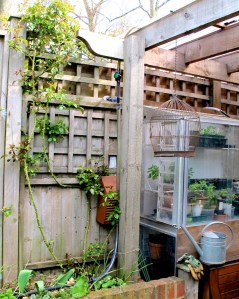
Hose over pergola and down wooden post to seeper hose at ground level - note control tap
The roof on a house collects about 85,000 litres of rain each year in the UK which runs straight into the sewers. This could fill 450 water butts which can be used to water garden lawns, vegetable patches and house plants.
Altogether I used 6 x 15 metres of hose and linked up some small supplementary hose to water the pots on the patio via a separate water butt which made a huge difference to those plants.
Then in times of drought the water butts are linked up to the seeper hose. I generally leave them on for about 4 hours when needed. Now you may feel this sounds all rather complicated and at the time I thought so too, but it in reality it works and is very simple in action. The key is to make sure the water flows in at a slightly greater height than the ground you are watering.
At the moment although there is a hosepipe ban, seeper hose systems are exempt where we are, so when the water butts are empty, I can link the outdoor tap to the seeper hose system and to the water butts. Check the website of the water company in your district to be sure.
Not all parts of the garden need to be watered, for instance the peripheral areas with the wild flowers – bluebells, muscari, oxalis – that look after themselves, so I inserted sections of ordinary hose to bypass those areas. It meant adding connectors which increased costs.
What is important to remember is to cover the hose with mulch or set it into the ground and cover with earth and then mulch – by far the most efficient arrangement, it keeps the moisture in the ground which evaporates very slowly.
Overall, when it rains the garden gets about third extra which is all stored under the mulch. Another important point is to water at night, again to reduce evaporation.
So what plants are important? Fruit trees, crops like peas, climbing beans and broad beans, broccoli, cabbages, spinach, carrots, beetroot, onions, tomatoes, salads, kale. All these came good last year even when we had extended periods of drought. This spring I have noticed the fruit trees all have much more blossom than in previous years.
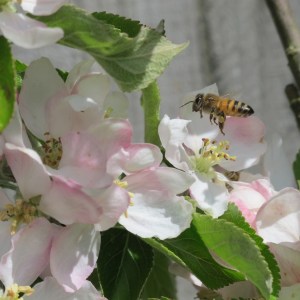
Honey bee collecting pollen on apple blossom
I have been really interested to see that plants grow slowly but steadily through the winter. I think it might be because the thick layer of mulch keeps the cold off the roots. I try, but seldom succeed, in putting at least a depth of 8-9 inches of mulch/compost/manure, which by spring time has been processed to some extent by the worms which means the ground is very easy to prepare for seedlings and plant plugs.
I sow annuals in with my vegetables to make it look less like an allotment. Nasturiums look really good, loving the extra moisture.
This year I have seeds of african marigold, red cornflowers, calendula, nigella and poppy to scatter through the garden. Attracting beneficial insects makes a difference to the life of the garden, they attract birds, making the garden more alive. Better than just putting out nut and seed feeders.
This year I interplanted self sown garlic plants found all over the garden with Malwinnie strawberries as they help the berries to fight disease. I had tasted these at the 2011 Thompson & Morgan Press Event and they were dribblingly good! Will have to think of some surefire way of keeping away the mice, birds and other creatures that know a good strawberry when they taste one!
Carrot, beets, kohlrabi, brassicas, dill, lettuce and tomatoes all do well when interplanted with the onion family.
A water saving tips poster and up to date information on the current water restrictions can be found at www.the-hta.org.uk/water
Growing Sweet Peas using a reliable support device
I have never had any success with germinating sweet pea seeds so having a sister who can grow most things was useful. I sent her the packets of sweet peas from Thompson & Morgan, see below, and hey presto, I have some seedlings in my little greenhouse, growing well, even after I cruelly pinched out their central shoots so as they grow they will throw out lateral shoots to give more flowers.
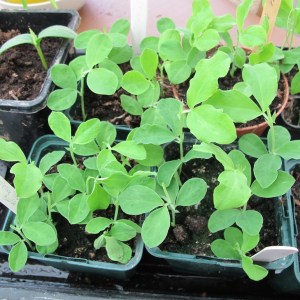
Sweet pea seedlings
Now I wait for the roots to show through the bottom of the pots before planting them out. The key to lots of sweet peas is to keep picking the flowers to prevent them from developing seed pods, so I’m looking forward to having a house full of sweet scent. Must remember to cut the plants off at ground level when they are finished so the little nodules of nitrogen are left in the ground to feed the next crop or group of plants. This could be called the lazy gardener’s way of improving the soil!
I have erected a Haxnicks Maypole Plant Support in readiness. Simplicity itself to erect, made from black powder coated steel with rot proof strings and galvanised pegs, it’s a feature in its own right. Designed for any kind of climbing plant, annual or perennial, at 6ft in height it will show off anything you plant. I’ll be getting a couple more for next year to add a clematis in the centre of a bed, and for the most successful climbing bean I’ve ever grown Cobra from Thompson & Morgan. Delicious! Other planting ideas are nasturtiums, a vine, french beans – could even experiment with climbing strawberries.

Haxnicks Maypole plant support
Growing Sweet Peas – Thompson & Morgan
- Prima Ballerina

Prima Ballerina
- Wiltshire Ripple
- Blue Velvet

Blue Velvet

Wiltshire Ripple
Val Reynolds, Editor
Revised Planting Plan for 2012 – In Praise of Plug Plants

Lady in Black - Double flowered fast climbing fuchsia
Isn’t it amazing how quickly sometimes plans have to be revised?
I’ve had to devise new plan where we will be using plug plants from established plant growers via the post for our front garden instead of growing from seed. Why plug plants? Four reasons: you know when they will be arriving, when you receive them they are well established, they take off like billyo and they have labels!
Why the new plan? With the prospect of our conservatory being turned upside down to store furniture from the sitting room and elsewhere in the house, because we are having some plasterwork and then redecoration done, I realised my seed planting plan was in peril because it’s in the conservatory where I grow all my plants from seed.
This is what is on order from: Thompson & Morgan
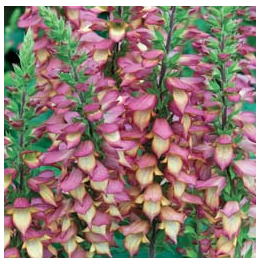
Foxglove Illumination Thompson & Morgan
- Tree lilies at the back against the wall – 6 bulbs
- Petunias Easy Wave – 36 plugs
- Fuchsia Lady in Black – 3 jumbo plugs
- Dahlia XXXL – 4 jumbo plugs – all different colours
- Foxglove Illumination – 3 jumbo plugs from the Titchmarsh Collection
 From Gardening Direct: Some beautiful scented begonias and some Monet coloured petunias for the hanging basket
From Crocus: some fabulous sweet peas
From Homebase: I’ll be getting some shamrock and some beautiful chocolate cosmos as recommended by Jo Swift.
In between these I’m going to fit in two tall supports for some sweet peas my sister will be growing for me in her greenhouse. And I’ll have to rearrange some of the existing plants, either moved into the back garden or given away.

Fabulous sweet peas from Crocus
In some ways being pushed into adapting to a new plan has been easier than planning from scratch. Having ultimate choice in daunting. All I have to do now is make sure the plants are sited so they don’t fight with each other over space nor clash in colour.
Other plug plants I’m expecting for the back garden include celery, onion, brussel sprouts, cabbage, sweet corn, beetroot – all except the onion will be grown under protective netting to keep the pigeons from guzzling the lot! The brussel sprouts I grew from seed last year have been very successful, we still have some to eat now in early February. The kale is still giving leaves to cook but the leeks are frozen solid in the ground.
So, onwards and upwards! Gardening is a joyful occupation that gives me so much pleasure and lots of challenges.
Val Reynolds, Editor
Vet’s Receptionist – In charge of a rabbit!

Along with other diverse and mostly unsuccessful jobs, I once held the position of receptionist in a local veterinary clinic. Two months into the job, my experiences had been limited to the care of cats and dogs, and I’d been feeling on fairly safe ground. This state of comparative complacency was soon to end, with the arrival of my first rabbit patient, and my introduction to the disturbing world of rabbits.
In my extreme youth, my acquaintance with rabbits was strictly limited. I usually met up with them after they had been casseroled with onions and carrots so knew little about their habits and hobbies, but I was also aware of a different breed which had been singled out for its unusually soft and fluffy fur. This type we didn’t eat; instead we wore its fur, often dyed pale pink or blue and knitted into tiny cardigans to be worn on special occasions, such as birthday parties. So it was that my first real encounter found me woefully unprepared for the hazards involved in rearing a domestic rabbit.
The owners of this particular pet – a charming lady with two young children – brought in their charge in a cardboard carrying case. I was relieved to hear that Bunny was full of verve and vitality, but this was in fact at the heart of the problem. Bunny was a red-blooded male, and was proving to be too much for his fellow male rabbit with whom it had been expected that he would live in close harmony. His owner, glancing briefly at the children, seemed reluctant to enter into details, but eventually I heard the word ‘castration’, so I presume that some very un-Beatrice Potter type behaviour had been observed, and that this radical step was being proposed to protect the sensitivity of his fellow rabbit.

Lop Rabbit - http://www.apbc.org.uk
One of the children, with a catch in her throat, asked about the risks involved in this operation. I, expecting from the vet the response ‘Oh, almost none’ that was routine for cats and dogs undergoing similar surgery, was shocked and alarmed to hear the vet tell her that general anaesthetics for rabbits are generally regarded as really bad news, and that they have a disturbing tendency to react by turning their toes up. Both children turned white, but the situation at home appeared to be serious enough to warrant risking Bunny’s neck in this way, and an appointment was made for the following day.
Though doubtless sympathetic, you are probably a little vague as to why I was so concerned, so I must explain the procedure on days on which an operation was performed. At the end of the morning consultation period the vet would go into surgical mode, which usually meant a fourth cup of coffee and the donning of yet another unattractive garment before disappearing into the theatre. When the deed had been done, both vet and nurse would rush off – notionally to work at another branch but frequently to catch up on the latest fashion to arrive at the local factory outlet – leaving the receptionist to clear up after them, and to keep an eye on the recovering animal. When it was a cat there was no problem. Cats are sensible creatures and not given to histrionics, so the occasional ‘There, there’ accompanied by an attempt to stroke them through the bars of the cage usually met with approval, and sometimes quite an enjoyable working relationship could be struck up. Dogs are all wimps, and lie huddled in a corner trembling and sighing and clearly convinced that their days are numbered, but can sometimes be heartened by being addressed briskly by name. All animals, as they gradually recover and remember that their last meal was yesterday evening, seem to think it the height of bad manners for me to eat my tuna sandwich in front of them, and occasionally tears will come to their eyes, but I’ve learnt not to be too concerned. Working in a vets’, you learn to eat when you can – postponing a meal for reasons of tact can result in having to gulp it down later in the day when some poor creature is being given an enema only a few feet away.

I had been happy to be left in charge of dogs and cats, in the knowledge that almost invariably they would recover and could be returned to their owners with great excitement and joy. It looked as if it might be quite different though for rabbits, and certainly Bunny’s family were thinking along the same lines to judge from their demeanour when they brought him in the following morning. There were tears in their eyes as they handed him over to me, saying ‘Please take great care of him – we’d be devastated if anything went wrong!’ Horribly aware that Bunny was going to be left in my sole care after the op, I made a final attempt to secure a reprieve for him, but his owner was adamant..
Bunny was duly settled in a cage to await operation time, and retreated to the back, trembling and gazing out with big, sad eyes. I retreated to the other side of the room and tried to avoid eye contact, just in case my feelings of doom might be transmitted and affect his chances of recovery. While the nurse was setting up the theatre, I thought I’d better adopt a more pro-active approach and ask the vet for more background information about rabbits. More bad news followed as I learnt that, apart from their tendency to overreact when faced with anaesthetics, rabbits have to eat constantly and go into a speedy decline if they don’t. Not for them the usual 12 hour fast, no, they are encouraged to keep putting it away right up to the vital moment, and to resume munching the instant they come round (if they come round!).
Being of a fairly squeamish disposition, and also keen to get my lunch before being compelled to face my responsibilities, I left the theatre, and tried to concentrate really hard on my other duties, such as beating my previous record at Solitaire. Only too soon though I heard sounds of Bunny being returned to his cage, and of the others preparing to leave the premises.
Keen to show my willingness to face a challenge, I hurried out to catch the vet and press her for more detailed instructions on the care of Bunny, who was now all mine for the next four hours. In what I thought was a callously offhand manner she replied ‘Oh, just keep him stimulated’ before disappearing out of the door and into her car.
‘Keep him stimulated?’ I muttered to myself as I observed Bunny. There seemed little scope for that at the moment as he was prostrate on the floor of the cage, doing a reasonable impression of a very dead rabbit, but he surely couldn’t have lost the heart to struggle on in the last couple of minutes? Advancing a little nearer I was relieved to see some evidence of breathing, and, heartened by this small triumph, I returned to my desk to consider how best to stimulate a rabbit.
Clearly the playing of games was a non-starter, for which I was very relieved. I reviewed my small repertoire of jokes, but found a surprising number of them began ‘A rabbit went into a bar’, so were probably intended for quite a different audience. Should I try singing to him, perhaps? Or maybe he’d appreciate a story being read to him?
With a shock I realised that I’d been pondering on this dilemma for some twenty minutes, during which Bunny might have given up all hope. With a rapidly beating heart I returned to his cage, but thankfully there were still unmistakeable signs of life. No one could have called him animated but at least he was now the right way up though showing no signs of getting to his feet and making for his lunch. Uneasily I reflected that it must now be around three hours since he’d last eaten – for how much longer could he survive?
Clearly stimulation was the thing. Still with no clear idea of what form this might take I edged closer to his cage, and to my consternation saw Bunny react with obvious terror, backing as far as he could into the corner furthest from his food. I reversed out of the room, but dared not leave him for long in case fear pushed him over the edge while I wasn’t there to look after him. The image of his stricken family appeared before me, and I could almost hear the recriminations. Could I live with myself if I allowed this poor Bunny to die in my care? The responsibility weighed very heavily on me (though actually that might have been partly the really huge baguette I’d had for lunch).
Again I peered around the door. Still alive, still a long way away from his food bowl, and still trembling. What a quandary! How could I stimulate an animal who almost passed out with fright whenever I got within ten feet of his cage? The situation became almost farcical as I spent the next half hour alternately retreating from the room, then, bent double, creeping back in, just far enough for him to see me, but not close enough to strike terror into his little heart. It might perhaps have looked a little odd, but at least I felt that I was doing something constructive. Certainly he was managing to cling to life, but still not a stalk had passed his lips. How could I explain this to his family, those poor children? How would it affect them? Would they no longer trust anyone, play truant from school, and wind up living in doorways in London all because of the trauma of losing a dear one?
I could stand the responsibility no longer. With a shaking hand I dialled our other branch, and to my relief it was answered by a nurse with years of experience. She of all people would know what to do.
‘This rabbit,’ I said, ‘I’m making no progress with him. He never stops trembling and hasn’t eaten for hours!!’ I could hear my voice sounding hysterical. ‘What can I do? I’ve tried everything I can think of!’
Gentle and reassuring she replied ‘Is he upright?’
I dashed over to have another look, risking another fit of the wobblies by Bunny.
‘Yes, but he’s not walking and he’s not eaten a thing and he has to keep eating or he’ll die!’
‘Oh, he’ll be alright, as long as he’s upright he’ll be alright now,’ she replied, ‘he’ll start eating again when he’s ready’.
‘But I was told I had to stimulate him to keep him alive?’
Her only reply was to collapse into waves of laughter, and I put the phone down.
A little later when the vet returned I met her at the doorway.
‘He’s OK!’ I said. ‘He’s still alive!’
‘Who?’ she said, walking past me and putting on the kettle. ‘Hey, look at this Armani dress I got, for less than a third of the real price!’
My responsibilities over for the day, it was time for me to go home. I took a last look at Bunny. Still he crouched in the corner of his cage, his food untouched, but he’d stopped trembling and his eyes – calm, clear and bright – met mine. Bunny was absolutely fine, it seemed, but someone had been making a monkey out of me.
Garden – New Plants and Sundries for 2012
My favourite garden press event was held this month and try as I might I didn’t get to visit all the stands I wanted but the ones I did visit were very rewarding.
 My intention was to source plants for the front garden and give it a completely new look this year and I found some great new plants. Beautiful Monet coloured petunias for the hanging basket and scented begonias for the front of the bed from Gardening Direct, excitingly coloured sweet peas from Kings and from Thompson & Morgan for the Garden Maypoles I have been promised by Haxnicks. Jo Swift suggested white shamrock from Homebase and a wonderful chocolate cosmos that he has chosen for the Chelsea Flower Show garden he has designed for Homebase. I’ll definitely get that cosmos it’s the one plant I can’t resist – they will be available in store from March.
Although the front garden is only 26 ft x 12 ft I still felt the pressure of choosing plants in terms of height, spread and of course colour. So I was really pleased to find Plantify – an inspiring, free online garden design tool available to everyone that I will be using it to redesign the front garden.

Fairy Magnolia Blush
This year Crocus has some absolutely gorgeous new plants on offer – one in particular Fairy Magnolia Blush looks absolutely wonderful, as does the white with blue back anemone Wild Swan – if only I had a bigger garden! And the Forest Series of hepaticas look absolutely beautiful, hope I can fit some in.

Spencer sweet peas from Crocus
And just look at these sweet peas from Crocus – irresistible!
At the event I was given far more packets of seeds from Thompson & Morgan, Homebase and Kings than I could ever use so if you would like a packet or two just send a stamped addressed envelope to me. There is a range of flower and vegetable seed, if you would like one or the other, or both, just write veg and/or flower on the back of the envelope.
My grafted tomato plants grew so well last year only to be cut down in their prime by blight that I had moreorless given up on the idea of home grown tomatoes because once blight, a disease of the foliage and fruit causing rotting, is in the soil it is difficult to avoid further contamination.

Quadgrow Slim
Then I came across the Quadgrow Planter. It has four pots that sit in a reservoir of water, taking away the possibility of erratic watering. It’s possible to link it direct to a water source either mains water or a water butt. I plan on siting it on a path in a south facing part of the garden. I’m hoping that particular cunning plan will mean blight won’t get a look in with the plants getting a steady supply of water and nutrients.
I have been promised some grafted tomato plants that have two varieties on each plant! Sounds really exciting.
My Heath Robinson style protection for the brassicas worked really well last year, deterring the pigeons and cabbage white butterflies, even though the netting was not wide enough and I had to use additional netting. This year I’ll be trying out a crop cage from Greentree Products that should work much better. Easy to fix clips and netting ties sound very attractive. Greentree are also supplying a Grow Cloche to try with one of our metre square raised beds. We’re convinced this will be much better than the hoops and fleece we used last year that has gradually broken down since last autumn.
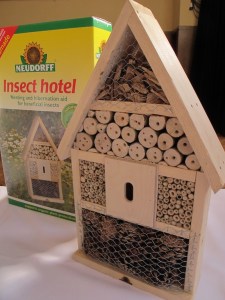
The Insect Hotel
Absolutely fascinated by insects, I was taken with the insect house from Neudorf, available on the web. One is on its way and I’m looking forward to observing what uses its 5 star bedrooms! The mason bees love a pipe filled with nesting tubes I’ve had for year and are fascinating to watch – see short video. I’m hoping for a wider range of insects this year that will give more photographic opportunities.
My gardening shoes have given me really good service for the last 17 years and I decided to replace them with a pair of Backdoor shoes. I chose ones with the bluebell print but as you will see on their website there are many other flower designs to choose from.
A range of gardening gloves were on offer and I thought it was time to replace a pair of Skoma gloves I’ve used continuously for the past three years and have seen better days. I liked them because they were flexible, wicked away perspiration, and gave me sensitivity, lacking in some gloves where you can’t feel anything. They survived frequent washing in the washing machine, but recently they have hardened a little and so I’ll be test driving three different levels of protection from Joe’s gloves – all rather brightly coloured – at least they won’t get lost in the compost bin. And a pair from Ethel Gloves, made from goatskin and bamboo, referred to as the little black dress of gardening! I have to admit they are rather stylish, I’m tempted to just use them for driving!
A rolling composter, one that be kept at ground level and pushed backwards and forwards to aerate your compost is by far the fastest way of creating compost – ready in six weeks! I’ll be trying out the Rollmix Composter and will write about how it works for us.
As you can imagine I had rather a lot to get home and was glad to reach my comfy chair by the fire, have a quick snooze and dream about the garden this year.
Val Reynolds, Editor
Gorgeous Scent in the Garden in deepest winter
Visiting the Royal Botanic Gardens in Edinburgh about this time last year I was captivated by the headiest scent wafting across a path. Some yards away I found the source, it turned out be the flowers of hamamelis. The bed of bushes was vast which accounts for the strength of the scent, they usually grow up to about four metres high. If only I had the space!

Hamamelis - Witch Hazel
The common name for Hamamelis is witch hazel, not related at all to hazel nut plants. Over the centuries it has been used medicinally for treating insect bites and bruises, it helps to shrink and contract blood vessels back to normal size, useful for treating haemorrhoids. It is also used in treating acne.
There are several varieties to choose from. Here the Thompson & Morgan description of : Hamamelis x intermedia ‘Westerstede’, Witch Hazel Hardy Shrub
During the bleak winter months, this deciduous shrub bears an explosion of golden blooms. The sweetly scented, shaggy flowers of Hamamelis intermedia ‘Westerstede’ cling resiliently to its leafless twigs. The summer foliage of Witch Hazel forms a simple backdrop for summer flowering perennials, before turning to vibrant shades of brilliant orange and red in autumn. This majestic specimen shrub is ideal for adding colour and interest to mixed borders and woodland gardens throughout the year.
Height and spread: 4m (13’). Flowering Period: January, February Position: sun or semi shade
1 plant in 9cm pot Despatch: By end of Mar 2012 £12.99
It was in the same gardens that the Queen Mother memorial garden is sited – I was really taken with the shell designs, the best I’ve seen – pictures below.
Val Reynolds Brown, Editor
Call The Midwife author, Jennifer Worth’s Fight with Eczema
Jennifer Worth, author of Call the Midwife – currently a hugely successful TV series – sadly died just before filming began in 2011.
Some seven years previously she had contacted me offering a feature about the severe eczema she had developed at the age of fifty five and her efforts to relieve it.
The first line was startling: Severe eczema doesn’t kill you; it just drives you insane.
Written in much the same style as her books the feature chronicles the development and relief of the eczema she experienced.

Jennifer Worth at the worst of her eczema
I developed eczema for the first time when I was fifty five. Within three short months two tiny patches of eczema on my legs had spread to cover my entire body. It is the itching that drives you mad. I would scratch the whole night long until I drew blood, then it would begin to hurt, but the pain was infinitely preferable to the itching.
Dermatologists could only offer steroids. These helped a little, but the itch came back worse than ever afterwards. I was in despair, until I happened to eat a Chinese meal, which gave me food poisoning and I did not eat for four days. During that time my eczema virtually cleared up. When I started eating again it came back. The cause was obvious – food allergy.
The dermatologists told me it was coincidence, as in their view there was no connection between food and eczema. But I was not convinced and searched every path for the offending foods – with no success. Let me say here that most people fail if they try to identify food allergies alone. It is too complex for the layman and you need an allergy specialist, a qualified nutritionist or at least a reputable book to follow.

Eczema on Jennifer's arms
I was fortunate in finding the right specialist, who guided me through a strict elimination diet. Once we had found the right diet, my skin cleared within three weeks. Then he led me through the challenge/reintroduction phase of the diet, which was very difficult and troubled by many pitfalls. After about six months, my skin was completely clear and I felt wonderful. Incidentally a side effect of an elimination diet is a surge of good health. Eliminating dairy products, gluten, yeast, sugars and chemical additives from your body can only be beneficial. We all eat the wrong things and suffer for it.
My specialist advised me to have a course of Enzyme Potentiated Desensitisation (EPD) because, he told me new allergies would develop. I have had EPD – see below – twice a year for nearly ten years and my skin remains perfect, for which I thank God every day of my life.

Clear of eczema
The charity Action Against Allergy asked me to write a book about my experiences detailing the elimination diet given me by my specialist. I was asked for this because there is so little information available on this subject. My book Eczema and Food Allergy was published in 1997 and featured in the Nursing Times, the Sunday Telegraph and the magazine Here’s Health. It sold out of two editions and last year they decided to republish online – see below.
This is a very controversial subject. Doctors, dieticians and even the National Eczema Society will state that eczema is not connected to food. But I have proved that it is.

Jennifer after treatment
In this article, I have deliberately refrained from giving any advice to eczema sufferers about diet. It would be rash and irresponsible for me to do so, because the subject is far too complex for a short article. But my book contains all the details necessary for a successful elimination diet and includes many addresses for specialist treatment. My heart goes out to anyone afflicted with severe eczema. I know the suffering involved and it is beyond description. If my experience can be of help to anyone, I am well pleased.
Many people have asked me what EPD is; how does it work, where can you get it, and what does it cost? It is a very subtle and complex medical process, and I give below a brief summary of what it is about.
Enzyme Potentiated Desensitisation is a form of immunotherapy developed by Dr. L. M. McEwen in the 1960s and now used worldwide. It has the potential to desensitise anyone to the allergens to which they are allergic. This includes foods, dust, animals, birds, grasses, pollens, moulds, and many chemicals. An ultra-low dose of allergen is used – approximately 1/1000 part of a routine skin-prick test – combined with the natural enzyme beta-glucuronidase which enhances, or potentiates the desensitisation process (thus we get the rather curious name). It is particularly effective for the treatment of eczema, and will work quickly for children – the younger the child the quicker it will work. It takes about 2-5 years to be effective for an adult.
EPD is only available on the NHS at the Royal Homeopathic Hospital (60 Great Ormond Street, London W1N 3HR). Dr Michael Jenkins, Consultant Allergist will see patients via a referral from their GP. EPD has a ‘Specials’ licence. This means it is accessible only to suitably accredited doctors to supply on a ‘named’ patient basis. The doctor must be a qualified MD trained in allergies, and who is specially trained to hold a licence to administer EPD.
There are about twenty such doctors in the country, and their names and addresses can be obtained from the British Society of Allergy and Environmental Medicine, PO Box No. 7, Knighton LD7 1WT Phone: 01547 550378; Web site: www.bsaenm.org.uk. This is a charity which will give you the address of your nearest medical practitioner of both EPD and Neutralisation. An adult course of EPD, lasting about five years, will cost around £2000, but far less for a child. This may seem a lot, but, believe me, EPD is worth a second mortgage.
In my book ‘Eczema and Food Allergy’ I devote two chapters to EPD, which gives far more detail than I can give here.
Eczema and Food Allergy is available in print from Merton Books www.mertonbooks.co.uk
Jennifer Worth, born 25 September 1935 died 31 May 2011, was a nurse, midwife and ward sister from 1954-1973.
Her book Call the Midwife about her years as a district midwife in the slums of London’s East End is published by Orion Books There is an interview with Jennifer talking to Danuta Kean about writing her books on that web page.
Two more books Shadows of the Workhouse and Farewell to the East End make up a trilogy. All three books have sold almost a million copies and stimulated a publishing subgenre of nostalgic true life stories.
You can watch a short video interview where she talks about her nursing career and working with the nuns in the East End of London.
Val Reynolds Brown, Editor
 In Balance