
Below Stairs Art
Watching the recently resurrected Upstairs Downstairs tv production I was reminded of the National Portrait Gallery exhibition Below Stairs: 400 Years of Servants’ Portraits held 2003/2004.

Staff portraits
The exhibition clearly showed some servants were highly regarded and valued enough to have their portraits painted. Many portraits were of senior staff, from gardeners and cooks to nurses or nannies close to their employers. Often commissioned to show wealth, through the livery, pastoral or interior surroundings of the sitter, a fair proportion of portraits were painted by amateurs or naive painters, having little or no extensive expertise.

Joseph Florance
Interestingly, the celebrated French chef, Joseph Florance, to three Dukes of Buccleuch earned about two and half times as much as the steward of the whole estate – he was painted by John Ainslie in 1817.
The exhibition was organised chronologically with the earliest British servant portraits, dating from around 1615, featuring the personal entertainers of the crown or aristrocracy. The sitters were descendants of medieval servants in the lord’s retinue such as minstrels and jesters, who had been his close personal servants in an age before literacy, the printed book and professional actors.
Some of most remarkable paintings were painted in isolated parts of the country, where the continuation of feudal patterns of service meant that servants such as jesters, pipers or champions survived long enough to be recorded in paint.

The Munshi Abdul Karim
The Munshi Abdul Karim by Rudolph Swoboda, 1888, shows a handsome, if romanticised portrait of one of Queen Victoria’s Indian servants. Munshi is Hindustani for teacher. She much admired this man who taught her Hindustani and who was promoted to the Queen’s Indian Secretary. His portrait is one of a series, now hanging at Osborne House.
Many paintings depicted the servant in distress from discrimination, or in a state of exhaustion after working the long hours expected of them. Elsewhere, a butler is shown helping himself to the port and other servants taking time off to rest.
Most, if not all, carry messages for the viewer, but some were direct messages for the servants themselves.
 This version of the Trusty Servant was painted by William Cave. The concept is old and international, going back to medieval literary sources. It epitomises the aspirations of masters and mistresses over the centuries to find the perfect servant and the qualities required. It shows the Windsor uniform designed by George III for members of the Royal Household.
This painting hangs next to the kitchens at Winchester College together with a panel with this explanatory verse.
A trusty servant’s picture would you see,
This figure well survey, who’ever you be.
The porker’s snout not nice in diet shows;
The padlock shut, no secret he’ll disclose;
Patient, to angry lords the ass gives ear;
Swiftness on errand, the stag’s feet declare;
Laden his left hand, apt to labour saith;
The coat his neatness; the open hand his faith;
Girt with his sword, his shield upon his arm,
Himself and master he’ll protect from harm
The concept is old and international, going back to medieval literary sources. Versions were reproduced during the nineteenth century in prints, china, glass, wood, textiles and inn signs.
Val Reynolds Brown, Editor
Incontinence – My most embarrassing experience
Incontinence sometimes feels more than embarrassing, it feels dirty, shameful and discourages contact with the outside world, in case you ‘leak’. This is not an unusual situation for a woman to find herself in, especially having had children, and more especially once you get beyond 60. Muscles have a tendency to lose their elasticity and this is when incontinence problems creep in. It’s not just the pelvic floor that is affected. Chewing your food where the jaw has lost some of its strength and doesn’t quite line up as it did before. This results in biting your tongue unexpectedly, or the inside of your cheek.
Much of this comes as a surprise to those of us who have kept fit and active. The effects of aging do vary, but they inevitably affect most of us.
For 40 year old Evie, it was when she was rushing along the platform at Paddington to catch the train back home that the first really humiliating accident happened.
It was Summer, and I was wearing a Nicole Farhi pale silk skirt, with bare legs and sandals. How could I forget.
I had had, on occasion over the previous couple of years, drips up until then – drips and sometimes trickles. But this time, as I ran, it was as if a bucket had upended inside me. It trickled down my legs and splashed onto my feet.
My skirt was stuck to my thighs. I kept running – it was all I could do. I had to catch the train – if I didn’t, I would be late picking my son up from school. I just hoped that if I ran fast enough, no-one would notice – I would be an indistinct blur, not a middle-aged woman who had wet herself … And anyway, I told myself, there’s no-one on this platform I’m ever likely to see again. Thank goodness. Once on the train I just rushed into the toilet. Not to go – no, I’d done that already. I pulled off the sodden and completely ruined skirt and equally sodden knickers. I tied my cardigan (oh thank god I had one) round my waist, and holding my bag (into which I had stuffed skirt and knickers) awkwardly in front of me, made my way to a seat. And at the other end, I just hoped for the best.
Since then, I have found out what it is all about. I have a prolapse due to a very difficult birth ten years ago, and it’s too far gone for pelvic floor exercises. I’ve had to come a long way in coping with it. Five years ago, it was getting worse, gradually. Crossing my legs when I knew I was about to sneeze, and sitting down if anyone made me laugh hysterically was just the beginning.
It’s now also affecting my bowel – the last taboo – but I have found ways of coping. The bowel was of course a terrible shock. I just didn’t believe it at first. Finding smears, I imagined, irrationally, I hadn’t wiped properly. For what else could it possibly be? When it became more than smears, I wondered if I had some kind of light diarrhoea. I felt puzzled, and a little frightened. I didn’t want to tell even my doctor, and I couldn’t tell my family or my best friend.
Urinary stress incontinence seems a cinch in comparison – almost something I mention in passing. They even refer to it on the adverts on the tv these days. Bowel stress incontinence is something else. It is, (and just don’t carry on reading if you can’t stomach it) exactly like leaving the top off a tube of toothpaste. That is the nearest way of describing it. Luckily, it only happens for 24 hours once a month, when my period is at its heaviest and the stress is at its greatest. And that, you will be happy to know, is as bad as it gets. The rest is good news.
You can, of course, have operations to put prolapses right. Most women can be fixed, and the kind of problems I have are something that usually much older women have to face, or anyone, like me, who for one reason or another, can’t have the operation. But there are ways of coping, and with the help of a good gynaecological therapist and adviser – ask your doctor to refer you – the problem is not unliveable with.
Pelvic floor exercises are the first stage, although after a while they didn’t work for me. I decided to try yoga. Upside down poses seemed to help, (well, it makes sense, doesn’t it?) and as I practised yoga every day my general fitness fitness improved. I learned how to do head stands and shoulder stands, and generally felt far more in control of my body. I used panty pads every day just in case, and support pants (big pants – who cares?) added to a feeling of ‘held in-ness’ and security.
When the bowel thing started, I despaired for a while. I felt dirty, and unfeminine. But then my gym adviser told me about Immodium tablets, which can be taken just on those one or two stressful days to hold everything in, and which work almost instantly. She monitored me carefully, making me write down a diary for a month, and then advised me to look carefully at my diet during the days leading up to my period. Less fibre and fruit means firmer stools. A football is less likely to fall out than peas – see what I mean?
Then, six months ago, I started jogging. Now this is something I had not thought I could do anymore – it was just too risky after the Paddington Station incident, wasn’t it? But I had a dog, I had a river with a tow path, and something made me go for it.
I prepare myself well. ‘Poise’ incontinence pads for ladies are discreet and effective. No drinks just before. A long T-shirt that reaches below my thighs just in case anyone but the dog is looking. A last minute visit to the loo, and I’m off. And something incredible and unexpected has happened. Having jogged a mile or two three times a week for several months, the pads have started coming home dry! I’ve lost a kilo or so, true, and I’m generally fitter. But I hardly ever leak, even running for a bus. I still cross my legs for sneezes and sit down for giggles, but apart from that one day of the bowel thing, I am absolutely fine – in control and fitter than ever. I’ve even discarded the support pants and only seldom wear a panty pad. It’s not cured, of course, and the problem could get far worse, apparently, during menopause. But for the time being, what is described as a purely ‘mechanical’ problem, that needs hoisting, stitching and mending, has miraculously got itself better by other means.
But I don’t tell anyone. No, not even my partner. There are just some days/nights when any kind of intimacy is absolutely strictly out of the question, and that’s that – don’t even go there, as they say …
And no, the skirt didn’t survive. Not even dry cleaning could help.
Author’s name withheld for diplomatic reasons
Incontact is the UK charity for people with bladder and bowel problems. Visit www.incontact.org or call 0870 770 3246
Do you have an embarassing experience you feel would benefit our readers to read about? Do get in touch – I guarantee absolute confidentiality.
Val Reynolds Brown, Editor, email editorinbalance@me.com
Dental Treatment Abroad
Check out the facts before you check in

A fine set of teeth
With more and more people considering dental treatment abroad, UK dental regulator, the General Dental Council (GDC) has issued guidance and advice to dental patients with a checklist of questions to ask before travelling abroad for treatment.
The aim of the checklist, produced in association with the British Dental Health Foundation (BDHF), the UK’s leading oral health charity, is to help dental patients make informed decisions about their dental care, wherever they receive treatment.
Duncan Rudkin, Chief Executive and Registrar of the GDC, said: Our job is to protect UK dental patients by making sure all dental professionals practising in the UK are trained appropriately and registered with us. We think it’s important for dental patients – wherever they receive their treatment – to know the questions to ask to ensure they receive the best possible treatment and care, and where they can go if something goes wrong.
That’s why we want to encourage people considering travelling abroad for dental care to ask questions before making a decision about their treatment. Qualifications and standards are likely to differ from country to country, so it’s important that you collect as much information as you can before committing to anything.
Dr Nigel Carter, Chief Executive of the BDHF, said: The National Dental Survey 2008 found that 16% of people would be willing to travel abroad for dental treatment and the figure was even higher among the 18 to 30 age group – suggesting the trend will continue.
This document provides members of the public with a very useful starting point on the questions to ask before getting dental treatment abroad.
Styles and standards of dentistry can vary a great deal from one country to another and, if things do go wrong, patients could still be left facing some difficult and potentially expensive decisions.
However by researching their chosen practitioner and asking the right questions they can reduce the chances of encountering potentially avoidable problems further down the line.
A copy of the dental tourism checklist is available on their website, www.gdc-uk.org.
The International Dental Health Foundation, is dedicated to improving the oral health of the public by providing free and impartial dental advice, by running educational campaigns like National Smile Month and by informing and influencing the public, profession and government on issues such as mouth cancer awareness and water fluoridation.
For free and impartial expert advice contact the Dental Helpline on 0845 063 1188 Monday to Friday.
Val Reynolds Brown, Editor
This feature was first published in January 2010
Amalgam tooth fillings – toxicity claims debunked

Heavily filled teeth
For a long time in the alternative health and more recently in the popular health press, concern has been flagged up of the possibility of mercury leaking from tooth filling amalgam. A lot of money can be spent on having fillings removed and replaced by non-toxic amalgams, even going abroad to save money.
So it was interesting to read on the QuackWatch http://www.quackwatch.org/ of reviews that dispute the toxicity claims. I am reproducing it in full:
False dental amalgam toxicity claims slammed again
A study of 56 patients who claimed to have symptoms caused by mercury in their amalgam fillings has found that none of the patients had significant levels of mercury in their blood or urine levels. The researchers noted that 20 of the patients has previously been previously diagnosed with mercury toxicity by “commercial practitioners using unconventional testing panels.” [Eyeson J and others. Relationship between mercury levels in blood and urine and complaints of chronic mercury toxicity from amalgam restorations. British Dental Journal 208(4):E7, 2010]http://www.ncbi.nlm.nih.gov/pubmed/20186178 A recent review by the American Dental Association Council on Scientific Affairs concluded: “Studies continue to support the position that dental amalgam is a safe restorative option for both children and adults. When responding to safety concerns it is important to make the distinction between known and hypothetical risks.” [ADA Council on on Scientific Affairs. Literature review: dental amalgam fillings and health effects on amalgam fillings and health effects. Amalgam Safety Update, Sept 2010]http://www.ada.org/sections/professionalResources/pdfs/amalgam_literature_review_1009.pdf
During the past few weeks, unjustified scare headlines have been generated by an anti-amalgam campaign that involved testimony at an FDA hearing. In response, Robert S. Baratz, M.D., D.D.S., Ph.D. noted:
“The simple truth is that there is no significant risk because amalgam fillings are safe. . . . The promotion of anti-amalgamism is regularly linked with fringe practitioners, people with financial interests in promoting something else, and pseudoscience. Based on past practices, and rhetoric, I’m one of many who conclude that the anti-amalgamists resemble more a religious cult than a group of serious, objective scientists searching for the truth.” [Baratz RS. More notes on the anti-amalgam movement. Dental Watch, Dec 18, 2010] http://www.dentalwatch.org/hg/hearings/fda(2010).html
Earlier this year we wrote about a checklist of questions to ask before travelling abroad for treatment issued by the General Dental Council, reproduced in this Health section.
Runnymede Spa and Hotel
 It was easy to relax and chill out in the darkened room, with soothing music, gentle aromas and competent hands massaging my weary body. It was quite companionable as my colleague was on a treatment couch just a few feet away. We didn’t speak to each other, but it felt good.
I was at the spa in the Runnymede Hotel, Egham and pleasantly surprised at the peace and quiet. Having battled my way through the M25 traffic, actually it wasn’t that bad, with the aid of my trusty SatNav, I welcomed the chance of the Crystals and Champagne spa break after a particularly trying week at work.
A group of six of us were booked into the Aquitaine suite*, with a member of staff assigned to look after us. A completely private area separated from the main spa and gym areas it is only accessible by pass codes. Absolutely ideal for private parties of up to about eight.
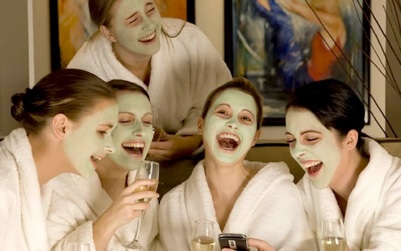 With a room for relaxing, tv, massage chair, settees, easy chairs there is an adjoining treatment room for two. A changing area with lockers, two large shower rooms and smaller treatment rooms.
The facilities of the spa upstairs made it possible for us to go off to swim, or gym, so it was seldom that all of us were in the room at the same time. It is possible to have all your meals served in the suite which makes it all the more attractive as a retreat. In fact it would be ideal for a group wanting to spend the time meditating, doing yoga, and simply being quiet as there was absolutely no extraneous sound. However if you chose a break with the overnight stay your room would be in the hotel itself.
The spa section is well laid out, the pool was big and spacious, jacuzzi and eucalyptus steam room, well designed gym and exercise studio. The treatment rooms were high standard. There were very pleasant seated areas for relaxation and a very attractive dining room. The food was excellent, imaginative, well displayed and light.
The Crystal treatment made up of neck, back and shoulders massage using hot stones was done well. We chose the oils that appealed to our sense of smell the most. I chose the one that was intended to invigorate – an excellent choice! The facial was rounded off by the use of cool crystals to give contrast and a stimulus to the lymph system. The final head massage was excellent. Espa products were used throughout. It was good to have a coordinated massage that lasted well over an hour.
There is no doubt Runnymede is a luxury hotel from the moment you step through the revolving door, the decor and facilities are of a very high standard. It’s a family hotel with a few rules to please those of us wanting to be child free. For instance at 12 noon children have to leave the spa. They are then allowed to return between 3 and 5 pm.
The hotel is on the River Thames with spacious terraces for warm weather relaxing and lawns down to the river. A heated outdoor pool is open between April and September.
With easy access from the M25 and Heathrow, it is ideal for the traveller who wants a break between flights, or before/after that long haul flight, wanting to do a little historic sightseeing and have a gorgeous spa experience. There is an excellent Treatment Finder on their website to suit individual needs.
Depending on the package you choose prices are from £160 per night based on two people sharing a room, inclusive of VAT and service.
There are plenty of good value offers to choose from.
For further information or to make a booking call the spa on 01784 220600 or visit www.therunnymede.co.uk
*The suite is named after Eleanor Aquitaine mother of King John, who signed the Magna Carta in the famous fields opposite the hotel
This feature also appears on the SpaWellBeing website
A Fish Spa – The Most Unusual Treatment in Town!

Hand therapy bar
I regularly meet up with five lifestyle journalists and a different spa experience really appealed. We had a choice of a hand or foot treatment at the second Aqua Sheko fish spa to open in London, in Frith Street, just off Shaftesbury Avenue.
When I mentioned my fish spa pedicure to my friends and colleagues I had a mixed response:
- Eek! I couldn’t possibly do it!
- Nothing would induce me to do that!

Having a 'treatment'
So what was it like? We all found it rather fun! After the initial trepidation of putting my feet in the tank of warm water when the fish flocked to my toes, I hardly felt the little Garra Rufa fish nibbling away and spent the 25 minute treatment watching them work hard, while I sipped herbal tea. The treatment ended with a wonderful foot massage that gave me a spring in my step!
Garra Rufa fish, a species of carp, inhabit Turkish hot springs where they naturally breed and feed. For years people with psoriasis and other skin disorders have visited the springs for the fish to painlessly nibble away the dead skin. By peeling away ordinary callouses and the thick lesions of psoriasis, the fish leave feet feeling softer and prettier.
This fish spa phenomenon has been taken up enthusiastically in the Far East where fish foot therapy is available in shopping malls and department stores.
There is of course the concern about transfer of skin infections. If your feet have any broken skin like Athlete’s Foot, or bruises, it is recommended you wait until they heal before having the treatment. At Aqua Sheko they have a UV water filter installed to destroy unwanted organisms.
Washing your feet just before the treatment is necessary which also ensures the removal of any skincare chemicals that might harm, or even kill, the fish.
At Aqua Sheko it’s possible to have a whole body treatment! This is something yet to be experienced … maybe a New Year treat.
All details on the Aqua Sheko website
Val Reynolds Brown, Editor
Just how hard should learning a computer program be?
Well, here is our new design for the website. I can hardly believe it’s the fourth design to appear, but then in ten years I guess that’s not too surprising. What is surprising is how much anxiety learning a new design program can be. I really must write something about how interpretation of words used in one language can differ when written by those in another English speaking country. I’m talking here about American English.
I’m sure the root of many of my problems is a resistance to use different meanings for words I have used for so many years and an astonishment at how my language is being changed by non-native speakers. Perhaps the answer is to compile and keep up to date a glossary.
I’m also wondering whether there is an easier way of working through the huge amount of information the beginner faces when learning a new program. I think an algorithm is vital here. There are videos to watch – rather long winded some of them, others lack vital and consecutive elements. One video took 60 minutes to show the difference between using a post and a page when creating a website. The lecturing style was so amateurish if I had watched it to the end I really would have lost the will to live. The two are not difficult concepts to understand, you just need a clear and succinct explanation.
Talking to other website creators I hear similar stories, so it’s not just me being slow and ‘stupid’. I am also relieved to hear other people have lost vast amounts of data, like me. So many images, databases, info have I lost, forever, due to computer crashes. Again over a period of more than 20+ years I guess it’s not surprising. What is surprising is that no one expects it to happen to them. I certainly didn’t.
Even now, with enough backup storage devices, as well as backed up on ‘clouds’, I’m still not confident I won’t lose something precious.
Another thing that frequently happens is the inability to completely recall how to do something with a program I did times without number, maybe months, or years ago. The time it takes to almost relearn is so frustrating. I couldn’t remember how to open the disk drive doors on my standalone computer this morning. Something I did for years when creating cds and dvds of the hard copy for the magazine.
I was reassured by a colleague confirming the same thing had happened to him and how stupid he felt.
Luckily there are forums to use for most things, but sometimes that can be frustrating – I like fast feedback, but it doesn’t always happen. So, for me, the best back up is really a personal service.
I use Apricotvs. I need fast response, 7 days a week and they are reliable. If necessary they will come out to the computer but the best bit for me is the Remote Desktop Support. Their technicians connect with my computer over the web and take control. It’s a bit odd seeing the cursor whizzing around the screen, but I got used to it quickly. It means there is no need for a visit, or a long winded, sometimes convoluted, conversation. It’s all done over the internet with the loudspeaker turned up. I love it! I’m signed up for the Gold Service which for £25 a pc a month is a bargain for peace of mind.
Val Reynolds Brown Editor
Football through the Viewfinder – Sports Photography
Television sports news reminds me of the football league matches I attended as an official photographer. They were rough, both on and off the pitch. Men and boys (well some of them) seemed to think it was a good time to be rude, spiteful and crude.
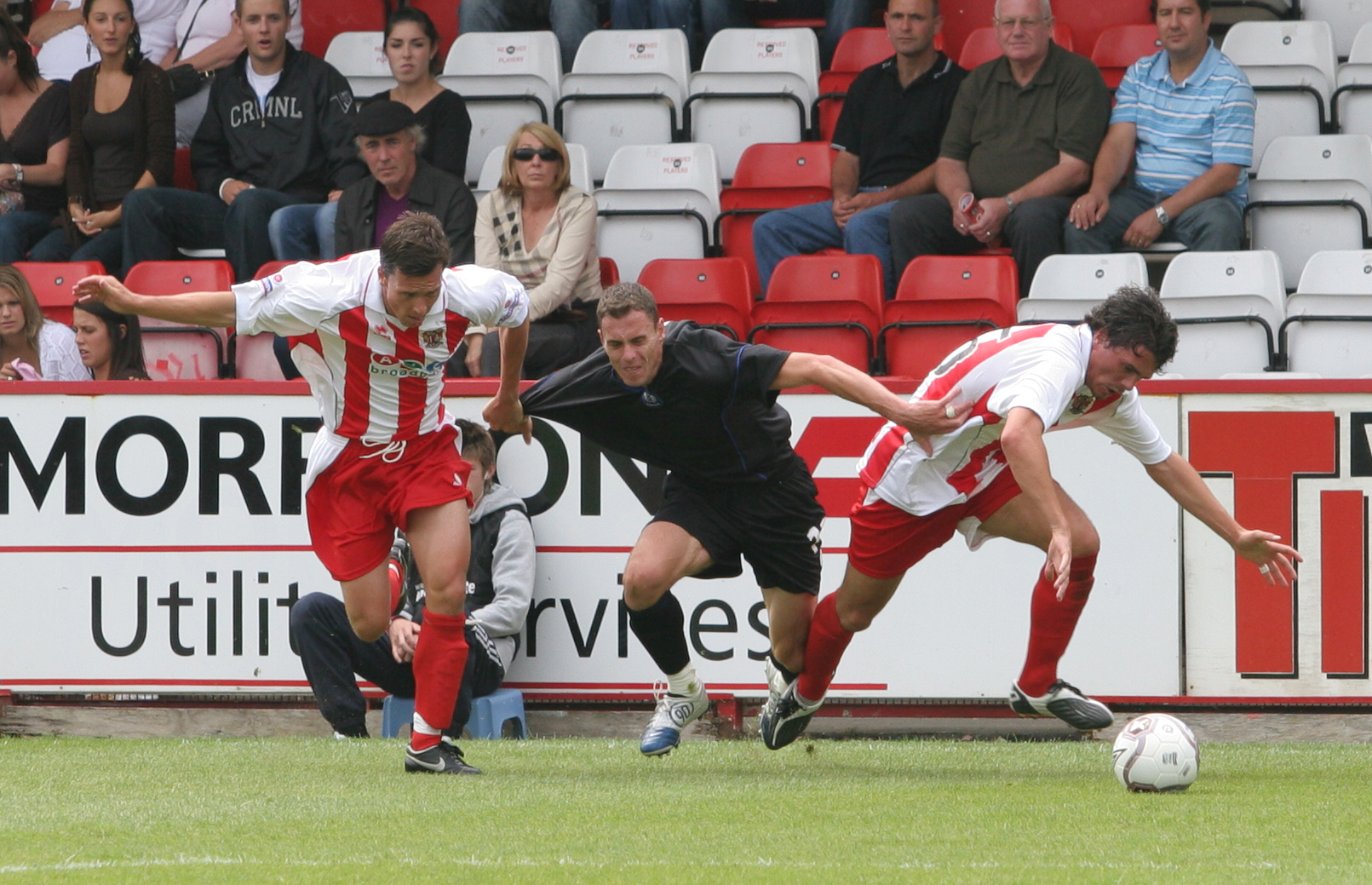
Stevenage Boro Match
I spent two years photographing pitchside and found it a dangerous and frightening place to be, some of the time. Avoiding footballs was the biggest worry, my reactions must have been pretty good as I managed to dodge them all, sometimes twice in a match! On one occasion another photographer wasn’t so lucky and incredibly the crowd cheered when he was hit!
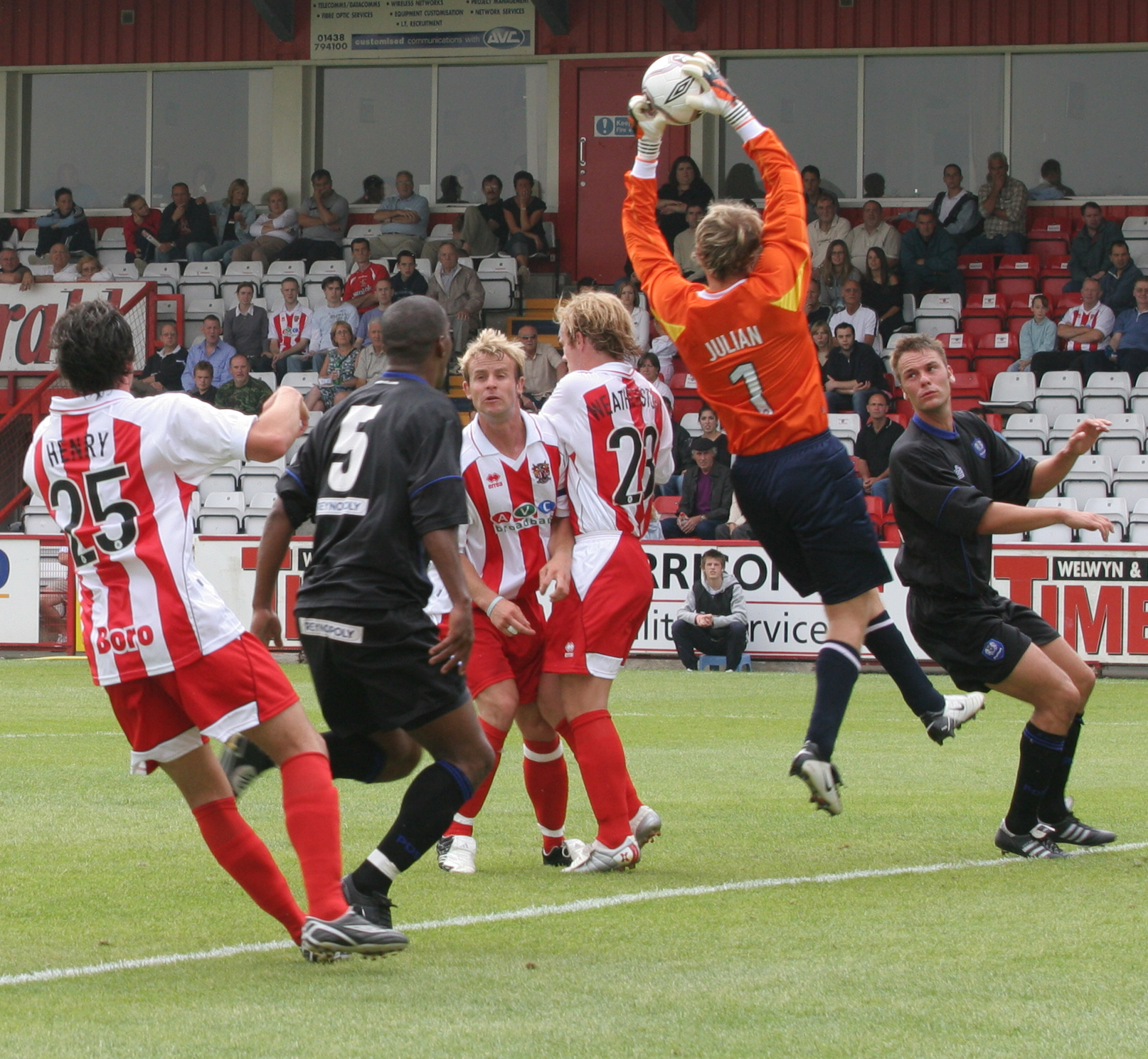 Spectators in the seated areas displayed greater restraint than those in the standing areas. One very large woman at one end of the pitch spent all her time castigating the players, of both sides, with a liberal helping of strong language. The poor ball boys were even shouted at and they had a really hard time. Sitting on small plastic seats they had little to do but when they did they had to move fast and throw it in the right direction to the right player, which wasn’t always obvious!
Referees were always the butt of jokes, cat calls, crowd abuse and aggravation from players. Eddie Keogh’s famous photo gives an insight into what can happen when feelings run high.

Did the ref get it in the eye?
This referee appeared to take all the aggravation in her stride.
 It was interesting when the crowd thought something was not right – there was a collective rush of sound, a mix of loud gasps and murmuring, often resulting in loud disputative noise.
 Did I enjoy my two years? Well I enjoyed taking the photographs and getting good shots, and of course getting my pictures in the papers. But I didn’t feel comfortable for most of the time, nor welcome really. A fellow woman photographer had a can of beer thrown at her, from behind, her head was split open and her camera was ruined. I decided to call it a day.

Welwyn Garden Rugby Club match
Perhaps if I had appreciated the finer points of the game I might have got more out of the experience. As it is, I prefer rugby, the players are great guys and my photoshoots have always been positive and no one has ever thrown anything anywhere near me!
Val Reynolds Brown, Editor
Plants Galore!

Lemon Basil
Some years ago I came across a packet of Lemon Basil seeds from Thompson and Morgan – my favourite seed supplier since 1970! – that I have to confess had been ‘loitering’ in my seed box for some time, four years in fact! As I had a bit of space in my tiny greenhouse, I thought I would see if they germinated, expecting a few to come up which would be very useful for salads. To my great surprise the whole seed tray bounced into life and I had so much basil I had to give much of it away! Recipes and more information is here.
With that experience in mind I decided to go through the T&M catalogue looking for herbs that I could grow to add to salads, even if they didn’t grow to full size they would add a variety of flavours. Most herbs are available at very reasonable prices and with germination rates generally pretty high it’s a win win situation!
Most recently I have successfuly sown

Basil
Outdoor Basil This gave an excellent germination and again found I had so much I had to give many plants away. I kept some indoors and others in the kitchen garden. I love picking a leaf or two and eating it when I’m wandering around looking for weeds to pull up.
Borage, the young leaves have a cucumber taste and widely used in salads and the bright blue flowers look wonderful in drinks, or salads. At the end of the season the plant can be added to your compost. It does get a bit untidy but I can forgive that characteristic as it attracts so many bees and other insects, it is a joy to see it thriving.
Coriander This can be sown direct in the ground. However it is useful to sow some in pots to keep indoors for year round fresh leaves to add to salads, salsas and Asian cuisine. Another flavour indispensable TO the adventurous cook.

Chervil
Chervil Used in French cooking to flavour fish dishes, sauces and soups, is a familiar taste of France. Can be grown in pot on the windowsill for all year fresh leaves.
Summer Savory this comes highly recommended from Bob Flowerdew who waxes lyrical about its effect on broad beans! Try it chopped and mixed with melted butter. Thompson & Morgan suggest adding it to breadcrumbs to coat fish, added to soups and stew – said to be magnificent!
Endive not often found on sale here in the UK, is easy to grow from seed. Easy too to grow it as salad leaves.
Other seeds I have successfully grown for the kitchen garden this year are globe artichokes, beetroot, parsnips, carrots, lettuce, sugar snaps, french beans, courgettes, leeks, pumpkin, outdoor melons – the jury is out on these they are not growing very quickly and I wonder whether they will flower and produce mature fruit, they are protected by a cloche to keep the heat in and the wind out.
I have grown many plants to attract insects. French marigolds, calendula, I have allowed the parsley to go to seed for insects to feed on, poached egg plant, nigella, and alfalfa to dig in as a green manure. Red clover has been sown for the same reason.
I have also used odd spaces to grow flowering plants for the main garden, for instance escholtzia, chrysanthemum daisies, scabious, sweet peas and I have experimented with unusual plants, for instance cucumelon.
It will be some weeks before I know which plants are worth keeping and which seeds are worth sowing next year. As always the gardener in me is constantly adding, subtracting and repeating plants, always aiming at perfection. Ever hopeful!
Val Reynolds, Editor In Balance Magazine
Johannesburg – Saxon Boutique Hotel & Spa
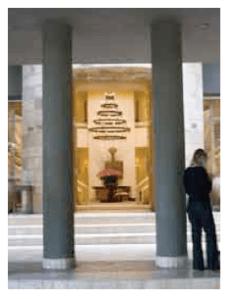
Main entrance to the Saxon Hotel
Bowling along in an airconditioned minivan on a sunny afternoon following 10 hours on a plane was a relief. The clouds seemed bigger and sky bluer than I had seen for a long time. Unfamiliar flowers on the roadside and birds in the trees were intriguing and exciting.
Given the opportunity to experience treatments on offer in some spa hotels in South Africa we were looking forward to a period of relaxed living in five star surroundings. We were not disappointed.
Starting in Johannesburg, with its reputation for violence and unrest seemed a little unwise, but we didn’t see anything untoward, although we found the number to street traders converging on the car at traffic lights somewhat unnerving. Anyway we had to start somewhere and why not experience what is considered the best of the best, the Saxon Hotel in the Sandhurst section of the Santon area.
We faced a high security entry procedure with a high perimeter wall, a 24 hour guard and a sliding door so heavy it rumbled along its tracking into the wall itself. I felt a bomb would have trouble making an impression on it.
Black ibis on the lawns
The gate opened onto a six acre park with a meadering drive, past groups of grey ibis busily searching for insects in the grass – quite a broadleaved type of rye grass, different from our fine fescue rich mixes, arriving at a magnificent entrance. It was easy to see how the management could promise peace and security for their highly placed guests.
In the huge entrance hall with its stunning central light fitting to match were dozens of examples of African artefacts – wooden carvings, masks, even doors, which featured on walls, tables, and floors in all directions, and through to my bedroom, well suite actually, with its beautiful masks and carvings to gaze at.
I had a balcony with a table and chairs overlooking the park and trees, a pillared bed, beautiful bathroom with a fantastic bath – oh what a wonderful soak to be had after our eleven hour journey! I would have liked to stay in the suite for a couple of days just to enjoy the luxury of it all and try out some of other facilities. It had a table I could work on big enough for a meeting of six people, with internet access, a huge television, round sound hifi system, lots of sofas and, luxury of luxury, a master pad at the door and by the bed to switch all lights and devices off in one fell swoop, or choose any combination you want. You can see images on the website.

Pool area
Saxon hotel is ideal for travellers of all kinds wanting the opportunity to relax and restore their energy. There is plenty to choose from including swimming pools and lounging areas in the most beautiful surroundings, an excellent spa centre, as well as a fitness centre.
I chose the unique sound therapy in the hotel spa, where tibetan bowls and gongs were all around the room. Whilst I lay on a water bed, bowls were placed on my chakra points, then gently tapped, the sound resonating through my body. I fell into a dream state going to a far away place while other bowls and gongs were softly sounded continuously. I really resented coming back into the here and now at the end of the session!
I’m unsure whether this could be considered an authentic African therapy, but then remembering the recent rapid development of spa centres of all kinds in South Africa it’s only to be expected that many treatments on offer are strongly influenced by others from around world. The 60 minute treatment was R690 (approx £49). You will find more details on the website that includes the spa brochure.
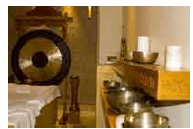
Spa with sound therapy treatment
Saxon was originally a private home and it was there Mandela stayed when writing his book A Long Walk To Freedom. The site was later transformed into the luxury conference venue and hotel it is today.
Oprah Winfrey and Bill Clinton have been notable visitors. I can see why Saxon says captains of industry, heads of state and even royalty can be offered a quality of service beyond reproach and with international chefs providing fantastic tasting food, beautifully crafted, there is everything here to enjoy and relax into.
Lunch was beautifully presented and cooked, if rather long in delivery. The dessert was especially good, a soft layered meringue with a cheesecake-like base. When faced with a beautifully laid out table with cutlery and glass to die for, my anticipation of an excellent meal is heightened. We were not disappointed, it was stunning.
It is possible to experience the hotel’s spa as a day visitor. If you happen to be in Jo’burg with a day or so to spare do consider a visit – whatever you decide it will be a memorable occasion.
We flew from London Heathrow to Johannesburg with South African Airways www.flysaa.com 0870 747 1111 Flights LHR to JNB approximately £700 return, including taxes
South African Tourism, www.southafrica.net Information/Brochure Line: 0870 1550044
Saxon Boutique Hotel and Spa 36 Saxon Road Sandhurst Johannesburg www.thesaxon.com Tel: 00 27 11 292 6000 Voted the World’s Leading Boutique Hotel for the last six consecutive years
The Saxon is an all-suite hotel – we each had an Egoli suite R 5,400 per room per night (approx £385) Presidential Suite R11,300 per room per night (approx £810) Platinum Suite R21,000 per room per night (approx £1,500) Rates include breakfast and use of the hydro facilities at the spa.
Editorial and Photography Val Reynolds Brown August 2008
 In Balance