
Anyone for a Swim?
 Am I the only woman to be deterred from all the benefits conferred by swimming by the sheer horrors awaiting me in the changing rooms?
When my six year old daughter managed to dry and dress herself more quickly than I did, I realised I was a slow-starter in certain organisational skills. And she even managed to dry between her toes! I’ve never found the time to do that. More than twenty years later -and she’s still watching me with a pitying eye as I struggle to get myself in a state fit to be seen in public after a visit to our local pool.
The problems begin even before the swim. I’ve now got the hang of my new swimming costume after two false starts when I first managed to put it on back to front, and then sideways. (I still don’t quite know how I managed that, but it was certainly an interesting look and worth consideration for next year’s London Fashion Week) So, there I am, costume on, towel tossed over shoulder, hat, goggles and earplugs clutched in one hand, leaving the other to carry everything else to the locker. Coat, scarf, boots, socks, jeans ….well, you can work out the rest, plus a large bag for carrying my swimming kit, and my handbag with money, keys, etc are all to be carried in one hand and fitted into this small space at ground level. Taking tiny steps on the slippery tiled floor, I progress at a snail’s pace but sadly without the snail’s self-contained house, leaving a trail of garments on the floor and watched with bemusement by a couple of sylphlike teenagers.
At last at the lockers, I try to think it all through logically. I open the door, stand sideways on so as to prop it open with my leg, but then realise I can’t bend in that position in order to put things into the locker as I’m facing in the wrong direction. By this stage most of what I’m still carrying is falling from my grasp, so I twist round and with a great heave hurl the rest into the locker, remembering too late that my glasses are among them. Now to retrieve the items I’ve dropped – but I daren’t leave my handbag behind while I do that, and my handbag is underneath all the stuff I’ve just crammed into the locker. I bend down to fish it out, and discover that the twisting and hurling has set off my back problem. Clutching my bag, I retrace my steps even more slowly now that my back is hurting, collect my belongings, return to the locker and stow everything away more neatly, slamming the door closed before everything falls out. Then I remember that I need a pound coin to lock the door, and the pound is in my handbag and my handbag has just been packed away at the bottom of the locker. Starting now to feel just a bit impatient, I tear everything out onto the floor, and extract the pound coin before piling everything back in, noting as I do so that most of my clothes are now wet due to the puddles of water on the floor which unfortunately I hadn’t noticed before.
Locker locked, all I now have to do is put on my swimming hat and that’s when I realise that I’ve thrown my hat and goggles into the locker along with everything else. Gritting my teeth I open the locker, yank out the missing items, and shut it again, before pausing for a moment to fasten onto my wrist the plastic wrist-strap holding the locker key. I say “for a moment” when what I actually mean is “for at least five minutes” as these things were never intended to be fastened with just one hand as they’re entirely rigid and therefore can’t be wrapped closely around the wrist without some pressure being applied. I brace my wrist against my knee, against the wall, and finally against the slatted seats – which involves kneeling sideways on the floor beside them, watched this time with concern by several small children.
My actual swim takes about ten minutes, since by now I am feeling exhausted. Sure that I’m being observed with scorn by all the regulars as they speed up and down the lanes, I creep away from the water and head for the showers. I hang my towel on the hook helpfully positioned on the back of the door, turn on the water and discover that I’ve brought with me the tube of body lotion rather than the matching shower gel. Never mind, I can at least rinse off the chlorine with plentiful hot water, which is fine until I realise that the hook can’t have been intended for towels as mine is now thoroughly soaked. Avoiding pitying glances as I shuffle back to my locker wrapped in a dripping towel, I open the door but am not quick enough to prevent the contents hurling themselves onto the floor again. Bit by bit I pick them up and clutch them to my soaking bosom before beginning the return journey to the cubicle.
Here, in a space which seems somehow to have shrunk in the past fifteen minutes, I fumble among my possessions for the body lotion and talc as there’s no point in trying to dry myself with a wet towel. Retrieving the lotion with triumph, I start to apply it to my limbs before stopping to puzzle over the apparent bubbles forming. Then I remember that this must be the shower gel that I’m carefully spreading over myself. I have a go with the towel to get rid of it, then shake on some talc in an attempt to soak up the water. Big mistake as now I have a sort of thick paste on my legs. At this point I might perhaps be moaning a little as I retrieve my pants and struggle to get them over my encrusted thighs. Worse is to come with jeans, a close fit at the best of times.
Eventually the horror comes to an end, and I sidle through the changing rooms to the exit. On all sides are women wrapped in clean dry towels, their hair swaddled in yet more clean towels, or fully dressed in dry clothes, carefully renewing their makeup and blow-drying their hair at the mirrors. I catch sight of myself as I scuttle past, hair wet and plastered to my skull, skin red and blotchy from the chlorine, eyes even redder as I never did find my goggles again, clothes looking as if they’d just been dragged from the dirty washing basket before being left out in a storm.
How does everyone else do it all so easily? And why can’t I?
Contributing author: Janet Hamer
Seeing Double – Was I a Twin?
 This is the story of Althea Hayton, a counsellor from St Albans who, after many years of soul-searching, had come to the conclusion that she had shared the womb for part of the time with a twin. She discovered me over the internet, because she knew that talking therapies could not access the areas of her life that were pre-verbal, pre-birth. And indeed my approach, myth-a-drama, enabled her to not only to heal this issue, but as a result of that experience, she found her life work.
This is her story.
“It started with the insight that I may have once been a twin, and that was why so many tiny details about my life that had always puzzled me, were always on my mind. I was very concerned with the life of the unborn child, thought a lot about death and dying and was never happier than when I was with one other person engaged in deep intense conversation at an empathetic level.”
She took part in a nine month programme I offered, the Ritual Theatre Group, and as a result was able to re-experience being small, being angry and very powerful in that anger. About half way through the programme, and after much planning, she created a special ritual to release her lost twin.
She claims that “there has never been a more intensely emotional, cathartic and cleansing experience in my whole life than that day”.
Unable to function normally for some days as she planned the ritual, she planned every detail. Every day for two weeks before the day, she wore a chiffon turquoise scarf that she loved and had bought for herself – for her, turquoise is the colour of dreams. She also took up a wide beige Indian cotton and made that ready, with some white card labels with ideas – ‘strength’, ‘dreams’ and ‘creativity’ written on them – to hang about the necks of the other group members.
A special ritual about the lost twin
She thought for a long time about music, then picked her favourite piece part of Bach’s Double Violin concerto. With a blindfold from a plane trip, a shallow meat tin and some matches, she was ready. The ritual, although involving other group members slightly, was a very personal thing. She sat inside a womb shape on the floor made with cloth, barefoot and blindfolded with the two scarves. One of the group members was nominated by the group to touch her gently from time to time – in the darkness of the womb, she was there with the tiny companion known only by touch.
The music played until, suddenly, the group made a terrible noise with percussion instruments – the catastrophe that took her brother away. She reached out, taking control, touching them one by one to make them quiet, in order to heal a sense of helplessness that had haunted her all her life. In the silence, the violin concerto played on. She stepped out of the womb and took off the blindfold, putting labels on group members to represent the gifts that her little companion had left. That didn’t work very well – she had to do this alone.
So to the strains of the music, she danced with the two scarves. As the music faded to silence, she came to the meat tin on the floor that contained a painting she had done of Kali, representing her negative anger, vengefulness and destructive power. She tore the picture into pieces but kissed every piece, forgiving and accepting all the negative qualities. Then placing the pieces back in the tin and covering them with the scarf, she carried it outside and set fire to it.
Later, she tipped the ash in the dustbin – they no longer had any power over her. Later, at home and still stunned by the experience, she knew that a final act of letting go was required. In a cleansing ritual, she gathered up the piles of papers she had accumulated over the previous twenty years about the unborn child, putting then into a black sack for recycling. Now, finally after more than fifty years, she has found peace.
She says: Since that amazing day, which has allowed me to put actions and images to a vague sense of something that had haunted me all my life, I have not looked back. I entered into a totally new phase of my life with ever rising energy and increasing focus. Within two years I had walked enough of my healing path to a point where I was ready for action. What happened was way beyond my expectations! I decided to write about womb twin survivors in 2002 and have since then created two anthologies of articles and stories about womb twin survivors and a major work detailing my eight year Womb Twin research project.
In 2007 I set up a non-profit organisation to help womb twin survivors and I now give seminars and workshops for womb twin survivors in various countries. Without that wonderful opportunity to express in the Ritual Theatre Group the grief and despair that had been within me all my life and say a loving farewell to my twin brother, many hundreds of womb twin survivors would not have been helped in the way they have. I didn’t know I had it in me, but myth-a-drama helped me to set it free.
Althea’s story will be featured in the book I am currently editing Ritual Theatre: Theatre of Healing to be published by Jessica Kingsley later this year in which I describe how I have helped hundreds of people like Althea heal issues that nothing else would work for. Most of my clients feel blocked, that some part of them is locked away. Myth-a-drama is based on drama therapy and brings together the healing power of drama and myth. It works for many reasons and enables participants to work directly with the unconscious patterns deeply buried within then. But most importantly it is enormous fun, and the fun aspect is why it is so accessible, liberating and enjoyable.
Guest Contributor: Claire Schrader
claire@makingmoves.net
Web Links
www.makingmoves.net
http://www.wombtwinsurvivors.com
For details of Althea’s new book “WOMB TWIN SURVIVORS: the lost twin in the Dream of the Womb” published in March 2011 go to http://www.altheahayton.com/wren/womb-twin-surviv.html
My Gardening Gurus – Anna, Sepp and Phil

One of winter’s best features is having the excuse to sit down with a good book. And Anna Pavord, my favourite gardening guru, published Growing Food last year and it is always going to be on the bookshelf to dip into from time to time.
Anna describes different planting plans, one such is the Exuberant Potager, where she mixes flowering plants to complement the vegetables. Here she advocates areas with different plant mixes:
- nasturtiums, beans and squash
- lettuce, onions with eschscholtzia
- carrots, beetroot with marigolds, among others
In fact, a bit like my planting which is very mixed, but not so well thought out. I’m working on a plan to incorporate her ideas.
Other plans include a formal herb garden, a Mediterranean garden, a city larder for a small balcony, cottage garden, salad and herb plot, a vegetable patchwork, traditional kitchen garden, an alcholic hedge (!), and a formal fruit garden. All the plans illustrated with delightful drawings, much in the style of the Dorothy Hartley books of yesteryear. The plans are easily adapted to suitable most plots, with a bit of artistic licence. Anna is such a respected gardener, she has had a hellebore named after her, Anna’s Red.
The ‘cunning plan’ of last November was to clear all the plants from most of the beds in the back garden and cover with leaves and horse manure. The leaves to provide an airy protective covering and eventually be taken down into the earth by the worms, with the manure holding the leaves down so they don’t fly around the garden. This mulching also ensures the bluebells, that have grown in large patches and grow between and through plants, come through the leaves and can be seen and easily dug up. Well as I said, that was the plan and it has worked reasonably well, although I think some bluebells have been missed, again, so probably next year will see me digging more up. We replanted them on the periphery of the garden and down a grassy drive beside our house.
 Mulching is big in Sepp Holzer’s activities in his property in Austria. Famous for his permaculture philosophy and practices, Sepp is so down to earth and practical, it is a joy to read his book. There are web pages you can read and also videos. He writes about using pigs to clear ground before planting – so similar to Phil Drabble‘s experiences I read about many years ago.
 Both inspirational men. I would love to meet Sepp and talk gardens, sadly Phil died in 2007 at the age of 93.
Val Reynolds Brown, Editor
The Day I Won, and Again, and Again, and Again, and Again, and Again!
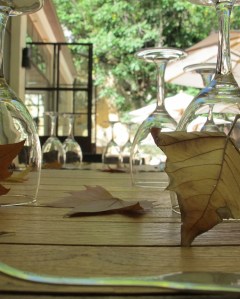
Eating al fresco, Languedoc Roussilion in October
I knew we were low on wine, in fact only a couple of bottles of rose cava which we usually only drink on special occasions, were loitering on the shelf. So I thought I would have another look at the Virgin Wine website where I had ordered a case of mixed white wines earlier in the year. Although my husband had sniffed at the absence of corks we rather liked the selection and they were drunk enthusiastically.
Now don’t get me wrong. I am most definitely not a wine connoisseur, I’m unable to tell one grape from another. However I have made wine over a period of more than 35 years with various ingredients, from potato to sultana, from peach to raspberry and also our own grapes grown in the garden, so I have a certain tolerance/experience of unusual/different flavours.
With wines conventionally made from grapes I know what I like the taste of and it is quite a range, but I always enjoy Chardonnay and Merlot, without always looking at the label. So looking at the Virgin Wine website I was interested to see what was on offer in their Auction section.

Wine tasting session
Several cases of really interesting mixes and bids were quite low. The bidding works like e-Bay, so I put some bids in and noticed the bidding increased as the time ran out, and I didn’t win any.
I decided then to place a fixed bid overall on eight different auctions running at the same time and watch how things went. The strategy worked … rather too well actually. Within a few minutes of the auctions closing I received an email telling me I had won one auction, then another, and another, and another, and another, and another. Six in all! I was breathless with surprise. I felt a bit like the sorcerer’s apprentice in the Disney film, they wouldn’t stop coming.
Although I was pleased my strategy had worked, how on earth would I explain this ‘success’ to my ever loving husband? I really hadn’t expected to win any actually, the bidding was quite fast towards the end and I couldn’t tell whether mine had been successful. I knew the auction conditions do not allow cancellation of bids, so six cases of wine were instantly winging their way to me. I decided to send him an email, much easier to explain the finer details than face to face explanation – no I’m not a coward, but he is profoundly deaf and all that entails …
Darling Good news, I have ‘won’ several Virgin wine auctions, average price £4.0729 a bottle. The bad news is we will have to find enough space as I have been rather more successful than I expected … Good news also, we won’t have to buy any wine for a few months … Just don’t be surprised when several boxes arrive … L/Kate, your rather too successful wine auction bidder!!!
I received what I thought was a fantastic reply:
We could ask the family to look after the excess. Well done!

Decanting red wine of any origin always improves it
How supportive is that? Actually I wouldn’t trust the family to look after the excess … too much of a temptation, so we will be finding space in the garage. I wonder whether I would be just as successful again … reluctantly I have given myself a six month ban before I have another go. The Virgin Wines promise of a refund if you don’t like the wine was very reassuring. I hope we like all the wines, but realistically there may well be some we don’t, in which case it will be interesting to see how the system works. One bonus that popped into my mind, with the cost of the cases being so reasonable we might consider giving some as Christmas presents, but then again … www.virginwines.co.uk/auctions
Kate Campbell
A Snowdrop to Die for! Elizabeth Harrison

Galanthus woronowii ‘Elizabeth Harrison’
How exciting to hear we may all be able to have a very special snowdrop in our gardens in the near future. Last Thursday Thompson & Morgan won at auction the world’s most expensive snowdrop Galanthus woronowii ‘Elizabeth Harrison’.
Costing £725 Thompson & Morgan will now set about commercial production via tissue culture, no easy task.
When T&M bought the world’s first Black Hyacinth Midnight Mystique in 1998 it took 15 years before it was available to gardeners.

Galanthus nivalis
To celebrate T&M are offering 75 bulbs of Galanthus nivalis, a single flowered snowdrop, for £7.99, that’s less than half the usual price. Click here to view details.
Snowdrops always give a lift to the spirits in the depths of winter – the promise of warmer times to come.
Val Reynolds, Editor
Revised Planting Plan for 2012 – In Praise of Plug Plants

Lady in Black - Double flowered fast climbing fuchsia
Isn’t it amazing how quickly sometimes plans have to be revised?
I’ve had to devise new plan where we will be using plug plants from established plant growers via the post for our front garden instead of growing from seed. Why plug plants? Four reasons: you know when they will be arriving, when you receive them they are well established, they take off like billyo and they have labels!
Why the new plan? With the prospect of our conservatory being turned upside down to store furniture from the sitting room and elsewhere in the house, because we are having some plasterwork and then redecoration done, I realised my seed planting plan was in peril because it’s in the conservatory where I grow all my plants from seed.
This is what is on order from: Thompson & Morgan

Foxglove Illumination Thompson & Morgan
- Tree lilies at the back against the wall – 6 bulbs
- Petunias Easy Wave – 36 plugs
- Fuchsia Lady in Black – 3 jumbo plugs
- Dahlia XXXL – 4 jumbo plugs – all different colours
- Foxglove Illumination – 3 jumbo plugs from the Titchmarsh Collection
 From Gardening Direct: Some beautiful scented begonias and some Monet coloured petunias for the hanging basket
From Crocus: some fabulous sweet peas
From Homebase: I’ll be getting some shamrock and some beautiful chocolate cosmos as recommended by Jo Swift.
In between these I’m going to fit in two tall supports for some sweet peas my sister will be growing for me in her greenhouse. And I’ll have to rearrange some of the existing plants, either moved into the back garden or given away.

Fabulous sweet peas from Crocus
In some ways being pushed into adapting to a new plan has been easier than planning from scratch. Having ultimate choice in daunting. All I have to do now is make sure the plants are sited so they don’t fight with each other over space nor clash in colour.
Other plug plants I’m expecting for the back garden include celery, onion, brussel sprouts, cabbage, sweet corn, beetroot – all except the onion will be grown under protective netting to keep the pigeons from guzzling the lot! The brussel sprouts I grew from seed last year have been very successful, we still have some to eat now in early February. The kale is still giving leaves to cook but the leeks are frozen solid in the ground.
So, onwards and upwards! Gardening is a joyful occupation that gives me so much pleasure and lots of challenges.
Val Reynolds, Editor
A View from the London Fringe Theatre

Mme Tussaud, photo Tim Parker
Readers familiar with my contributions to In Balance magazine will know I’m not the greatest fan of formal, expensive West End plays, nor of the plethora of crowd-pleading musicals that come and go. So as usual, I have been spreading my theatre-going activity amongst the smaller stages of the London’s fringe theatres.
New venues pop up from time to time, and it was one of these, that had albeit been in existence for a little while unbeknown to me, that I visited recently. It’s the New Diorama Theatre, tucked just off the busy Euston Road in Regent’s Place, a new development of offices and housing which has a pleasant village-like feel about it. I was pleased to learn from the charming members of staff there that there is a statutory obligation to include a community space in such new developments, which is how the theatre came into being. It has, of course, a cafe cum snack restaurant which hits all the right modern buttons, lots of organic stuff, herbal teas and sausages made from happy free-ranging pigs!
But back to the theatre. The production I saw was Waxing Lyrical, the story of Marie Tussaud, a one-woman show featuring Judith Paris who I have watched performing other such shows in the past about different women, each one mesmerizing. This tale of the enterprising wax-worker from Switzerland, to France and the revolution of 1789 and beyond, and then to her life in England was both informative and entertaining.
 On to the Soho Theatre in Dean Street to see the excellent adaption of Chris Mullin MP’s diaries entitled: A Walk On Part – The Fall of New Labour. Another excellent evening out, with a very talented actor taking the part of the writer, and four others playing a total of 96 parts! Not quite an impressions show, but close sometimes; you have to commend an actor who can bring Tony Blair, Tony Benn and Denis Skinner (among others) to the stage, all of them quite convincingly!
 Finally that week, to one of my favourite local venues, the Tricycle Theatre in Kilburn, to see one of their admirable verbatim plays, The Riots. Again, with actors playing several parts each, including politicians, this was not just a worthy exercise but a truly engrossing evening presenting, as they used to say on a now-forgotten US television show ‘just the facts, man’. The Tricycle is not always so serious and worthy, though. They are currently reviving their excellent Stones In Their Pockets, and bringing a new Alan Ayckbourn to their stage in the spring – Neighbourhood Watch runs from 10 April to 5 May.
Needless to say, tickets for all the above productions were very good value for money; and the average for a concessionary ticket was around £10.
And now to an apology. I wrote recently in the pages of this magazine of my outrage at the increase of ticket prices at the newly refurbished Swiss Cottage Odeon, just weeks after its opening. I have since discovered that I was wrong to condemn them thus, but not entirely. It seems that they have adopted the most complicated of ticket pricing systems. So there are indeed relatively cheap seats still, dependent on the time of day, the film you want to see and which of the many screens it’s playing in. But it seems that for the majority of films, the price is quite out of proportion to a simple visit to the cinema; I’m not talking about the live performances of opera or theatre, which, though I have yet to see one, will obviously benefit enormously from the great technological advances the cinema boasts of, but of relatively ubiquitous films that could be viewed at a cinema down the road for almost half the price.
Call me old-fashioned, but I do get a bit fed up with the amounts of choice we have these days. I find it confusing enough to have to choose utility suppliers or simply a type of coffee in a cafe; I’d just like to go to my local cinema and know that all the films in all the screens are the same price!
 Jeannette Nelson, Arts Critic
A bit of a culture vulture, Jeannette enjoys art exhibitions, cinema and classical music, but her main interest is the theatre. For several years she ran theatre discussion groups for which her MA in Modern Drama together with teaching skills stood her in good stead. She prefers to concentrate on the many off West End and fringe productions as well as that real treasure of the London theatre scene, the National.
Vet’s Receptionist – In charge of a rabbit!

Along with other diverse and mostly unsuccessful jobs, I once held the position of receptionist in a local veterinary clinic. Two months into the job, my experiences had been limited to the care of cats and dogs, and I’d been feeling on fairly safe ground. This state of comparative complacency was soon to end, with the arrival of my first rabbit patient, and my introduction to the disturbing world of rabbits.
In my extreme youth, my acquaintance with rabbits was strictly limited. I usually met up with them after they had been casseroled with onions and carrots so knew little about their habits and hobbies, but I was also aware of a different breed which had been singled out for its unusually soft and fluffy fur. This type we didn’t eat; instead we wore its fur, often dyed pale pink or blue and knitted into tiny cardigans to be worn on special occasions, such as birthday parties. So it was that my first real encounter found me woefully unprepared for the hazards involved in rearing a domestic rabbit.
The owners of this particular pet – a charming lady with two young children – brought in their charge in a cardboard carrying case. I was relieved to hear that Bunny was full of verve and vitality, but this was in fact at the heart of the problem. Bunny was a red-blooded male, and was proving to be too much for his fellow male rabbit with whom it had been expected that he would live in close harmony. His owner, glancing briefly at the children, seemed reluctant to enter into details, but eventually I heard the word ‘castration’, so I presume that some very un-Beatrice Potter type behaviour had been observed, and that this radical step was being proposed to protect the sensitivity of his fellow rabbit.

Lop Rabbit - http://www.apbc.org.uk
One of the children, with a catch in her throat, asked about the risks involved in this operation. I, expecting from the vet the response ‘Oh, almost none’ that was routine for cats and dogs undergoing similar surgery, was shocked and alarmed to hear the vet tell her that general anaesthetics for rabbits are generally regarded as really bad news, and that they have a disturbing tendency to react by turning their toes up. Both children turned white, but the situation at home appeared to be serious enough to warrant risking Bunny’s neck in this way, and an appointment was made for the following day.
Though doubtless sympathetic, you are probably a little vague as to why I was so concerned, so I must explain the procedure on days on which an operation was performed. At the end of the morning consultation period the vet would go into surgical mode, which usually meant a fourth cup of coffee and the donning of yet another unattractive garment before disappearing into the theatre. When the deed had been done, both vet and nurse would rush off – notionally to work at another branch but frequently to catch up on the latest fashion to arrive at the local factory outlet – leaving the receptionist to clear up after them, and to keep an eye on the recovering animal. When it was a cat there was no problem. Cats are sensible creatures and not given to histrionics, so the occasional ‘There, there’ accompanied by an attempt to stroke them through the bars of the cage usually met with approval, and sometimes quite an enjoyable working relationship could be struck up. Dogs are all wimps, and lie huddled in a corner trembling and sighing and clearly convinced that their days are numbered, but can sometimes be heartened by being addressed briskly by name. All animals, as they gradually recover and remember that their last meal was yesterday evening, seem to think it the height of bad manners for me to eat my tuna sandwich in front of them, and occasionally tears will come to their eyes, but I’ve learnt not to be too concerned. Working in a vets’, you learn to eat when you can – postponing a meal for reasons of tact can result in having to gulp it down later in the day when some poor creature is being given an enema only a few feet away.

I had been happy to be left in charge of dogs and cats, in the knowledge that almost invariably they would recover and could be returned to their owners with great excitement and joy. It looked as if it might be quite different though for rabbits, and certainly Bunny’s family were thinking along the same lines to judge from their demeanour when they brought him in the following morning. There were tears in their eyes as they handed him over to me, saying ‘Please take great care of him – we’d be devastated if anything went wrong!’ Horribly aware that Bunny was going to be left in my sole care after the op, I made a final attempt to secure a reprieve for him, but his owner was adamant..
Bunny was duly settled in a cage to await operation time, and retreated to the back, trembling and gazing out with big, sad eyes. I retreated to the other side of the room and tried to avoid eye contact, just in case my feelings of doom might be transmitted and affect his chances of recovery. While the nurse was setting up the theatre, I thought I’d better adopt a more pro-active approach and ask the vet for more background information about rabbits. More bad news followed as I learnt that, apart from their tendency to overreact when faced with anaesthetics, rabbits have to eat constantly and go into a speedy decline if they don’t. Not for them the usual 12 hour fast, no, they are encouraged to keep putting it away right up to the vital moment, and to resume munching the instant they come round (if they come round!).
Being of a fairly squeamish disposition, and also keen to get my lunch before being compelled to face my responsibilities, I left the theatre, and tried to concentrate really hard on my other duties, such as beating my previous record at Solitaire. Only too soon though I heard sounds of Bunny being returned to his cage, and of the others preparing to leave the premises.
Keen to show my willingness to face a challenge, I hurried out to catch the vet and press her for more detailed instructions on the care of Bunny, who was now all mine for the next four hours. In what I thought was a callously offhand manner she replied ‘Oh, just keep him stimulated’ before disappearing out of the door and into her car.
‘Keep him stimulated?’ I muttered to myself as I observed Bunny. There seemed little scope for that at the moment as he was prostrate on the floor of the cage, doing a reasonable impression of a very dead rabbit, but he surely couldn’t have lost the heart to struggle on in the last couple of minutes? Advancing a little nearer I was relieved to see some evidence of breathing, and, heartened by this small triumph, I returned to my desk to consider how best to stimulate a rabbit.
Clearly the playing of games was a non-starter, for which I was very relieved. I reviewed my small repertoire of jokes, but found a surprising number of them began ‘A rabbit went into a bar’, so were probably intended for quite a different audience. Should I try singing to him, perhaps? Or maybe he’d appreciate a story being read to him?
With a shock I realised that I’d been pondering on this dilemma for some twenty minutes, during which Bunny might have given up all hope. With a rapidly beating heart I returned to his cage, but thankfully there were still unmistakeable signs of life. No one could have called him animated but at least he was now the right way up though showing no signs of getting to his feet and making for his lunch. Uneasily I reflected that it must now be around three hours since he’d last eaten – for how much longer could he survive?
Clearly stimulation was the thing. Still with no clear idea of what form this might take I edged closer to his cage, and to my consternation saw Bunny react with obvious terror, backing as far as he could into the corner furthest from his food. I reversed out of the room, but dared not leave him for long in case fear pushed him over the edge while I wasn’t there to look after him. The image of his stricken family appeared before me, and I could almost hear the recriminations. Could I live with myself if I allowed this poor Bunny to die in my care? The responsibility weighed very heavily on me (though actually that might have been partly the really huge baguette I’d had for lunch).
Again I peered around the door. Still alive, still a long way away from his food bowl, and still trembling. What a quandary! How could I stimulate an animal who almost passed out with fright whenever I got within ten feet of his cage? The situation became almost farcical as I spent the next half hour alternately retreating from the room, then, bent double, creeping back in, just far enough for him to see me, but not close enough to strike terror into his little heart. It might perhaps have looked a little odd, but at least I felt that I was doing something constructive. Certainly he was managing to cling to life, but still not a stalk had passed his lips. How could I explain this to his family, those poor children? How would it affect them? Would they no longer trust anyone, play truant from school, and wind up living in doorways in London all because of the trauma of losing a dear one?
I could stand the responsibility no longer. With a shaking hand I dialled our other branch, and to my relief it was answered by a nurse with years of experience. She of all people would know what to do.
‘This rabbit,’ I said, ‘I’m making no progress with him. He never stops trembling and hasn’t eaten for hours!!’ I could hear my voice sounding hysterical. ‘What can I do? I’ve tried everything I can think of!’
Gentle and reassuring she replied ‘Is he upright?’
I dashed over to have another look, risking another fit of the wobblies by Bunny.
‘Yes, but he’s not walking and he’s not eaten a thing and he has to keep eating or he’ll die!’
‘Oh, he’ll be alright, as long as he’s upright he’ll be alright now,’ she replied, ‘he’ll start eating again when he’s ready’.
‘But I was told I had to stimulate him to keep him alive?’
Her only reply was to collapse into waves of laughter, and I put the phone down.
A little later when the vet returned I met her at the doorway.
‘He’s OK!’ I said. ‘He’s still alive!’
‘Who?’ she said, walking past me and putting on the kettle. ‘Hey, look at this Armani dress I got, for less than a third of the real price!’
My responsibilities over for the day, it was time for me to go home. I took a last look at Bunny. Still he crouched in the corner of his cage, his food untouched, but he’d stopped trembling and his eyes – calm, clear and bright – met mine. Bunny was absolutely fine, it seemed, but someone had been making a monkey out of me.
Garden – New Plants and Sundries for 2012
My favourite garden press event was held this month and try as I might I didn’t get to visit all the stands I wanted but the ones I did visit were very rewarding.
 My intention was to source plants for the front garden and give it a completely new look this year and I found some great new plants. Beautiful Monet coloured petunias for the hanging basket and scented begonias for the front of the bed from Gardening Direct, excitingly coloured sweet peas from Kings and from Thompson & Morgan for the Garden Maypoles I have been promised by Haxnicks. Jo Swift suggested white shamrock from Homebase and a wonderful chocolate cosmos that he has chosen for the Chelsea Flower Show garden he has designed for Homebase. I’ll definitely get that cosmos it’s the one plant I can’t resist – they will be available in store from March.
Although the front garden is only 26 ft x 12 ft I still felt the pressure of choosing plants in terms of height, spread and of course colour. So I was really pleased to find Plantify – an inspiring, free online garden design tool available to everyone that I will be using it to redesign the front garden.

Fairy Magnolia Blush
This year Crocus has some absolutely gorgeous new plants on offer – one in particular Fairy Magnolia Blush looks absolutely wonderful, as does the white with blue back anemone Wild Swan – if only I had a bigger garden! And the Forest Series of hepaticas look absolutely beautiful, hope I can fit some in.

Spencer sweet peas from Crocus
And just look at these sweet peas from Crocus – irresistible!
At the event I was given far more packets of seeds from Thompson & Morgan, Homebase and Kings than I could ever use so if you would like a packet or two just send a stamped addressed envelope to me. There is a range of flower and vegetable seed, if you would like one or the other, or both, just write veg and/or flower on the back of the envelope.
My grafted tomato plants grew so well last year only to be cut down in their prime by blight that I had moreorless given up on the idea of home grown tomatoes because once blight, a disease of the foliage and fruit causing rotting, is in the soil it is difficult to avoid further contamination.

Quadgrow Slim
Then I came across the Quadgrow Planter. It has four pots that sit in a reservoir of water, taking away the possibility of erratic watering. It’s possible to link it direct to a water source either mains water or a water butt. I plan on siting it on a path in a south facing part of the garden. I’m hoping that particular cunning plan will mean blight won’t get a look in with the plants getting a steady supply of water and nutrients.
I have been promised some grafted tomato plants that have two varieties on each plant! Sounds really exciting.
My Heath Robinson style protection for the brassicas worked really well last year, deterring the pigeons and cabbage white butterflies, even though the netting was not wide enough and I had to use additional netting. This year I’ll be trying out a crop cage from Greentree Products that should work much better. Easy to fix clips and netting ties sound very attractive. Greentree are also supplying a Grow Cloche to try with one of our metre square raised beds. We’re convinced this will be much better than the hoops and fleece we used last year that has gradually broken down since last autumn.
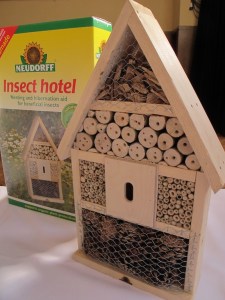
The Insect Hotel
Absolutely fascinated by insects, I was taken with the insect house from Neudorf, available on the web. One is on its way and I’m looking forward to observing what uses its 5 star bedrooms! The mason bees love a pipe filled with nesting tubes I’ve had for year and are fascinating to watch – see short video. I’m hoping for a wider range of insects this year that will give more photographic opportunities.
My gardening shoes have given me really good service for the last 17 years and I decided to replace them with a pair of Backdoor shoes. I chose ones with the bluebell print but as you will see on their website there are many other flower designs to choose from.
A range of gardening gloves were on offer and I thought it was time to replace a pair of Skoma gloves I’ve used continuously for the past three years and have seen better days. I liked them because they were flexible, wicked away perspiration, and gave me sensitivity, lacking in some gloves where you can’t feel anything. They survived frequent washing in the washing machine, but recently they have hardened a little and so I’ll be test driving three different levels of protection from Joe’s gloves – all rather brightly coloured – at least they won’t get lost in the compost bin. And a pair from Ethel Gloves, made from goatskin and bamboo, referred to as the little black dress of gardening! I have to admit they are rather stylish, I’m tempted to just use them for driving!
A rolling composter, one that be kept at ground level and pushed backwards and forwards to aerate your compost is by far the fastest way of creating compost – ready in six weeks! I’ll be trying out the Rollmix Composter and will write about how it works for us.
As you can imagine I had rather a lot to get home and was glad to reach my comfy chair by the fire, have a quick snooze and dream about the garden this year.
Val Reynolds, Editor
Gorgeous Scent in the Garden in deepest winter
Visiting the Royal Botanic Gardens in Edinburgh about this time last year I was captivated by the headiest scent wafting across a path. Some yards away I found the source, it turned out be the flowers of hamamelis. The bed of bushes was vast which accounts for the strength of the scent, they usually grow up to about four metres high. If only I had the space!

Hamamelis - Witch Hazel
The common name for Hamamelis is witch hazel, not related at all to hazel nut plants. Over the centuries it has been used medicinally for treating insect bites and bruises, it helps to shrink and contract blood vessels back to normal size, useful for treating haemorrhoids. It is also used in treating acne.
There are several varieties to choose from. Here the Thompson & Morgan description of : Hamamelis x intermedia ‘Westerstede’, Witch Hazel Hardy Shrub
During the bleak winter months, this deciduous shrub bears an explosion of golden blooms. The sweetly scented, shaggy flowers of Hamamelis intermedia ‘Westerstede’ cling resiliently to its leafless twigs. The summer foliage of Witch Hazel forms a simple backdrop for summer flowering perennials, before turning to vibrant shades of brilliant orange and red in autumn. This majestic specimen shrub is ideal for adding colour and interest to mixed borders and woodland gardens throughout the year.
Height and spread: 4m (13’). Flowering Period: January, February Position: sun or semi shade
1 plant in 9cm pot Despatch: By end of Mar 2012 £12.99
It was in the same gardens that the Queen Mother memorial garden is sited – I was really taken with the shell designs, the best I’ve seen – pictures below.
Val Reynolds Brown, Editor
 In Balance