
A Decent Read – suggestions for a quiet break
How often are you at a loss to know where to find a good book. What is a good book? To me it’s one I can lose myself in. All the angst of the day goes to the back of my mind. So a book at bedtime is a joy and pleasure. But I’m not prepared to read books that don’t satisfy my curiosity, don’t stimulate my interest, or from which I learn nothing new.
So we have decided to provide our assessment of books we have enjoyed, or not. Short, pithy asides and plaintive squeals of dismay are included, so you don’t have to waste time turning off at page ten. That’s the crunch time for us … unless page eleven beckons that tome is passed on to Oxfam, or some such charity shop where maybe someone will view our assessment with disdain and totally disagree with us!
Here are three books all read and finished and assessed by Les Tucker, our intrepid bookaholic.
A Small Circus Hans Fallada* One of the Penguin Classics ISBN 978-0-141-19655-8 *Other books by Fallada
 Do not read A Small Circus expecting a similar experience to the later Alone in Berlin. Fallada’s portrait of life in wartime Berlin is a universal tragedy which is impossible to ignore.
A Small Circus, published in 1931, is just that: a much more parochial examination of politics in a small town. It is a local eye’s view of the collapse of the Weimar Republic (Germany’s first democracy) leaving a situation ripe for the rise of National Socialism, and subsequently, the promotion of Hitler.
The book is not a dry history. It is full of sardonic humour, as pompous local officials tussle over bribes and ill-gotten gains. Outside the little town, the country is spinning off its axis, but a greedy bunch of politicians and journalists seem not to care.
The greater proportion of the novel is written in dialogue, so there is no authorial voice. In many ways, this worked to Fallada’s advantage, as his breakthrough novel received praise from both sides of the political spectrum. It appeared as if he was not taking sides, although a modern reader might beg to differ.
A Small Circus may not make you laugh very often, but it might have you nodding with agreement at the portrayal of human foibles and frailties.
Noughties Ben Masters Published by Penguin ISBN 978-0-241-14526-5
 Ben Masters’ novel is helpfully divided into three sections, entitled; “Bar”, “Club” and “Pub”. My advice to the reader would be to stay in the Bar !
Imagine a dodgy episode of Skins combined with a literary pub quiz and half an episode of Morse chucked in for good measure.
This is Oxford, but beyond the colleges, overheated young things are drinking themselves into oblivion, clumsily bonking each other, but then spoiling the whole experience by agonising about it!
Noughties is a Top Trumps pack of literary references and allusions. Forget about the narrative, just play spot the disguised quotation. The protagonist, Eliot Lamb (get it?) is trying to resolve the dilemma of his love life. As his journey to the light includes such evocative meetings with the opposite sex as, “She places her warm breath inside mine..” one can only hope it is achieved speedily.
There are lots of topical music references and characters spend an inordinate amount of time texting. You don’t need to join Eliot Lamb in his final days at Oxford to enjoy the richness of that experience ! Try the Open University.
The Pale King David Foster Wallace Penguin ISBN 978-0-141-04673
 Did you ever read the one about the American Internal Revenue Regional Examinations Centre ? No … and I wonder how many people will actually finish The Pale King. The author didn’t, as he died in 2008 before it was completed. This edition has been assembled and published by his editor, Michael Pietsch.
Try this chapter opening :
“Until mid-1987, the IRS’s attempts at achieving an integrated data system were plagued with systemic bugs and problems, many of these exacerbated by Technical Branch’s attempts to economise by updating older Fornix keypunch and card-sorter equipment to handle ninety-six column Powers cards instead of the original eighty-column Holleriths.” Come on … keep up !
Wallace is feted as a truly great writer, especially in his love for precision and meaning. This unfinished work is about boredom and sadness, but as it stands it is too great a challenge to the reader. The tedium of the daily tasks of the IRS is plain enough. It is detailed in well over 500 pages. There are jokes, lots of jokes, strange observations, descriptions, and even characters, but this is still a novel about tediousness, and it is act of daring to leave the reader to extract from it the individual stories within. For many, the doors of the tax return processing centre will remain closed. For the legions of Wallace’s admirers, this unfinished work may well achieve the status of an icon. If you enjoy James Joyce, you’ll love this. If not, then tax avoidance may be the answer.
Creating a Wildlife Friendly Garden

Frog tadpoles
As a child I was fascinated by things that moved which included frogs and newts, to dragonflies, to ants and slugs, bees and butterflies. At one stage my sister aged four and I, a couple of years older, put together an outdoor ‘museum’ with our exhibits in boxes to show our parents. Our ‘cunning plan’ to bump up our pocket money was to charge them a penny each for admission – it worked!
Then birds entered my world and both interests have continued throughout my life.
One year I wanted to photograph birds in the garden and did a bit of research to find out how it had been done by others. We visited the RSPB headquarters and watched the great tits, blue tits, finches and great spotted woodpeckers feed on the nut and seed containers. Incredibly I saw a sparrowhawk take a great tit feeding on the nuts. Unlucky for the great tit of course, but the speed of the sparrowhawk was breathtaking. I was stunned, hardly able to believe what I had seen. I can still picture the body of the great tit hanging from the claws of the sparrowhawk.

Waiting a turn
The first step to set up a photographic area was to establish a feeding station. Regular feeding will attract the birds from the local area and as they come to rely on them it is important to keep the supply going throughout the winter. We use a squirrel proof seed container with the RSPB no mess mixture. That sounds a bit ‘neat and tidy’ but switching from the usual mixture saved having to frequently clean up the empty husks of the sunflowers all over the patio. Photographing birds on the feeder is ok and can show how attractive tits find the nuts and seeds.
However Kevin Keatley, a wildlife photographer advocates screwing a clamp to a pole just below the feeder. The birds land on it just before they go on to the feeder. Adding a sprig of autumn berries, or spring blossom makes for a more natural shot. Kevin uses a hide and a feeder about three to four metres away. The advantage of using a hide is that you can move it with the changing light. If you keep the sun to one side it gives a bit more depth to your photos. The ideal light is around midmorning or midafternoon. He has used the hide in heavy snow, the snow or frost covered hide is just like an igloo, insulating him from the freezing wind. There was a time when his wellies froze to the ground – but he says it was worth it when the slides came back with fantastic close ups of pheasants in the snow. Kevin has a website where you can see the hide and chair he uses. His site is well worth a visit, it is full of fascinating information and likely to stimulate some unexpected wandering on the web – have a look at his links.
Our feeders were hung from the pergola, about ten feet from the conservatory windows. I fixed a bed sheet across the open window and down to the ground, cut a slit in the sheet and poked the camera lens through. The camera was mounted on a tripod. I was happy with the bird shots I was getting and then one day a woodpecker came to the peanuts and I had to think about how to have it feeding away from the peanut container which didn’t look very natural. So I asked a friend to let me have a fallen branch from one of his trees.

Male great spotted woodpecker
We drilled big holes to hold the unshelled hazel nuts and almond nuts and placed the branch between two posts of the pergola. The nuts started to disappear although we didn’t get a glimpse of a woodpecker. Then one morning we did – it was very excited, making that distinctive, sharp ‘pic’ call. From then on we were adding nuts every three or four hours. Then may be two weeks later, two fledged young ones visited with their father. You can imagine how excited we were at the prospect of photographing them. That was easier said than done. As there was no regularity to the visits, the window was nearly always shut at the most exciting times!
I took some pictures through the double glazed window of the parent feeding the young but they were not sharp. Eventually only one young one came with its parent, and it took to hanging around the garden waiting for its parent, making desultory attempts at breaking open the nuts.

Young great spotted woodpecker
Once it found how to successfully eat the peanuts it lost interest in the hazelnuts. Then we witnessed the inevitable, the parent actually attacked the young one quite fiercely in response to its crying for food and we never saw them together again. They visit separately now. We expect them to continue to visit in the colder months and will have a big stock of nuts waiting for them! Strangely we haven’t had any problem with squirrels taking the hazelnuts. We did have problems with the peanuts until we bought the strong wire version that can’t be unhooked.
So progress? We are going to drill out bigger holes and put in walnuts – a tip from a very successful woodpecker attractor! We’re going to put a dead branch parallel to the ground about three feet up near to the feeders – I missed some really good shots of a great tit feeding its young – they were partially hidden by greenery on the cherry tree and I’m hoping with careful pruning and branch placement I’ll get the pictures I want!

Hoverflies eating pollen on a poppy
Other steps I have taken to make the garden friendly to both insects and birds are to flowering plants that attract insects. The poppies, all varieties, attract hoverflies in droves. The nettles – kept in a pot – have ladybird larvae all over the leaves that hoover up aphids on neighbouring plants at an enormous rate. I let most plants go to seed – the evening primrose was a huge success with goldfinches. I had problems with keeping the seed from setting the next year, but the hoe is a wonderful tool!

Tiny midges hovering over cabbage flowers
I let some cabbage go to seed and had clouds of tiny black insects hovering over them. An expert told us it was their mating pattern.
In the spring plum blossom attracted a range of bees, from solitaries that live for six weeks, to big queen bumbles. I’ve found foxgloves, onion flowers and blackberries attract the most bumblebees. I like lots of colour in the garden and through trial and error have marigolds, escholtzia, oregano, poppies, evening primrose, foxgloves, nasturtiums, nigella growing unchecked. I’m trying lots of others – herbs, beans, roses, clematis, vines and hops.

Song thrush bathing
The latest attraction is the bird bath perched on the patio wall. We’ve seen everything drinking and bathing there, from wrens to a pigeon that just flopped in and sloshed around to keep cool, and of course our woodpeckers.
What’s next? We’ll be putting up some nest boxes. It’s absolutely essential to have reliably waterproof and well designed boxes. The RSPB’s most popular boxes are for the tits and the open fronted box – suitable for robins, pied wagtails, and more excitingly, spotted flycatchers which are much more common than you might imagine.
The worst type of nest box lets in the rain – the young die from cold and damp, or the exit hole is too low and the young ones emerge underdeveloped and can‘t fly strongly. Result: they flop to the ground and are easy prey for jays, magpies, cats, rats. So if you are serious about making your own please, please, please get a copy of the British Trust for Ornithology booklet Nestboxes, written by Chris de Feu. It’s a gem, with designs for all kinds of birds including owls and house martins and a fascinating read.
For a month by month guide to attracting birds Stephen Moss has written The Bird-friendly Garden, published by Collins and gives lots of advice on how to make your garden a haven for birds. He gives advice on predators and pests, for instance for cats he recommends a machine that emits a high pitched whilst, inaudible to human ear but intolerable to cats. Gardens are the one place where we all can make a difference to wildlife … we felt enormously privileged to play a part in the upbringing of the two great spotted woodpeckers this year. We hope we’ll be doing the same next year.
Last year we attracted some bees to our bee nest box and are hoping for more this year. We brought the box indoors and kept it in a cool area of the house until early spring when the bees emerge. We bought our bee nest boxes from the now defunct Oxford Bee Company. Read our recent feature about the Neudorff Insect Hotel here. By the way we now have another Neudorff Insect Hotel to giveaway! All details on the feature.
Val Reynolds, Editor
Successful Watering with Seeper Hose System

Diverter on downpipe and hose to seeper at ground level
Last year I ran the bath water on the front garden via a hose connected to seeper hose but it took a long time for the water to filter through. So I finally got round to organising a watering system for the front and back garden using rain water from the roof and what a difference it has made. All my plants made much better growth than in any previous years.
I don’t have the patience to stand watering the garden with a hosepipe and have never had a spray system, if I had I’m sure I would have left it on by mistake and racked up a terrific water bill – we are on a meter, so a seeper hose system was the obvious answer. It was reassuring to read a typical drip irrigation system uses up to 92% less water than a hosepipe and is a far more efficient way of watering the garden – www.the-hta.org.uk/water.
The system I devised for the back garden, after a lot of head scratching and frustrated thought, was to put in place rain diverters on the downpipes from the roof, attach a hose to that which led to the seeper hose system. When that overflowed the rain was diverted back to the downpipe and on to another diverter that was connected to a water butt. When that overflowed the water then feed back into the downpipe to the main drainage system.
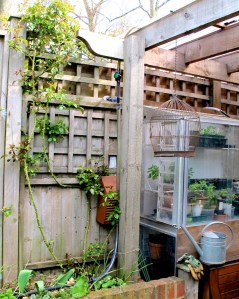
Hose over pergola and down wooden post to seeper hose at ground level - note control tap
The roof on a house collects about 85,000 litres of rain each year in the UK which runs straight into the sewers. This could fill 450 water butts which can be used to water garden lawns, vegetable patches and house plants.
Altogether I used 6 x 15 metres of hose and linked up some small supplementary hose to water the pots on the patio via a separate water butt which made a huge difference to those plants.
Then in times of drought the water butts are linked up to the seeper hose. I generally leave them on for about 4 hours when needed. Now you may feel this sounds all rather complicated and at the time I thought so too, but it in reality it works and is very simple in action. The key is to make sure the water flows in at a slightly greater height than the ground you are watering.
At the moment although there is a hosepipe ban, seeper hose systems are exempt where we are, so when the water butts are empty, I can link the outdoor tap to the seeper hose system and to the water butts. Check the website of the water company in your district to be sure.
Not all parts of the garden need to be watered, for instance the peripheral areas with the wild flowers – bluebells, muscari, oxalis – that look after themselves, so I inserted sections of ordinary hose to bypass those areas. It meant adding connectors which increased costs.
What is important to remember is to cover the hose with mulch or set it into the ground and cover with earth and then mulch – by far the most efficient arrangement, it keeps the moisture in the ground which evaporates very slowly.
Overall, when it rains the garden gets about third extra which is all stored under the mulch. Another important point is to water at night, again to reduce evaporation.
So what plants are important? Fruit trees, crops like peas, climbing beans and broad beans, broccoli, cabbages, spinach, carrots, beetroot, onions, tomatoes, salads, kale. All these came good last year even when we had extended periods of drought. This spring I have noticed the fruit trees all have much more blossom than in previous years.
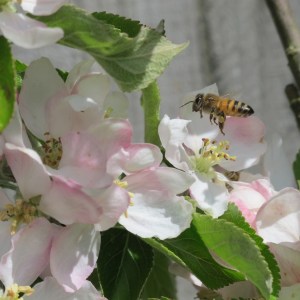
Honey bee collecting pollen on apple blossom
I have been really interested to see that plants grow slowly but steadily through the winter. I think it might be because the thick layer of mulch keeps the cold off the roots. I try, but seldom succeed, in putting at least a depth of 8-9 inches of mulch/compost/manure, which by spring time has been processed to some extent by the worms which means the ground is very easy to prepare for seedlings and plant plugs.
I sow annuals in with my vegetables to make it look less like an allotment. Nasturiums look really good, loving the extra moisture.
This year I have seeds of african marigold, red cornflowers, calendula, nigella and poppy to scatter through the garden. Attracting beneficial insects makes a difference to the life of the garden, they attract birds, making the garden more alive. Better than just putting out nut and seed feeders.
This year I interplanted self sown garlic plants found all over the garden with Malwinnie strawberries as they help the berries to fight disease. I had tasted these at the 2011 Thompson & Morgan Press Event and they were dribblingly good! Will have to think of some surefire way of keeping away the mice, birds and other creatures that know a good strawberry when they taste one!
Carrot, beets, kohlrabi, brassicas, dill, lettuce and tomatoes all do well when interplanted with the onion family.
A water saving tips poster and up to date information on the current water restrictions can be found at www.the-hta.org.uk/water
Growing Sweet Peas using a reliable support device
I have never had any success with germinating sweet pea seeds so having a sister who can grow most things was useful. I sent her the packets of sweet peas from Thompson & Morgan, see below, and hey presto, I have some seedlings in my little greenhouse, growing well, even after I cruelly pinched out their central shoots so as they grow they will throw out lateral shoots to give more flowers.

Sweet pea seedlings
Now I wait for the roots to show through the bottom of the pots before planting them out. The key to lots of sweet peas is to keep picking the flowers to prevent them from developing seed pods, so I’m looking forward to having a house full of sweet scent. Must remember to cut the plants off at ground level when they are finished so the little nodules of nitrogen are left in the ground to feed the next crop or group of plants. This could be called the lazy gardener’s way of improving the soil!
I have erected a Haxnicks Maypole Plant Support in readiness. Simplicity itself to erect, made from black powder coated steel with rot proof strings and galvanised pegs, it’s a feature in its own right. Designed for any kind of climbing plant, annual or perennial, at 6ft in height it will show off anything you plant. I’ll be getting a couple more for next year to add a clematis in the centre of a bed, and for the most successful climbing bean I’ve ever grown Cobra from Thompson & Morgan. Delicious! Other planting ideas are nasturtiums, a vine, french beans – could even experiment with climbing strawberries.

Haxnicks Maypole plant support
Growing Sweet Peas – Thompson & Morgan
- Prima Ballerina

Prima Ballerina
- Wiltshire Ripple
- Blue Velvet

Blue Velvet

Wiltshire Ripple
Val Reynolds, Editor
Beware Dr Google – The dangers of self diagnosis on the web

© Pintail Media
One in four British women has misdiagnosed themselves on the internet – then bought the wrong product in an attempt to cure themselves, a study revealed yesterday.
Researchers found Dr Google is now the first port of call for women with genuine health concerns who are almost twice as likely to check online before consulting a doctor or even talking to Mum. A trend towards trusting the internet over friends, family and medical professionals meant half of the 1,000 women studied would first try to treat an ailment themselves rather than risk embarrassment. But searching their symptoms online and self-medicating has led a tenth of the country’s women to endure unpleasant side effects as a result of their misdiagnosis.
The research, which was commissioned by feminine health brand Balanceactiv found a quarter of British women will trust the internet for advice on treatments if they find their symptoms embarrassing.
Penny McCormick, spokeswoman forBalance Activ said yesterday: ”There is an increasing trend towards using the internet to diagnose any irregularities or worries we have about our bodies.
”The web gives us a wealth of information that can be useful in reducing our worries until we’re able to gain proper advice from a medical authority if it’s needed, but the results show how easy it is to make mistakes when diagnosing ourselves.
”It’s important we learn which information to trust online and that we’re able to make the distinction between what can be self-diagnosed and easily treated, and what definitely requires the help of a medical professional.
“What can seem like a relatively harmless but embarrassing symptom could develop into something more serious so it is important for women to ensure they are asking the right questions and treating certain conditions effectively in the first instance.”

Carving on 15th century font © Pintail Media
The study was carried out to mark National BV Day on 18th April – which aims to raise awareness of Bacterial Vaginosis (BV) – a condition that is almost twice as prevalent as thrush that 2 out of 3 women are misdiagnosing. If left untreated BV has been linked to some serious health implications including an increased risk in contracting STIs, infertility and miscarriage if present during pregnancy. The report also found despite having diagnosed themselves online and decided on a high street treatment, 45 per cent never check they are buying the right thing with a pharmacist or counter staff.
The agonising wait for answers is what drives thirty per cent of women to look for help online, while one in ten hesitate to tell friends or family of any health problems because they don’t want the issue to be ‘made into a fuss’. Tellingly, three quarters of the 1,000 women said there are certain health issues they aren’t comfortable talking to friends and family about. Indeed, women are more likely to trust their own diagnosis when embarrassed by their symptoms – half of the study would always try to deal with the problem themselves before seeking help from others. Over a quarter of respondents dread talking to doctors about anything they are embarrassed about.
Most women had spent a few days worrying over symptoms before speaking to anyone, while a worry-stricken third of the sample had endured at least two weeks sweating over an ailment. Remarkably, one in twenty women said they had spent a number of years worrying a particular symptom was something serious before eventually getting it checked out. Because of waiting times, thirty per cent only visit the doctor as a last resort, while half of the women studied said they would always try all they can to cure themselves and only seek medical advice if the problem didn’t go away.
The symptoms most likely to prompt women to diagnose themselves are problems sleeping, headaches and depression, while muscle pain, itching and fatigue regularly cause women to consult Dr Google. A fifth of women had at some time suspected they had a serious disease – the most common false alarm came over breast cancer, while many women had wrongly diagnosed themselves as having thrush, high blood pressure or asthma.

Skating along Eastbourne promenade © Pintail Media
Penny McCormick, spokeswoman for Balance Activ, continued: “With the resource the internet provides us, it makes sense that women now see this as the first place to consult, especially as they can do so in private.
“However women choose to get advice about their health, being embarrassed by symptoms should never lead to them making a quick or unsupported diagnosis on their own unless they are certain of the quality of the information.
“Worrying symptoms or anything relating to our intimate areas naturally makes it harder to deal with and often leads women to rush to a diagnosis or avoid the issue completely.
“Leaving symptoms untreated, particularly with BV, can lead to serious health implications including an increased risk in contracting STIs, infertility and miscarriage if present during pregnancy.
“That is why we have launched an online symptom checker so women with any health concerns relating to their intimate areas can diagnose themselves accurately to help treat it right.”
Visit www.balanceactiv.com/symptomchecker
TOP 10 MOST COMMONLY MISDIAGNOSED
1. Breast cancer
2. Other forms of cancer
3. Thrush
4. High blood pressure
5. Asthma
6. Arthritis
7. Depression
8. Diabetes
9. Sexual health problems
10. Thyroid problems
Data provided by Balanceactiv to raise awareness of Bacterial Vaginosis Day 18 April 2012.
Indoor Plants – Pest Management & Pollution Control

Scented orchid
Indoor pest management includes a careful inspection before purchase and when bringing plants in from the garden. Meeting a plant’s environmental needs reduces plant stress and a healthy plant is less vulnerable to attack.
When pest control is necessary non-toxic or less toxic insecticides can offer effective control. Natural pyrethrum spray is relatively safe, synthetic pyrethrum is less desirable. A 0.2 per cent solution of mild washing-up liquid is generally an effective method of washing plant leaves. Cotton buds dipped in surgical spirit is a good way to remove spider mites, mealybugs, scale insects and aphids, although I found scale insects needed this treatment for far longer than I imagined. The only effective method I found was to lever them off with a flat ended knife.
Making your own non-toxic spray: Mix 2 teaspoons (10 ml) vegetable oil, 1/8 teaspoon (0.6 ml) washing-up liquid, 8 fl oz (230 ml) warm tap water is quite rewarding. Shake vigorously.
Not all my plants are strictly houseplants, I raise a lot of fuschias from cuttings. These are wholeheartedly targetted by whitefly so I have an ongoing fight! Now I keep them outside for the birds to take their share right up to the last possible day before frost might wipe them out.
My absolute favourite indoor plant book was written by Wolverton – Eco-Friendly House Plants: How to grow and nurture 50 houseplants to ensure you have clean, non-polluted air in your home and office. Wolverton undertook some pioneering research on clean air in space stations by the US Space Agency. You can read more about his work here.
Of the houseplants that fall into the category of eco friendly according to Wolverton a rubber plant is the most likely to be successful. Bred for toughness, it will survive in less light than most plants its size. It has a high resistance to insect infestation and is easy to grow and, very important, is especially effective at removing formaldehyde most often found in furnishings that take years to cease emitting fumes.
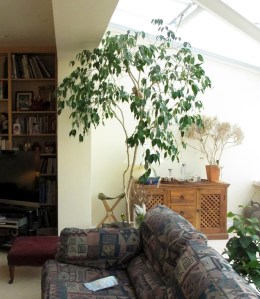
Weeping fig in conservatory
A ficus longifolio alii commonly known as the weeping fig, has proved to be exceptionally hardy in our conservatory. It is sited partially in the sitting room and has tolerated neglect over the past 15 years. Apparently it does like misting – now becoming a bit difficult in view of its size – almost 10 feet high. I spread polythene around and use the step ladder! It is good at removing a range of chemical vapours, is easy to grow and maintain.
Christmas and Easter cactus have the unusual property of removing carbon dioxide and releasing oxygen at night – the opposite of most plants – which makes them suitable for bedrooms. These plants often become quite large and survive for many years. Easy to propagate from cuttings and very resistant to insect infestation they make a great gift for friends.
 Source: Eco-Friendly House Plants by B C Wolverton How to grow and nurture 50 houseplants to ensure you have clean, non-polluted air in your home and office.
THIS IS THE ONE BOOK I WOULD NEVER EVER BE WITHOUT! and when my copy lent to a friend wasn’t returned I looked on Amazon and found a used copy at £2.01+£2.80 pp.
It has been recently updated as How Grow Fresh Air
Val Reynolds, Editor
Photography Pintail Photo
Attracting wild bees to your garden – Result!

Insect Hotel
I put the Neudorff Insect Hotel on 26 March and today, 29 March I saw a tiny bee crawling into one of the holes!
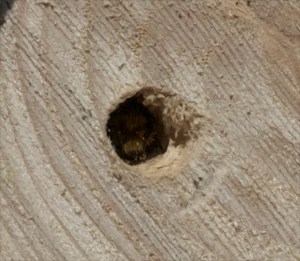
Bee crawling into hole
We have a welcome guest. How good is that! Little did I expect such a fast response.
You can read our article about attracting Mason and other bees here.
We have an Insect Hotel to give away – details on the same webpage.
Val Reynolds, Editor
Attract Wild Bees in your Garden with an Insect Hotel
It is time of year when I reinstall the bee nest boxes kept in our dry cool garage since last autumn, into the garden. I bought my nest kits some years ago from the Oxford Bee Company, which sadly is now defunct.

7 cm bee nest
The Oxford Bee nests I have are two sizes: 7 cm and 12 cm

12 cm bee nest
As the tubes the bees use to lay their eggs degrade over time and sometimes fall out and get wet, or birds pecking at the tubes make them fall out – some folk have trouble with woodpeckers – I had to search around for a website where I could get replacement tubes.
Red Mason bees use the tubes to lay their eggs and the most curious fact is that the first egg they lay emerges last? How can that be? Evolution I know – perhaps there’s some kind of chemical difference in the nectar moistened pollen used that delays development. Honey bees feed their queens 100% on what is known as royal jelly, a high protein secretion the worker bees produce from their heads, a somewhat less amount is fed to the drones, and even less to the workers.
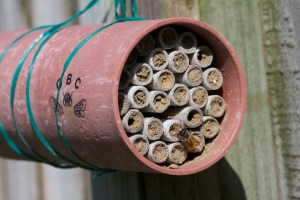
7 cm bee nest with red mason bee
This year I transferred most of the tubes from the smaller pipe to replace those gaps and degraded tubes in the larger pipe. So I decided to add some dried stalks of fennel and hollyhock that I left standing for insects to overwinter. Here is the result, a bit raggedy but useable. Another of my cunning plans – code for hopeful experiment! I use a pipe support for the pipes to rest on and then use wire to keep them in place.
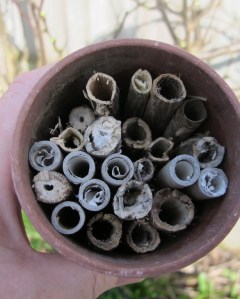
A mix of ready made tubes and dry plant stalks
When I need more I’ll make them from plastic water piping. One end would have to be blocked off to mimic the Oxford design.
In my search for replacement tubes I came across the Schwegler bee nesting box which has fascinating see-through tubes, the eggs and pollen can be clearly seen. And I found this really interesting website about bees – the drawings are delightful.
Here’s a link to info about Red Mason Bees http://www.hedging.co.uk/acatalog/Mason_Bee_FAQ.html
Here is a Google page with lots of references to Red Mason Bees.

Neudorff Insect Hotel
Our Neudorff Insect Hotel is now erected. We have placed it near the greengage tree and look forward to watching the insects inspecting it!
Helping insects find a safe haven in your garden for nesting and hibernation isn’t just good for the environment – it helps your garden, too. Ladybirds and lacewings munch greenfly and blackfly, while mason bees pollinate fruit blossoms as do lacewings.
Neudorff’s new insect hotel offers a stylish way of greening your garden. Designed to attract ladybirds, lacewings, mason bees, digger wasps, wild bees and hibernating butterflies like Peacocks, Brimstones, Small Tortoiseshells and Red Admirals, its wooden structure features different rooms to suit insects’ varying needs, such as hollowed out wood for mason bees and a central space for butterflies to seek shelter.
It’s also a great educational and instructive device that fascinates young children from age of three upwards. Great for school projects too!
For more information, visit the Neudorff site.
GIVEAWAY
UPDATE: We now have TWO Neudorff Insect Hotels to give away to In Balance readers. All you have to do to enter the draw is send an email to:
With Neudorff Insect Hotel in the Subject box and your contact details including telephone number in the text box
Only one entry per household will be accepted and must have a UK or Forces postal address.
Last date for entries has been extended to 10 June 2012.
Val Reynolds, Editor
A Great Day Out – Warwick Castle!

Caesar’s Tower, Warwick Castle
Whatever time or financial limits parents may have at half term, a special trip is always a lasting memory especially when you are very young. Can you remember the first time you visited a zoo, or a circus. I must have been all of six years old when we visited Whipsnade Zoo and still have the memory of the taste of my first ice cream! It was a Walls ice cream wafer sandwich that dripped all down my front and the memory includes the smell of the elephant house and the screaming of some monkeys in their big outdoor cage. In Balance reader Karen, with her husband, six year old Ben and four year old Aeryn visited Warwick Castle last half term and had what was clearly a memorable visit and would love to go again.
Karen writes:
I have visited Warwick Castle several times – around the age of 8, 15, mid 20s and now in my mid 30s with my husband and two young children and I can happily say that I have thoroughly enjoyed every visit and can foresee more visits in future, it is that good.
We decided to base our day around the verbal and visual displays that were well described on the website.
So we started off at the ‘Raising of the Portcullis’. It was great to see the portcullis being lifted and to imagine that you are walking into the past.
We went straight on to the ‘Attack & Defence Tour’. The lady made a point of getting the children to the front used some children to demonstrate the width of the wall – which helped put it in perspective for them. As they don’t fire the ballista maybe they could consider having some mini ones set up somewhere so that children, or indeed adults, can have a go to get an understanding and respect for the weapons.
 We then walked around to ‘The Mighty Trebuchet’ which was easily seen and heard as the trebuchet is across the river and the commentator had a set place to stand. He was also miked up to several speakers that were spread out over a wide viewing area. It takes quite a while for the trebuchet to be prepared and fired but there is detailed description and historical explanations during each stage. Facts like using blind people to be the ‘walkers’ as the motion sickness generated from viewing the slates could cause people to fall and break their necks. Tip bits such as using the trebuchet to send dead animals or beheaded messengers over the walls to spread disease and fight a psychological battle are gruesome enough, images that strangely cause fascination with the use of such devices during sieges ie it’s so much more than just something which throws balls of fire. Which, to be fair, on its own is an amazing sight and the way our six year old’s eyes lit up when it happened was testament enough that it’s well worth the wait. I thought it was great that over 18s could volunteer to be part of the team that prepped the trebuchet. Hands on history is always the best in my opinion.

Eagle with handler Warwick Castle
The ‘Flight of the Eagles’ was held in the main arena so benefitted from speakers and four wooden posts which the man lead each bird to in turn so we easily got a good view of each bird. Our six year old particularly enjoyed watching the vulture as he was “walking funny”. The use of questions and answer time to one side after the show was particularly thoughtful as it meant that our shy child was able to ask a question that he wouldn’t have done in front of the whole audience. It also meant that we got a good close up picture of one of the birds.
The ‘Warwick Warriors’ probably held our children’s attention the best as there were three main people involved and there was plenty of appropriate and amusing banter between them. There were lots of visual demonstrations alongside interesting explanations. The idea of destroying Hollywood film myths really did challenge the average concept of what it would have been like to be a knight. They also included some great references for the children such as comparing how Scooby Doo quickly hides in a suit of armour and yet real knights would have needed someone to dress them. The actual demonstration of this amplified the point. Once more humour was used to maintain attention, for example, the fully armoured knight demonstrated that he could run, jump and even do star jumps.

Fire juggler and knight in armour
Lots of facts were given throughout all these demonstrations and at the time we were not sure just how much our children were taking in but a dinner time conversation a couple of days later reassured us that our visit to the castle was not only a fun day out for our family but also very educational even for a four year old. Both our children couldn’t say enough about what they had seen and heard when asked to tell their uncle and nan where they had been. “Did you know that they learnt how to use a sword when they were six and a bow and arrow when they were eight” Benjamin, aged six.
With all of these displays the people leading them were all of an impressive standard. They all kept the audience’s attention well and had a good mixture of information and humour. The information was also pitched well starting from small and factual for children to recall, to enough detail for proper historians without boring the more average visitor. There was also a good mix of visual, audio and kinaesthetic techniques used to involve the audience without overly applying the audience participation which can put some people off. The use of characters for most of these displays was very well balanced between ‘in role’ and ‘not taking themselves too seriously … often explaining why out of role’. We loved the delivery, as I’m sure you can tell.
After all these displays we stopped off for a toilet break (of a good standard and easily found) then visited ‘The Mound’, ‘Dream of Battle’, ‘The Tower and Ramparts’, ‘The Kingmaker’ and then ‘The Chapel, Great Hall & State Rooms’ (although the rooms were disappointing – not much information and not really geared up for young visitors). The Mound and The Ramparts were great for the children to get excited pretending that they were defending the castle. The Kingmaker was well set out with plenty of mannequins and brief bits of information (both verbal and written) so that it was easy enough for the children to imagine what life might have been like but without being too scary (although our four year old was a little wary especially in the slightly darker areas).

Aeryn in the stocks
We ended our visit with the Peacock Gardens, Conservatory (although not much to see in there) and the Rose gardens (which were being renovated and obviously the roses were not out yet but we still appreciated the layout). Finally, we took photos of our children ‘stuck in the stocks’.

Ben in the stocks
I did weigh up the possibility of taking my father on our next visit. He is disabled and would need the use of wheelchair to experience a day long visit. I do think there would be enough to justify a visit for him. Although I could not find information regarding the price of ticket for a disabled visitor – I hope it is heavily discounted as probably only a third of the whole attraction (if that) is accessible from information gleaned and accessibility assessed on our visit.
We heard later of a spine-chilling new addition to the programme: Witches of Warwick which promises to thrill visitors from March this year – are you up for the challenge?
Karen Fletcher, contributing author
DID YOU KNOW? Just an hour and fifteen minutes by train from London, Warwick Castle is rated by Tripadvisor as one of the most talked about attractions in Europe and is the most visited stately home in the UK. It has a variety of attractions to appeal to families, retirees and mid-30 something culture vultures alike.
Go to the Warwick Castle website for further information and booking online
Photography Karen Fletcher & Warwick Castle
The Day I Sang at The Albert Hall
Well, me and 3,840 other people!
 I’d heard about the huge choirs of amateur singers that sometimes gather at the Albert Hall to sing together, but had never got further than thinking vaguely that it might be nice to join in. It took another member of my local choir to start the ball rolling and whip up some enthusiasm, and eventually tickets were bought for “Messiah From Scratch” in November. It was unfortunate that all four members of our little group then did the same thing – put the tickets aside without checking to find out exactly what was involved – so it was just a few weeks before the date of the concert before we realised that when the organisers called it “From Scratch”, they really meant it. We were to turn up at 6.15pm in order to be ready for the concert to start at 7pm, without even a few minutes in which to warm up, let alone actually practise the music!
At this stage, we had no way of knowing how many people would be singing with us, and therefore how exposed our own singing abilities and knowledge of the music would be. If we’d known then that nearly 4,000 people would be there to sing, we probably wouldn’t have worried so much, but even so, The Messiah isn’t especially easy music to sing and none of us had sung it all the way through for years, if at all. Our first task obviously was to get hold of copies of the musical score, and even this wasn’t simple as the organisers specified the exact version to be used. Here, though, we were very lucky as our local library still had just enough copies left for us to borrow even though Christmas was approaching fast. Recordings of the work then had to be found/bought/borrowed, and our unfortunate families had to suffer the dreadful, dirge-like sound of amateur singers droning their own rather approximate version of Handel’s great work along to a professional recording. All four of our group are contraltos, which means we sing the lower of the two female parts, mainly to provide harmony, so we never get the good tunes. I have to confess that in our household, even the cat found pressing reasons to go out once I and/or my daughter started rehearsing!
 By the week before the date of the concert, we were all beginning to wonder why we’d volunteered for this event. Some friends and colleagues were incredulous. “You mean you have to pay in order to sing at the Albert Hall? You don’t get paid to do it?” And no, we don’t get paid, and we do have to pay (£20 for this performance) because this was a charity event, and the proceeds were going to the British Heart Foundation.
An added complication was the dress code. As ever, men got off lightly as they were only required to wear a dark suit, but ladies were requested to look elegant, with sopranos wearing blue, and the contraltos red. None of us had anything red which could remotely be described as “elegant” so several hours had to be spent in going around the shops in the search for red tops to be worn with black skirts or trousers, but eventually we managed to cobble together some respectable outfits, and by 4 pm on the day of the concert we were all dressed up and heading for the station for the trip to South Kensington.
 We were in luck; the trains and tubes ran perfectly, and within an hour and a half we were outside the Royal Albert Hall, where people were gathering and chatting enthusiastically. After demolishing the sandwiches which we’d brought with us and paying a quick visit to the Ladies, we made our way to the seats which we’d been allocated, right up in the Circle. Already nervous and a little bit prone to vertigo, I found the steepness of the rake and the height above the main auditorium alarming and for a few minutes was wondering if I’d have to remain sitting for the whole of the performance, but I became acclimatized to it surprisingly soon and began to relax and take in the scene. We’d taken our seats quite early, so were able to watch the other singers gradually arriving and taking up their positions all around the Hall. Lots of people were greeting friends, while others were arriving on their own, clearly content just to be there and to sing. The majority of singers were probably in the middle-aged to mature bracket, but there was a substantial number of young people too. There was also considerable variation in dress. While a lot of women had opted for the safe combination of black bottoms with a red top of some kind, others had made only a minimal gesture towards the dress code with perhaps just a red flower or brooch pinned onto a black T shirt. A few had decided to take the light-hearted approach and were apparently wearing fancy dress, with one rather substantially built young woman happily wearing what looked like the costume of the Red Fairy, complete with frills and red sequins.
By the time we’d arrived at the Royal Albert Hall, it had felt as though we’d travelled quite a long way on a dark winter evening but when Don Monro, the man who had dreamt up The Really Big Chorus in 1974, stood up to speak, he welcomed singers from around the world! Singing alongside us would be singers from Australia, Canada, South Africa and many parts of Europe, so popular have these events become.
His short speech over, the soloists and the conductor, Brian Kay, took their places, and the orchestra struck up the overture. At this point, I noticed a really interesting phenomenon. Up until then all the people I’d been watching, far away on the other side of the hall, had been sitting relaxed in their seats, sometimes bending down to adjust their belongings, sometimes chatting to other singers beside them. But the moment that familiar music started it was if an electric current had passed through them all, or as if an order had been barked out. In an instant, everyone was sitting bolt upright, heads erect, their entire bodies looking alert and ready to sing.
 After a beautifully sung aria from the young tenor (“Comfort Ye, My People”) the conductor signalled to singers on the ground floor of the auditorium to stand. It was really at this point that we became aware of how different it would be to sing in such a huge hall with so many other singers. We could see the conductor, but from our position high up in the Circle, he was just a tiny figure far below, and when we lifted our music to sing, he became invisible behind it! Instead of relying on him for cues as to when to come in, when to slow down, and all the other more subtle variations in the performance, we’d be dependent on hearing other voices singing our part in other areas of the auditorium, the singers who were much closer to the conductor and could therefore follow his directions.
I think it’s fair to say that the first few choruses were a little bit ragged, while the singers gradually got used to the acoustics. At one point, I could see the conductor frantically signalling to the huge mass of sopranos to sing more quickly, but, however distinguished and able he may be, it’s a brave man who takes on a thousand sopranos alone, and very wisely he deferred to their group judgement and allowed the choir to find its own pace. Before very long, our little group had relaxed in the knowledge that any musical mistake we might make would be lost in the huge volume of sound being produced by so many singers.
One of the delights of singing with these big choirs at the RAH is being able to watch and listen to the soloists. For this performance, the soloists were all very young singers in training for professional careers, and to me at least their extreme youth added poignancy to the music.
Our position in the Circle meant that we were well placed to make a dash in the interval to the bar, so by the time the second half began and our gin/vodka’s were taking effect, we were feeling quite comfortable and ready to tackle the remaining choruses with enthusiasm. By now, the choir was (almost) singing as one, so that by the time we reached the famous Hallelujah Chorus, I think we produced a very creditable performance. Knowing that our audience would all have been eagerly anticipating this most famous of all choruses probably tipped the tension rates up a notch, and I think we all gave it all we’d got. It certainly got a rapturous reception from the audience! Many people think that the Hallelujah chorus is the final part of the Messiah but in fact there are more arias to follow, before the last chorus “Worthy is the Lamb” leading into the final section known as the Amen chorus. This is a far more sombre and spiritual chorus, and I felt that the huge choir sang it with a surprising amount of sensitivity and feeling, perhaps aided by the knowledge that this marked the end of the occasion.
Discussion of the evening had to be postponed until we’d accomplished the journey back to the railway station, but, once on the homeward-bound train, we shared our thoughts. My daughter and I agreed that we hadn’t experienced the huge rush of emotion felt by a lot of singers, which was a surprise and a bit of a disappointment, but I suspect that this was due to our position in the Hall. Because we were so high up, the sound of the rest of the choir was coming to us almost as if we were listening to a recording, whereas I think that if we’d been seated downstairs in the main auditorium we’d have been far more aware of being part of a huge group of singers. We agreed that it was only towards the end of the concert that we’d really relaxed and enjoyed ourselves, so we’re all keen to have another go before too long. It was clear from the joy and sense of achievement on some of the faces around us that taking part in this event means a huge amount to many people and I suspect that like them, we’re already hooked and will be booking our places for the next big chorus. This time though we won’t get so stressed about our musical abilities (or lack of them) as all we need to do is relax and prepare to enjoy ourselves and let the music and the other singers scoop us up and carry us along with them.
Contributing Author: Janet Hamer
For more information about how The Really Big Chorus began, and how to get tickets, the website to go to is www.trbc.co.uk
 In Balance