
Save our Vegetables!
 A Most Suitable Gardener’s Gift
This opportunity of supporting a charity and helping to save a rare vegetable variety under threat of extinction will appeal to many gardeners with a sense of history and future preservation of vegetable varieties, especially if they grow plants from seed.
Britain’s leading organic growing charity, Garden Organic, offers the perfect green gift by encouraging people to Adopt a Veg.

The organisation looks after over 800 varieties of rare and heirloom vegetables in its Heritage Seed Library (HSL), and is offering people the chance to adopt one of these vulnerable varieties through it’s Adopt a Veg scheme, preventing them from becoming extinct.
 For over thirty years the charity has been campaigning to save Britain’s traditional vegetable varieties, which are threatened by commercial pressures and EU red tape, and argues that some of these varieties may save us from a world food shortage.
Garden Organic’s head of the Heritage Seed Library, Sandra Slack, explains: “Without maintaining a range of vegetable varieties there is a very real threat to our food supply. Diversity of varieties means crops are less likely to fall foul of pests and diseases on a massive scale, and with a changing climate this can only become more and more important.
“Believe it or not the Victorians once grew 120 different tall garden pea varieties, but today, due to a range of pressures, only one tall pea variety remains. Many rare vegetable species have unique characteristics that make them suitable for growing in a wide range of conditions. We need to ensure we are not relying on one or two main varieties for our food source.”
 By Adopting a Veg you can contribute to protecting these varieties, you will also be helping to protect the biodiversity of our planet. It costs just £20 and will help to pay for seed handling, storage and propagation facilities, as well as the staff needed to look after the ever-expanding collection.
 You will receive a certificate of adoption for one year, background information on your adopted variety and a gift card designed by artist-in-residence, Lesley Davis. Most importantly you will have the personal satisfaction that you are helping to keep alive part of the UK’s precious vegetable heritage.
 To Adopt a Veg visit http://www.adoptaveg.org/or call 02476 308210 to choose from their extensive list.
London’s Hidden Secrets – the City’s Quirky and Unusual Sights
 New guides to London are proliferating! Last July I reviewed the London Sketchbook for this magazine, a personal and somewhat quirky look at the capital that took certain areas and walked you through them.
Now, like the proverbial buses (you wait half an hour then two turn up at once!) I have in front of me London’s Hidden Secrets by Graeme Chesters, with the sub-title A Guide to the City’s Quirky and Unusual Sights. Strangely enough, I wouldn’t particularly have chosen the word ‘quirky’ to describe this one, though certainly ‘unusual’. This is a beautifully produced and methodical guide that takes you from the heart of London to the outer suburbs and describes in precise and concise terms points of interest that are certainly not on the tip of every tourist’s tongue.

Piccadilly Circus
The layout is clear and consistent: Every sight has two pages devoted to it, the left displays photographs and an ‘at a glance’ box which gives you the all important information on location, cost and opening hours. (There is a ‘health warning’ right in the front of the book in a stand-out red box to check times as they may have changed – with continuing cut-backs some places are shortening visiting times). The right page is devoted to an informative and very readable written description of the sight with a charming one-line quote at the end from the author, summing it all up as he sees it.
So let me whet your appetite with a few examples, starting right at the heart of the city. Have you ever noticed the Twinings Teashop and Museum opposite the Royal Courts of Justice? Or in particular its 18th century doorway with its two Chinese figures and the company’s golden lion? The quote at the end of this one is ‘More tea, vicar?’, a lovely illustration of the liveliness of the author’s writing.
Moving outwards, would you like to see ‘Some of the best Italian art in London’? Then head for the Estorick Collection in Canonbury, which also often has interesting temporary exhibitions and is particularly regarded for its Futurist works, all housed in a lovely 19th century building. Interested in Art Deco architecture? Then, if you’re a north Londoner like me, grab your passport and head south of the river (though not very far) to Tooley Street by London Bridge station and look carefully at St Olaf House. I’ll confess that I must have been past here on numerous occasions and never noticed the intricacies of the building before, both the Tooley Street side and the Thames side. I’ll be looking out for it next time I’m in the area.
And finally, if all Neasden conjures up for you is the magazine Private Eye, take a Tube there and wonder at ‘Europe’s first traditional Hindu temple’ with its souvenir shop (of course!) and a restaurant serving Indian vegetarian food. Named, apparently, by Readers’ Digest as ‘one of the seventy wonders of the modern world’.
I thought I was well-versed in the standard and less-standard fare that London has to offer. Since I’ve had this lovely book in my possession I’m not so sure!
London’s Hidden Secrets is published by Survival Books priced at £10.95.
 Jeannette Nelson A bit of a culture vulture, Jeannette enjoys art exhibitions, cinema and classical music, but her main interest is the theatre. For several years she ran theatre discussion groups for which her MA in Modern Drama together with teaching skills stood her in good stead. She prefers to concentrate on the many off West End and fringe productions as well as that real treasure of the London theatre scene, the National.
Finding a Suitable Care Home, a book to help

© Pintail Media
The time may come when we are faced, probably unwillingly, with the possibility of finding a suitable care home for a relative or family friend. With little or no experience of such places searching out an acceptable home can be daunting. One that at least I had had no experience of. As luck would have it I heard about the independent guide to choosing a care home in the south east of England, entitled The Care Homes Guide – South East England. One in a series, it proved to be a mine of information especially in relation to financial considerations.
For us it raised more questions than answers which needed a lot of time to understand and resolve. However the book has an extensive directory of approved homes, impartial and clear comparisons, and essential advice on choosing the right home, as well as useful contacts. We found it a reliable and very readable source of information and became our essential reference source. 
Highly recommended, published by Crimson Publishing, £14.99, http://www.crimsonpublishing.co.uk
You may also find our recent feature Care Homes: How to avoid being wrongly charged of interest.
Val Reynolds Brown, Editor
Puppy Problems Solved 4: Winnie learns about other dogs

Winnie, left, in playful mood
Written from Winnie’s point of view
We’re out in my favourite woods for a lovely walk. I love coming here, I never get tired of it, there’s so many interesting things to sniff at and play with. Lots of rabbit trails to follow, other people to say hello to and loads of other dogs that are so friendly!
I like Claire’s other friend who has come with us today. She likes playing with me too.
Ooh, what’s that amazing smell?! I’ll just follow it into these bushes. This is so much fun.
Hang on, I’d better go and find Claire again, she’ll get worried if I disappear – I don’t want to lose her!
Oh, there she is, she’s waiting for me.
Winnie! Here girl!
Here I am! Don’t worry I didn’t go far! Scratch my ears … but wait, there’s something else to smell here … this is interesting …
What’s that coming towards me? It must be a friendly animal to play with.
Aaagghghg! Whine … ouch, that hurts, why is this dog biting me, I thought all dogs liked to play with me … ouch, ouch, whine …
Why won’t someone help me!? I can’t shake this dog off me at all, he’s biting into my neck!
Claire and her friend are helping now, I hope they don’t get bitten too! Oh and a man is helping, he’s pulled his dog off. Thank goodness, that hurt so much.
Claire, I need a cuddle, I’ll cower behind your legs. Please protect me! That was very frightening.
It’s okay Winnie.
A nice cuddle, thank you Claire. My heart is racing, I’m so scared – at least that horrible dog has gone. I didn’t realise some of them weren’t very friendly! All the dogs I’ve met so far have been really nice to me and wanted to play, not attack me – and I didn’t even do anything, I was just walking along, minding my own business!
I don’t understand …
Claire’s putting my lead on and we’re heading back to the car. Thank goodness. I hope that dog doesn’t come here very often, I’ve never seen him before, but it makes me a bit scared. Perhaps I should be more on my guard in future.
Comment from Owner Claire Price: Winnie was attacked by a bull dog, it seemed to appear from nowhere and just launched itself at her. I had my small daughter on my back in a carrier at the time and the dog’s owner was walking with children too. It was a very scary moment, the family were very apologetic and fortunately no harm was done, it was more frightening for Winnie. She’s always been a bit dense about other dogs until this incident, she was always very friendly and wanting to play, but from then on she learnt to be a bit more circumspect and give dogs a bit of a space.
BREEDER’S ADVICE: Pat Thomas
Although moving away from my area of expertise (breeding) a few comments may be helpful.
- Don’t put your own safety at risk or the safety of others, especially children.
- Some breeds – usually “bull” breeds have an interlocking jaw. These breeds cannot be pulled off as their bite allows them to hold fast to whatever piece of the “prey” they are holding, i.e. flesh/ear tips/tail etc. One hopes that the owners of such dogs will walk them with a muzzle firmly in place.
- Resist the temptation to smack the biting dog. This only serves to further increase the adrenalin.
- Although it happened to Winnie, it is unusual for a dog to launch an attack without giving off signals – tail held erect, hackles rising, maybe a growl or snarl. This gives you a minute to put your dog on a lead and (if possible) change direction.
- If puncture wounds are suffered – either to you or your dog – go to the appropriate medical centre. Dogs carry a huge amount of bacteria on their teeth and a puncture wound allows this bacteria to enter the blood stream. Usually (after bathing/stitching) it is antibiotics for dogs and a tetanus injection for people.
- If the fight was serious, inform the Police. Although unlikely to act on a “dog-to-dog” fight, if enough people complain about a certain dog, then the Police may – at the very least – have a word with the owner. The Control of Dogs Act give the Police the authority to investigate.
- The “attacked” dog may have various reactions ranging from couldn’t care less to extreme fear. It may be necessary to ensure that only friendly dogs are encountered on the next few walks, until confidence returns.
- If problems remain, then contact a dog behavourist who should be able to help.
Pat Thomas bred her first litter in 1971 and has bred Border Collies, Irish Setters, Cavalier King Charles Spaniels, Papillions, Labradors and, of course, Golden Retrievers.
Although Winnie is not yet in season most of her litter is booked. This is usually the case, although too many of one sex can be a problem. As a Kennel Club Accredited Breeder, Pat has free access to the K.C. website and if she have any puppies not sold, she puts them on there. However, mostly the pups are sold by word of mouth and families returning for a second, third and even a fourth puppy.
Have you ever experienced a dog attack? How did you cope? Would you like to write about it. You can email me at editorinbalance@me.com
This feature is the fourth in a series of seven episodes entitled Winnie’s Woes
Episode 1: Winnie finds Digging is not Popular
Episode 2: Winnie Chews a Shoe
Episode 3: Winnie Eats Too Much
Anythingdogz – an excellent website owned and run by Lisa Evans, an In Balance reader
A Bad Back is a Painful Thing

© Pintail
Janet ruefully writes about her Back. A bad back. Something a lot of us suffer from. We are all in a search to soothe, relieve, strengthen, our back. The back is our weakest part of our structure and as Janet says, once it goes, there’s not going back. This is how it is for Janet.
The world is divided into two kinds of people; those with Backs, and those without. And before you sigh and turn to another feature, let me remind you that you could find yourself in the other camp at any time and without warning. And once you’re in that camp, you’re there for life.
For me, it all kicked off at the age of around 40 when I was slim and supple, and attended a weekly two hour yoga class taught by an inspiring teacher. I don’t know what mischievous yogic demon persuaded her to introduce her class of middle-aged mothers to the splits, but one fateful day this is what she did. To my great joy, and very short-lived sense of smugness, I was pretty successful and went home determined to keep practising, though quite what I thought mastering the splits would do for my life, I don’t know. But sheer stupidity led me to think that I could safely attempt at 7.30 am the next day what I’d done previously at the end of a long series of stretches. The pain as I tried to sink into this extreme position was excruciating, and my 40 years of not having a Back had ended. I soon learnt to tell no one how I’d hurt it as the looks of incredulity followed by badly concealed amusement spoke volumes.
So from then on life changed, as it does for all Back sufferers. Because you, the owner of a Back, are constantly searching for the ultimate goal – a permanently painfree back – your antennae are always on the alert for some new and amazing therapy. Your address book is full of chiropractors and physios, while your postman is at risk of developing a Back himself due to the volume of books on Back Care that you’re ordering,
Then you discover a book called You Can Heal Your Life and find that the cause of your problems might not be physical at all, but a reflection of your financial anxiety, or of feeling unloved and unsupported. You pass some of this information onto your partner who takes instant offence and moves into the spare room – where he’d been thinking of going anyway as he’s fed up with falling over the arsenal of back support devices littering the bedroom (Tens machines, magnetic blankets, etc) and with the hour which you now need to prepare for bed every night; gentle yoga postures followed by a period of meditation while lying on the floor, aromatherapy oils burning to help your spine to absorb new energy.
Travelling is well nigh impossible unless accompanied by someone strong who can lift all your suitcases as well as their own, and who hasn’t by now lost all sympathy for you. And when/if you reach your destination, well, hotel beds! Almost without exception, hotel beds are soft enough for that neurotic princess with the pea phobia, and provide no support for aching joints. If you don’t have the nerve to ring beforehand to ask them to provide a stiff board to be placed under the mattress, resign yourself to sleeping on the floor. Don’t take offence if your partner appears to be delighted as this means he gets a nice bed all to himself after weeks of being condemned to the tatty old spare bed. After all, he’s resigned now to the total lack of sex since your Back injury. Oh, hadn’t I mentioned that?
Not only is your sex life non-existent but your social life dwindles. Shopping – of the recreational kind – becomes a challenge. How long will my Back hold out while I try on new clothes? More importantly, how will my best friend react when I have to leave her alone to try things on while I retreat to the coffee shop to rest? You could of course take a leaf from the book of another friend – also a Back sufferer – who simply looks for a quiet part of the store, and lies on the floor! This might just work in Liberty’s or Selfridges where they’re used to eccentrics, but I wouldn’t recommend trying it in Primark in Oxford Street.
Concerts and films? Forget about what’s on; what’s important is how good the seats are. People with proper backs don’t understand this. Their thinking is that if you’re sitting down then you’re resting and your Back is OK, but those of us in the other camp know a bad seat is worse than no seat at all. And sometimes it’s impossible to tell good from bad at first, but slowly the truth reveals itself, and you find you’re starting to wriggle, searching for support for the lower Back. You find it and relax, but several minutes later you’re wriggling again because now there’s no support for the upper part of your Back. Eventually you come upon a way of sitting that suits all your Back – bliss! – until you realise that a serious pain is developing in your buttock and down your leg. To alleviate this you slide your hand underneath your buttock to cushion it from the hardness of the seat and stretch out your leg and this works for a few minutes until your shoulder begins to hurt due to being twisted, and you’re contorting yourself in your seat as your calf muscle has developed cramp. By now you’ve thoroughly infuriated the people sitting next to you and behind you, and you have to annoy them still further because you can’t stand sitting for a moment longer and have to get out. But you can’t leave without your handbag which is somewhere on the floor, so you have to bend down to feel around for it which of course hurts your Back, so gasps and little groans are added to the rustling noises which you’re already making. Heads are now turning in all directions to identify the source of the disturbance, and a chorus of “tuts” and indignant mutters accompanies you as you limp along the row of seats, invariably tripping over outstretched feet. Your partner, unable to withstand the embarrassment, has remained in his seat pretending to be unaware of what’s going on, his face a picture of serious concentration.
Will I ever get better? you think to yourself after months of this. Well, I can say with some certainty that my days of doing the splits were over before they really started, and I’ll never be able to dig the garden again, but with care I can manage a fairly normal life, most of the time. You might be able to do almost everything you did before, but Backs have long memories. One day, probably when you least expect it, the Back will be, er, back.
Back Books
Back Sense by Dr Ronald Siegel, Michael H Urdang and Dr Douglas R Johnson is a selfhelp programme that I can recommend. The cycle of Pain-Fear-Tension-Inactivity-Pain is explained clearly. I wouldn’t accept for some time that pain didn’t necessarily mean that I should rest, but gradually came to notice that after a day of resting, I usually had more pain. Dr Siegel was himself immobilised for some time with back pain, so understands what we go through.
The Body Control Pilates Back Book by Lynne Robinson is also good, though I’d suggest consulting a qualified Pilates instructor before embarking on some of the exercises.
Janet Hamer, Contributing author
We would like to hear of readers’ experiences of a bad back and anything they found gave them relief. Just email editorinbalance@me.com
Looking at Old Age … Nobody Told Me what to Expect

Diana, a fiesty lady at Speakers' Corner © Pintail Media
My Scarf – An ironic short story
This story, written by Val Fief, a contributing author, has echoes of the kind of irony Roald Dahl included in many of his stories.
I love my scarf. It is 72 years. I knitted it when I was 8. Those were very cold years and my mum gave me a woolly jumper to unravel so that I could have some wool to knit with. She taught me how to knit plain stitch, then purl stitch and how to pick up stitches that I had dropped.
I cut open all of the seams and set to work pulling out the curly wool and stretching it round the back of a chair. It was hard work undoing someone else’s carefully knitted work. I did this for a long time and when I had these big skeins of wool, I washed them hoping to straighten the wool out as they hung out on the line and I made balls of wool with them. At last I had something to knit with although the wool was still curly. We didn’t have washing machines and spin driers then – it was 1939 and the outbreak of war.
My mum taught me to cast on both with my thumb and with two needles. Metal knitting needles number 10s. I came home from school and knitted while listening to the wireless. I had finished by the end of November and was very thrilled to wear it to school. It was as tall as I am. I felt cosy and warm on the way to school. When it was very cold, I wore it over my nose.
As I wasn’t evacuated because we lived in Suffolk, we had other children come to live with us. We stayed friends with some of them throughout our lives. I was an early reader and read voraciously. In 1949 I went to University to study English. When I was a student I met another student, James. He was studying Maths. I was always baling him out with money. With the excitement of past war freedom, we got married. We had 7 children including twin girls. James studied and became a bank manager eventually but this made us move house often. Each time I had to find new schools and friends and houses. It was hard work but we managed with lots of challenges and laughter. We moved 14 times. I grew a garden everywhere we went. We managed it all and my scarf went with me to every location. It was like a baby’s comforter to me. A reminder of base. My original safe home.
The children grew up and had careers and interests. And we had a safe and permanent home and we would never have to move again. It was a lovely home in the middle of Cambridge with room for the children to come home. Until one day, James came home looking very serious. He said that it was time to leave home to be with a woman who always made him the most important person in her life. I was stunned. I blurted out “I suppose she has no children?”. “As a matter of fact, no”. He replied. “I will return tomorrow for my things” he said. “We will sell this house and you can have something small”. “You haven’t worked so you don’t deserve such a big house”.
Wow! He would simply return for his things, abandon me, and throw me out! I was shocked and unhappy and held tightly on to my scarf. Confused and frightened. I was distraught. Work? What does having seven children and moving 14 times to do with work? The next evening I took the bulbs out of the hall lights and left my scarf on the stairs and as he stormed out in great anger, he fell down the stairs and broke his neck. I retrieved my scarf, put the bulbs back in the sockets, and called 999 sobbing profusely.
That was all 20 years ago. My children come and see me in the house I love so much. My grandchildren too. There was accident insurance. I have had a wonderful life and I love my scarf.
Val Fieth, Contributing author

Knitting is becoming a more popular past time. John Lewis have kits for beginners on their website and a good range of funky wools to choose from. One of our favourite wools is Sirdar Squiggle Super Chunky Yarn, Pale Blue Mix at £3.80 per ball.
On the same website we noticed some cushion covers to knit, hmm with winter evenings coming up would be good to curl up in front of the fire and knit …
I welcome features to appear on the website. Do get in touch with me with your ideas.
Val Reynolds Brown Editor
Supporting the Family on the Final Journey

Fleur de Lys © Pintail Media
A family’s journey through life-limiting illness is very different from that of the patient’s. Isabel Hospice cares for the patient and all those around them. When someone in the family has a diagnosis of a serious illness, everybody is affected. It takes time to adjust and find ways of managing illness and treatment
Isabel Hospice cares for the patient and all those around them. The Family Support Team consists of staff specially trained in counselling and family work and a team of highly skilled and trained volunteers. These teams work closely with the nursing staff and Hospice Chaplain. They know that patients and families need not only physical support but also emotional, practical and spiritual care too.
Jeff’s wife, Cathy lost her fight against breast cancer four years ago. She was just 33 years old. About five months after she was diagnosed, Cathy’s consultant suggested they contact Isabel Hospice. Their initial reaction was typical of many patients and families who have not experienced hospice care before; that the Hospice is a place where people go to die and “she was not going to die yet.” Cathy was struggling at the time with the chemotherapy treatment she was undergoing and so they decided to make use of the care being offered by Isabel Hospice for just a short period. This was the beginning of a relationship between Jeff and the Hospice that still remains today. “They were superb and the care was fantastic. They looked after me as well as Cathy. Cathy would go in for a week or so and they would get everything under control with her medication, etc until she was ready to come home.”
“It would give me a break too. You don’t realise how things build up and up. You think you should be able to cope and you don’t realise things are getting on top of you or how the stress is building. The times when Cathy stayed in the Hospice would let me recover too. I could go and stay with her there whenever I wanted to, knowing that they were handling everything. When she came home I was stronger and in a better position to care for her myself.”
“I was there for her if she wanted to shout or as a shoulder to cry on but I couldn’t really help her. I would think I was coping and then something, usually something small, would just snap and I would find myself snapping back at her and saying things I really didn’t mean. There was one time when a bike show was on in London and Cathy wanted me to go. She was very poorly at home and I didn’t want to leave her. Helen our Hospice Nurse Specialist came and stayed with her and they both convinced me to go and even supplied me with a mobile phone so that I could keep in touch. I worried all afternoon but the break was wonderful and allowed me to feel so much better when I returned.”
“On those occasions when Cathy went into the In- patient hospice I felt a bit of a failure, I was her husband and I should be able to look after her I thought, but she was suffering with terrible pain and a week later she would come back home and it would be all under control again. I couldn’t do that for her, but it made it so that we could cope again for a period together as husband and wife.”
At Isabel Hospice everyone works together with families and carers, allowing them to dip in and out of the facilities, care and support on offer to them as it best suits their current needs. The Family Support Team is there throughout the illness and into bereavement and also specialises in support for the children and young people involved. Although a family’s journey through the illness of one of them is very different from that of the patient’s, their need for support, information and for feeling valued and respected are the same.
Isabel Hospice staff stand beside the family, ready to help when needed. This may be soon after bereavement or it may be years later. The support does not go away. Following bereavement Isabel Hospice support people in many ways such as giving information about the effects of grief and help to sort out finances and other practical worries. One to one or group support is on offer for adults and separately for children and young people.
Where children and young people are involved the Hospice has programmes which offer a group experience for grieving children and their parents. On these programmes children and young people share with others of the same age some of their worries and painful feelings. They are encouraged to express their emotions by using music, art, talking, physical activities and they also have some fun together. Parents are encouraged to accompany their children and meet together while their children are in the group. They take part in similar activities and this provides the basis for the children and adults to have a shared experience.
For adults Isabel Hospice offers one-to-one sessions. There is a team of trained visitors who can either meet with people at home or arrange to meet at one of Isabel Hospice’s bases. The service is confidential and concerned with helping people to cope with their feelings of loss. There are also different groups all over the area that meet to share feelings, experiences and friendship.
Many ill and bereaved people question why and what is the meaning of the illness. The Hospice Chaplain is available to support families whether they have particular religious and spiritual beliefs or none at all. “90% of our patient intake have no religious beliefs and do not attend a worship centre. Yet I have never met a patient without some form of spirituality. By listening and getting to know the patient, we, on the caring team, learn each patient’s spiritual language and so discover their spiritual needs. If a patient is in some kind of spiritual pain we work with them for control or release from the pain.” Geoffrey Brown (Chaplain)
“Some people feel bereavement is like an injury which you will recover from. It is of course not like that at all.
I found the staff at Isabel Hospice were prepared to let me talk to them about Cathy when I wanted to. Friends were very kind but there came a point where I felt guilty repeating myself over and over to them. The Hospice were and are always there and ready to listen when I needed or indeed need to talk.” Jeff.
More information about Isabel Hospice and the services offered free to the local community in eastern Hertfordshire can be found on the website: www.isabelhospice.org.uk or by calling 01707 382500. It is an independent hospice funded mainly by charitable donations. The majority of the £3+ million running costs are generously raised by and through the local community to allow this service to continue to be provided free to local people.
Isabel Hospice care is based on the simple idea that our patients are ordinary people living with physical, social, emotional and spiritual needs. We are an independent Hospice funded mainly by charitable donations. We have developed our services to meet the needs of our local community in eastern Hertfordshire and rely on the help of a multitude of specially trained voluntary staff, highly trained nursing staff and specialist doctors to make the lives of patients and their families as good as they can possibly be.
The Hospice provides its services for free to local people. Around £2 million of the £3+ million it costs to run the service each year needs to be raised through charitable donations.
Cancer, Positive use of Raw Goat’s Milk
This feature, first published in 2002, was lost when an earlier version of the In Balance Magazine website was irretrievably corrupted. We recently rediscovered the feature on an archive website and decided to republish.
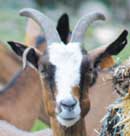
Goat © Pintail
A diagnosis of cancer and its subsequent remission were what made Natalia Markelova, a 49-year-old divorcee set out on the road to establishing her the goat farm in Togliatti, Russia, and ultimately receiving national accolades for her work as a businesswoman
When a friend organised a visit for me to someone whom I would end up referring to as ‘the goat woman’, I expected a tough wizened old goat farmer. Instead, I met a large, plump woman with friendly cornflower-blue eyes, a halo of silver-grey hair and a gentle smile.
Natalia explained that she had been diagnosed with uterine cancer and subsequently decided to refuse conventional chemotherapy. Instead, she embarked on an intense research programme concerning the medical benefits of drinking goat’s milk. Convinced she was on the right track, she doggedly stuck with her preferred self-treatment of drinking goat’s milk only to find that her cancer was in remission.
Inspired by her own self-cure, and because the only way to obtain goat’s milk in this city of almost a million people was to own a pet-goat, she vowed to set up a goat farm with a view to producing milk for fellow sufferers of cancer and other ailments.

Goat herd France © Pintail
Thirty eight of Natalia’s goats produce 110 litres of milk every day. This doughty woman has the help of four workers, two of whom work at a time on one of two shifts. Milk is sent to kindergartens, hospitals and orphanages. After a tour of her the barn where the female goats were separated from the male goats and the bleating kids, Natalia explained that once her illness had been diagnosed she cut out cow’s milk altogether and switched to goat’s milk. Since the day she was told that she had only six months to live, she has now extended her life by another seven years.
She believes that as a society we need to be closer to nature and more in tune with its benefits. Indeed, judging by her close companions: a nervy toy poodle, a sleepy black cat, a fluffy white cat, and the fact that she says she knows all her goats by name, it is evident that she practices as she preaches.
It took her three years to start the farm from scratch and fulfil the promise once given to her pet goat: “I will help others as you helped me”. Natalia has visited nine states in the USA to learn about goat farming and to import specific breeds that were superior to native stock. She has also visited goat farms in the UK. She has been elected the leader of the Russian Goat Farmers’ Association which she helped to found.
I asked her what her thoughts were on receiving a diagnosis of cancer. “I was afraid for three days at first, but then decided that I was not going to accept the diagnosis and that I would find some way to fight it,” she says, adding that her three children had been her main motivation for staying alive. “I wanted to prove to them that there is nothing in life that can take you out of life’s saddle, if you are not prepared to get out if it first, yourself.”
Natalia explained that scientific research showed that goat’s milk takes 15 minutes to be digested in contrast with cow’s milk which takes some 45 minutes. Goat milk is also said to be the only product that helps rid the body of metal products. She also believes that it helps to kill allergies in children, and helps to calm ulcers.
I asked her if when she received her diagnosis, she changed her diet in any other way. “I eat anything I want, in addition to all goat products including meat, milk and cheese.” Regarding other cases where goat’s milk cures cancer she referred me to the work of Dr Bernard Jensen PhD, an American physician who was diagnosed with cancer at age 35 but who went on to cure himself with goat’s milk and lived to the ripe old age of 96. She is a devotee of his book: ‘Goat milk magic’. (This book is still in print Ed.)
She then takes out a thick file filled with letters which she tells me are from people who say how they have been saved by goat’s milk. Natalia suggests that if someone has cancer, she would advise them to read up on the healing benefits of goat’s milk and then make their own decision about whether or not to use it.
Contributing authors: Martine Self and Anna Garmash, martine.self@ntlworld.com
Editor’s Note:
Growing interest in alternatives to cow’s milk is reflected in the availability of pasteurised goat’s milk now widely available in UK supermarkets.
There is a proliferation of goat’s cheese from France, especially sourced by Tesco. Some goat’s cheeses are made from unpasteurised milk.
A huge amount of information was discovered in a general search on Google using unpasteurised goats’ milk.

British Goat Society
The British Goat Society has an interesting website – You can call them on 01626 833168
Other In Balance features relating to cancer:

Tulip Time – Plant now!
I always seem to miss the right time to plant tulips and left it so late the poor bulbs never had a chance. As a result my tulips have always been rather poor specimens. So drastic measures – I’ve dug them all up, kept the best looking ones and am about to order some more from Thompson & Morgan.
They are having a sale from now until stocks last

Melissa Morgan, Contributing author
 In Balance