
Seduced by Reduced! Making a Bargain into a Real Treat

Supermarket limes
How often have you been seduced by the REDUCED label in a supermarket – say ten or more onions, or like today, twenty limes – in your supermarket and find it irresistible and confidently expecting to make something of it? But it gets put to one side, gradually to the back of the fridge, forgotten and then discarded, optimism lost in the chasm of inertia! Well it has happened to me of course. The good news is that it happens less often now. Why? I can explore the web for ideas of what can be done with whatever I have bought.
Today I have twenty limes – these are going to be either made into lime curd (my mouth is watering at the prospect!) which takes very little time, or lime chutney – here’s a Google page with lots of recipe sites to choose from.
I collect jars to re-use and buy new tops from Lakeland. Jam and curd take time but very rewarding and make good standby gifts for many occasions.
A recent cookery course I attended included truffles – three different flavours, one including lime zest* which gives me the excuse to make some. They are so luscious I’m not sure they will get to their intended recipients … we just love ‘em! We rolled the truffles in a mix of plain and toasted coconut.

Lime truffles
Here’s a recipe I found on the web which is similar to the one I used on the course.
Celeriac, not as often used by home cooks here as they do say in France, is frequently reduced in my local supermarket and it gives me the opportunity to produce Salmon with mustard coating, potato, pea and celeriac mash found on the BBC Good Food website. Again a recipe that works very well.
It’s this time of year when I look out for peaches and nectarines getting lower and lower in price and especially in the Reduced section. Then I usually reach for Elizabeth David’s cook book – At Elizabeth David’s Table – for her easy recipe Peaches in Wine. She tells us the best peaches for this dish are the yellow-fleshed variety. Dip the fruit in boiling water so the skins can be easily peeled off. Slice them straight into big wine glasses, sprinkle with sugar and pour a tablespoon or two of white wine into each glass. Preparing them too far ahead will make the fruit go mushy. If you would like to give the glasses an attractive look, before you start working on the fruit, put a little water in a saucer, put sugar in another saucer, holding the glass upside down gently dip the glass in the water, shake it to remove any excess water, dip the glass in the saucer of sugar, shake off any excess. Voila! You can now add the fruit and wine, carefully! This works with lots of different fruits and you could experiment with flavoured liqueurs – Cointreau and oranges, raspberries and pear vodka! Pears and raspberry liqueur, the list could go on … and on. Just experiment, great fun.
By the way, my favourite prune sweet is to use prunes soaked in white wine – could be red – for at least 3 months. I use screwtop jars, covered with cling film and the cap screwed on lightly, no need to tighten hard. This is so easy to do and makes a wonderful treat with custard! or cream or even better fromage frais, unsweetened. I keep them in a cupboard out of sight otherwise they are just too easy to dip into and devour the lot!
* For any recipe using lime zest be sure to remove the wax generally added to citrus fruit, unless marked as unwaxed. The easiest way to do this is to dunk the fruit in boiling water for 5 minutes, twice if needs be.
Katie Simpson Guest writer, Caterer for the Choosey
Visiting Gardens – A Great Pasttime
Visiting gardens is a most interesting and a very popular pasttime. Wimpole Hall was the latest we visited end of May, 2012 where it was interesting to see the advanced growth of their onions, whereas ours were mere blips on the landscape by comparison! We also noted the wild bee houses liberally sited throughout the gardens. A variegated horseradish was much admired by visitors and irises were in full bloom despite the lack of rain for the last week or so.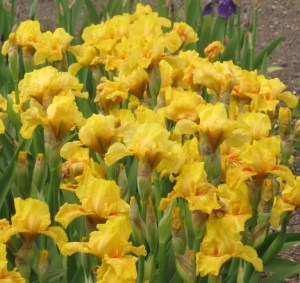 Based in Hertfordshire we tend to spread out north and east, so for us a visit to the Langford village gardens in Oxfordshire on Sunday 17 June between 2 and 6 pm is not really on our agenda. However the gardens sound magnificent and if you are anywhere near do consider a visit.

Young villager, Isabella Potter, helping to prepare the garden of the late Sir Hardy Amies
There are 26 gardens to wander round, both large and small including one created by Hardy Amies, famous for dressing the Queen for more than 55 years. The Grange and Ansells Farm gardens are open for the first time and Lower Farm House, a garden at the medieval end of the village has been completely remodelled.
Garden visiting wouldn’t be the same without tea and homemade cakes and there will be two locations to choose from.
£4.50 per person on entry and children go free!
More information on website
Val Reynolds, Editor
Super Strength Cat Repellent

Florence, a 12 year old cat, fostered by Laura
When I heard of a super strength cat repellent I was sceptical – I have tried so many products over the years. Cats wander through our garden at will and catch and kill birds visiting the garden. We feel responsible for the safety of birds visiting our garden as we encourage them by providing a seed feeder and apples from our trees for a pair of song thrushes.
One year we had a great spotted woodpecker that visited regularly and brought its two young to eat the hazelnuts we put into a bough of a dead tree. To read that feature click here.
However, to our great delight the Neudorff Super Strength Cat Repellent has worked! We haven’t seen a cat since I scattered the granules where they appear over the fence, through the privet hedge and under the garden gate.
At £4.49 I thought it was a bit on the dear side. I also read on the instructions the granules will lose their strength if it rains, so another tub would be necessary after rain. But, in view of its complete success I won’t begrudge the cost.
The clay based mineral granules are grey in colour that hold plant based oils – garlic oil in fact. The long lasting odour is disliked by cats so the best places to scatter the granules is where the cats enter the garden and also where the birds are most active. In our garden this is where the bird feeders are, on seed beds and beside the pond.
Depending on the weather, the period of protection is 3-4 weeks.
 The granules come in a 500 g can.
So would I buy more? A resounding yes! And I would have a couple of spares to make sure I can keep those pesky critters out of our garden forever, or is that tempting fate!
Super Strength Cat Repellent is £4.49 available from:
Blue Diamond centres, full range at Derby, Trentham and Le Friquet
Hilliers group
Haskins group
All good garden centres
Val Reynolds, Editor
Buy British Innovative Light Bulb and save on energy costs

Groove Bulb packaging
An unprepossessing name hides a remarkable new product. The Groove Bulb is a high quality, low energy light eminently suitable in the home. It uses 85 per cent less electricity than standard bulbs, so despite its higher purchase price* it ensures immediate savings. With an approximate life span of 30 years there’ll be no need to replace it for a very long time**.
So what are its credentials apart from the impressive cost savings?
It’s available in bayonet or Edison screw cap
Instantly ‘on’
No flicker
Provides a clear white light – good for reading and activities involving small detail much easier
They are dimmable
Mercury free
99 per cent recyclable
Has the lowest CO2 emissions of any lighting technology on the market
Aesthetically we prefer the natural – nearly white – grooves to the silver grooves

Groove Bulb Fact Sheet
The company, Groove Bulb, intends expanding the range to include a 100w equivalent and a candle style bulb by the end of the year.
Groove Bulb is a privately owned company operating in the UK. The founder, James Theobald, has over thirty years’ experience of LED manufacturing.
OUR EXPERIENCE
This bulb is neat. It’s very bright. We have used it in the entrance hall and would prefer it to be somewhat less bright, so a dimmer switch would make it more appropriate. Perhaps placing it in an enclosed light fitting would help to reduce its brightness.
OTHER ADVANTAGES It could be left on all night, with a dimmer switch, in dark corridors rather than using the much more expensive motion sensor light switches used in hospitals and high activity corridors.
WILL WE BE BUYING SOME?
Yes – what’s not to like?!
The Groove Bulb can be purchased exclusively via the website: www.groovebulb.com
*9w bulbs are retailing at £15.95, which is 25 per cent cheaper than similar quality LED bulbs on the market
**Calculations are based on a UK average of 24 bulbs per household used for three hours per day with electricity charged at 15p per kilowatt saving you c. £200 per year/£16 per month.
Val Reynolds, Editor
When did you last polish your shoes?

Cherry Blossom Polish lids on production line
It would seem to be a generational thing. I’m old, much older than many of our readers, and I don’t clean my shoes very often. All made from Nubuck they only needed proofing on purchase and later, much later, a clean/restoration session.
Okay, so I’m different and don’t do the polish bit, but what I do remember about polish is Cherry Blossom, Meltonian, Mansion Polish, along with other contemporary products such as Dinky toys, sugar in blue paper bags, crisps with blue twists of salt in the packets, broken biscuits in Home & Colonial – all products my generation will be familiar with. And just how many are still around?
Well Meltonian has gone, as has Mansion Polish but Cherry Blossom shoe polish is blooming, or should I say shining! Apparently these days we are more conscious of repair and care, rather than throwaway and buy again and shoes are taking a more centre stage position.

A pair of miners’ boots after one has been renovated with Granger product
Cherry Blossom is a British product through and through, originally conceived and produced in 1906 but over the years the name has changed hands. In 1992 Grangers, the company well known to campers wanting to reproof their tents, equipment and clothing, bought the right to use the name, manufacture and sell in the UK and export to certain other countries.
I visited the Cherry Blossom factory in Alfreton, near Derby a couple of months ago. It had a real good feel factor about it.
The science of polish is not hugely technical, although over the years it has adapted to health and safety standards and more recently bypassed the need for certain specific ingredients by creating replicas. This sounds a bit odd, but in the case of a specific wax – mined in Hungary which is becoming very scarce as the mines close down – it makes total economic sense.
So why the interest? I was curious to see how polish was made. The production methods are not specially high tech, nor base production, and some parts are labour intensive. But there is something reassuring about a British company still producing goods that go all over the world. I felt a quiet pride that such a successful original was still being produced in the UK.
With a widening user base, a broadening range of trade customers, and 30 different polish colours on offer it’s no wonder impressive sales are in evidence.
In fact an impressive range of products to complement shoe polish, creams and wipes is going to push the company’s profits hugely in the next year or so.
Clothing proofing
Grangers are astutely widening their product range to include shoe inserts, insoles – the ones I tried are excellent, orthotics, toe warmers – great for skiers, hand warmers – excellent for football fans among others and I can foresee a very promising future.
Have a look at their website.
Interesting fact: Although called Cherry Blossom Polish the tin has never depicted Cherry Blossom but shown the rich shine which appears on ripe red cherries. Good question for a pub quiz!

Some of the Cherry Polish product range
Val Reynolds, Editor
Photography © Pintail Media
Verbascum, Cottage garden hardy perennials
I can’t keep up with Thompson & Morgan! Verbascums, a favourite background filler for flowerbeds, have always been yellow! Then last year T&M brought out Clementine, a golden/bronze beauty. The plug plants I received grew strongly are now blooming rather well in May a year later.

Verbascum Clementine flowering in May 2012
Then a blue verbascum, Blue Lagoon, came on the market and I had to have some, especially to plant with Clementine as they would make a great contrast.

Verbascum Blue Lagoon
I have always loved delphiniums but like many other gardeners find my slugs love them even more and plants have always been decimated, always when my hopes were riding high for a fabulous display. So I ordered two plug plants £9.99 each or 2 for £17.99 to make up for my disappointing attempts to grow delphiniums. As they only arrived three weeks ago and won’t be anywhere near mature until next spring I will plant them in larger pots for the time being, making sure I use my outstandingly good labeller so they don’t become the pots that I wonder what’s in them!
Blue Lagoon has been developed using specialist micro-propagation techniques. It has the same characteristics as its fellow verbascums: low maintenance and well adapted to growing in poor, stony soils. It should grow to about 30 inches high and spread out for about 12 inches. Flowering from June through to September they like full sun. Although my garden loses it by 2 pm, Clementine is doing very well. Verbascums spread their leaves flat to the ground – a remarkably useful weed control feature.

Pink Pixie 2012 Verbascum
Then I heard of yet another new verbascum – Pink Pixie. Spoilt for choice! I’ve decided to get some to grow with the aquilegia Green Apples, again it will be a good contrast and I’m hoping the height difference will add to its impact. I’ll be sure to space the verbascum plants far enough apart so as not to smother the aquilegia.
All the verbascum cost £9.99 each or £17.99 for two plants that come in 7cm pots. See T&M webpages for more details
Val Reynolds, Editor
Not as Lively as I would like, How it all Began
 A traditional ‘who did what and what became of them’ story, How it All Began is an easy read that doesn’t really challenge the intellect. I found it only mildly amusing – a candidate for ‘pick up when bored’ book status. Definitely not on the compulsive can’t put it down list, I think it could be referred to as a pot boiler on a rating of 5 on the 1-10 scale. I have to say she is good at character studies, but I didn’t like any of the characters and found little pleasure in her artful descriptions.
Tutus in your Garden – Miss Huish – A Beautiful Aquilegia

Miss M I Huish, aquilegia vulgaris
Miss M I Huish, Aquilegia vulgaris, has a deep crimson flower like a Ballerina’s tutu. Perennials, aquilegias grow up to 2 feet tall and mix well with lighter foliage plants.
I found seed germinated well in May. Planted in the front and back garden around August 2011 about 2 feet apart, they are now flowering in May 2012 and expected to continue on until early June. Apparently they don’t last long as cut flowers, only 3-4 days, but they are very pretty so I’ll probably pick a few short stalks for a small table decoration.

Green Apples, aquilegia vulgaris
I sowed seed of Green Apples, Aquilegia vulgaris, at the same time as Miss Huish which had a lower germination rate. They flower initially as white blossoms gradually turning to green.
Both these aquilegia resemble a double clematis but of course nowhere as large a flower. Aquilegias do well in full sun or partial shade, being a meadow and woodland plant. They will seed freely so I’m looking forward to them migrating all over the garden.
Thompson & Morgan offer a dual pack of seeds for £3.49, 70 seeds in total, or separate packs Green Apples £2.99 for 20 seeds, and Miss M I Huish 50 seeds for £1.99.
Val Reynolds, Editor
Link to our front garden website
A Decent Read – suggestions for a quiet break
How often are you at a loss to know where to find a good book. What is a good book? To me it’s one I can lose myself in. All the angst of the day goes to the back of my mind. So a book at bedtime is a joy and pleasure. But I’m not prepared to read books that don’t satisfy my curiosity, don’t stimulate my interest, or from which I learn nothing new.
So we have decided to provide our assessment of books we have enjoyed, or not. Short, pithy asides and plaintive squeals of dismay are included, so you don’t have to waste time turning off at page ten. That’s the crunch time for us … unless page eleven beckons that tome is passed on to Oxfam, or some such charity shop where maybe someone will view our assessment with disdain and totally disagree with us!
Here are three books all read and finished and assessed by Les Tucker, our intrepid bookaholic.
A Small Circus Hans Fallada* One of the Penguin Classics ISBN 978-0-141-19655-8 *Other books by Fallada
 Do not read A Small Circus expecting a similar experience to the later Alone in Berlin. Fallada’s portrait of life in wartime Berlin is a universal tragedy which is impossible to ignore.
A Small Circus, published in 1931, is just that: a much more parochial examination of politics in a small town. It is a local eye’s view of the collapse of the Weimar Republic (Germany’s first democracy) leaving a situation ripe for the rise of National Socialism, and subsequently, the promotion of Hitler.
The book is not a dry history. It is full of sardonic humour, as pompous local officials tussle over bribes and ill-gotten gains. Outside the little town, the country is spinning off its axis, but a greedy bunch of politicians and journalists seem not to care.
The greater proportion of the novel is written in dialogue, so there is no authorial voice. In many ways, this worked to Fallada’s advantage, as his breakthrough novel received praise from both sides of the political spectrum. It appeared as if he was not taking sides, although a modern reader might beg to differ.
A Small Circus may not make you laugh very often, but it might have you nodding with agreement at the portrayal of human foibles and frailties.
Noughties Ben Masters Published by Penguin ISBN 978-0-241-14526-5
 Ben Masters’ novel is helpfully divided into three sections, entitled; “Bar”, “Club” and “Pub”. My advice to the reader would be to stay in the Bar !
Imagine a dodgy episode of Skins combined with a literary pub quiz and half an episode of Morse chucked in for good measure.
This is Oxford, but beyond the colleges, overheated young things are drinking themselves into oblivion, clumsily bonking each other, but then spoiling the whole experience by agonising about it!
Noughties is a Top Trumps pack of literary references and allusions. Forget about the narrative, just play spot the disguised quotation. The protagonist, Eliot Lamb (get it?) is trying to resolve the dilemma of his love life. As his journey to the light includes such evocative meetings with the opposite sex as, “She places her warm breath inside mine..” one can only hope it is achieved speedily.
There are lots of topical music references and characters spend an inordinate amount of time texting. You don’t need to join Eliot Lamb in his final days at Oxford to enjoy the richness of that experience ! Try the Open University.
The Pale King David Foster Wallace Penguin ISBN 978-0-141-04673
 Did you ever read the one about the American Internal Revenue Regional Examinations Centre ? No … and I wonder how many people will actually finish The Pale King. The author didn’t, as he died in 2008 before it was completed. This edition has been assembled and published by his editor, Michael Pietsch.
Try this chapter opening :
“Until mid-1987, the IRS’s attempts at achieving an integrated data system were plagued with systemic bugs and problems, many of these exacerbated by Technical Branch’s attempts to economise by updating older Fornix keypunch and card-sorter equipment to handle ninety-six column Powers cards instead of the original eighty-column Holleriths.” Come on … keep up !
Wallace is feted as a truly great writer, especially in his love for precision and meaning. This unfinished work is about boredom and sadness, but as it stands it is too great a challenge to the reader. The tedium of the daily tasks of the IRS is plain enough. It is detailed in well over 500 pages. There are jokes, lots of jokes, strange observations, descriptions, and even characters, but this is still a novel about tediousness, and it is act of daring to leave the reader to extract from it the individual stories within. For many, the doors of the tax return processing centre will remain closed. For the legions of Wallace’s admirers, this unfinished work may well achieve the status of an icon. If you enjoy James Joyce, you’ll love this. If not, then tax avoidance may be the answer.
Creating a Wildlife Friendly Garden

Frog tadpoles
As a child I was fascinated by things that moved which included frogs and newts, to dragonflies, to ants and slugs, bees and butterflies. At one stage my sister aged four and I, a couple of years older, put together an outdoor ‘museum’ with our exhibits in boxes to show our parents. Our ‘cunning plan’ to bump up our pocket money was to charge them a penny each for admission – it worked!
Then birds entered my world and both interests have continued throughout my life.
One year I wanted to photograph birds in the garden and did a bit of research to find out how it had been done by others. We visited the RSPB headquarters and watched the great tits, blue tits, finches and great spotted woodpeckers feed on the nut and seed containers. Incredibly I saw a sparrowhawk take a great tit feeding on the nuts. Unlucky for the great tit of course, but the speed of the sparrowhawk was breathtaking. I was stunned, hardly able to believe what I had seen. I can still picture the body of the great tit hanging from the claws of the sparrowhawk.

Waiting a turn
The first step to set up a photographic area was to establish a feeding station. Regular feeding will attract the birds from the local area and as they come to rely on them it is important to keep the supply going throughout the winter. We use a squirrel proof seed container with the RSPB no mess mixture. That sounds a bit ‘neat and tidy’ but switching from the usual mixture saved having to frequently clean up the empty husks of the sunflowers all over the patio. Photographing birds on the feeder is ok and can show how attractive tits find the nuts and seeds.
However Kevin Keatley, a wildlife photographer advocates screwing a clamp to a pole just below the feeder. The birds land on it just before they go on to the feeder. Adding a sprig of autumn berries, or spring blossom makes for a more natural shot. Kevin uses a hide and a feeder about three to four metres away. The advantage of using a hide is that you can move it with the changing light. If you keep the sun to one side it gives a bit more depth to your photos. The ideal light is around midmorning or midafternoon. He has used the hide in heavy snow, the snow or frost covered hide is just like an igloo, insulating him from the freezing wind. There was a time when his wellies froze to the ground – but he says it was worth it when the slides came back with fantastic close ups of pheasants in the snow. Kevin has a website where you can see the hide and chair he uses. His site is well worth a visit, it is full of fascinating information and likely to stimulate some unexpected wandering on the web – have a look at his links.
Our feeders were hung from the pergola, about ten feet from the conservatory windows. I fixed a bed sheet across the open window and down to the ground, cut a slit in the sheet and poked the camera lens through. The camera was mounted on a tripod. I was happy with the bird shots I was getting and then one day a woodpecker came to the peanuts and I had to think about how to have it feeding away from the peanut container which didn’t look very natural. So I asked a friend to let me have a fallen branch from one of his trees.

Male great spotted woodpecker
We drilled big holes to hold the unshelled hazel nuts and almond nuts and placed the branch between two posts of the pergola. The nuts started to disappear although we didn’t get a glimpse of a woodpecker. Then one morning we did – it was very excited, making that distinctive, sharp ‘pic’ call. From then on we were adding nuts every three or four hours. Then may be two weeks later, two fledged young ones visited with their father. You can imagine how excited we were at the prospect of photographing them. That was easier said than done. As there was no regularity to the visits, the window was nearly always shut at the most exciting times!
I took some pictures through the double glazed window of the parent feeding the young but they were not sharp. Eventually only one young one came with its parent, and it took to hanging around the garden waiting for its parent, making desultory attempts at breaking open the nuts.

Young great spotted woodpecker
Once it found how to successfully eat the peanuts it lost interest in the hazelnuts. Then we witnessed the inevitable, the parent actually attacked the young one quite fiercely in response to its crying for food and we never saw them together again. They visit separately now. We expect them to continue to visit in the colder months and will have a big stock of nuts waiting for them! Strangely we haven’t had any problem with squirrels taking the hazelnuts. We did have problems with the peanuts until we bought the strong wire version that can’t be unhooked.
So progress? We are going to drill out bigger holes and put in walnuts – a tip from a very successful woodpecker attractor! We’re going to put a dead branch parallel to the ground about three feet up near to the feeders – I missed some really good shots of a great tit feeding its young – they were partially hidden by greenery on the cherry tree and I’m hoping with careful pruning and branch placement I’ll get the pictures I want!

Hoverflies eating pollen on a poppy
Other steps I have taken to make the garden friendly to both insects and birds are to flowering plants that attract insects. The poppies, all varieties, attract hoverflies in droves. The nettles – kept in a pot – have ladybird larvae all over the leaves that hoover up aphids on neighbouring plants at an enormous rate. I let most plants go to seed – the evening primrose was a huge success with goldfinches. I had problems with keeping the seed from setting the next year, but the hoe is a wonderful tool!

Tiny midges hovering over cabbage flowers
I let some cabbage go to seed and had clouds of tiny black insects hovering over them. An expert told us it was their mating pattern.
In the spring plum blossom attracted a range of bees, from solitaries that live for six weeks, to big queen bumbles. I’ve found foxgloves, onion flowers and blackberries attract the most bumblebees. I like lots of colour in the garden and through trial and error have marigolds, escholtzia, oregano, poppies, evening primrose, foxgloves, nasturtiums, nigella growing unchecked. I’m trying lots of others – herbs, beans, roses, clematis, vines and hops.

Song thrush bathing
The latest attraction is the bird bath perched on the patio wall. We’ve seen everything drinking and bathing there, from wrens to a pigeon that just flopped in and sloshed around to keep cool, and of course our woodpeckers.
What’s next? We’ll be putting up some nest boxes. It’s absolutely essential to have reliably waterproof and well designed boxes. The RSPB’s most popular boxes are for the tits and the open fronted box – suitable for robins, pied wagtails, and more excitingly, spotted flycatchers which are much more common than you might imagine.
The worst type of nest box lets in the rain – the young die from cold and damp, or the exit hole is too low and the young ones emerge underdeveloped and can‘t fly strongly. Result: they flop to the ground and are easy prey for jays, magpies, cats, rats. So if you are serious about making your own please, please, please get a copy of the British Trust for Ornithology booklet Nestboxes, written by Chris de Feu. It’s a gem, with designs for all kinds of birds including owls and house martins and a fascinating read.
For a month by month guide to attracting birds Stephen Moss has written The Bird-friendly Garden, published by Collins and gives lots of advice on how to make your garden a haven for birds. He gives advice on predators and pests, for instance for cats he recommends a machine that emits a high pitched whilst, inaudible to human ear but intolerable to cats. Gardens are the one place where we all can make a difference to wildlife … we felt enormously privileged to play a part in the upbringing of the two great spotted woodpeckers this year. We hope we’ll be doing the same next year.
Last year we attracted some bees to our bee nest box and are hoping for more this year. We brought the box indoors and kept it in a cool area of the house until early spring when the bees emerge. We bought our bee nest boxes from the now defunct Oxford Bee Company. Read our recent feature about the Neudorff Insect Hotel here. By the way we now have another Neudorff Insect Hotel to giveaway! All details on the feature.
Val Reynolds, Editor
 In Balance