
Theatre Tips for 2011
 Jeannette is a bit of a culture vulture who enjoys art exhibitions, cinema and classical music, but her main interest is the theatre. For several years she ran theatre discussion groups for which her MA in Modern Drama together with teaching skills stood her in good stead. She prefers to concentrate on the many off West End and fringe productions as well as that real treasure of the London theatre scene, the National.
New Richard Bean play

The Heretic logo
A new Richard Bean play will shortly be opening at the Royal Court Theatre in Sloane Square. The Heretic is an interesting take on the climate change debate.
The last Richard Bean production I watched certainly courted controversy. England People Very Nice was a rumbustious romp with a cast of hundreds of all colours, shapes and sizes Bean traces the lives of waves of immigrants to London’s Bethnal Green, from the Huguenots, the Irish, the Jews to the Bangladeshis.
 Jeannette is a bit of a culture vulture who enjoys art exhibitions, cinema and classical music, but her main interest is the theatre. For several years she ran theatre discussion groups for which her MA in Modern Drama together with teaching skills stood her in good stead. She prefers to concentrate on the many off West End and fringe productions as well as that real treasure of the London theatre scene, the National.
London Pub Theatre

A Slice of Saturday Night
Why traipse into the West End and pay those impossible West End prices when for less than half the cost you can spend a wonderful evening out in an intimate space. You can even enjoy a delicious Loseley icecream in the interval for a mere £1.50! Currently showing is ‘A Slice of Saturday Night’, an 80s musical about the 60s which is absolutely great. Watch out for ‘Troy Boy’, a reworking of Offenbach’s ‘La Belle Helene’, in the weeks to come.

La boheme, photography Leonora Saunders
With the first rows of the audience almost sitting on the playing space (and those in the back rows not that far behind) it certainly was up close! With handsomely rewritten lyrics transporting the hovel in Paris to a typical student digs near you and talented fresh-faced young singers delivering them, it really was a wonderful experience. The ‘coup de theatre’ was performing the second act, which takes place in a tavern, in the public bar of the pub itself. I think that by the time I saw the production (back there for a second run by popular demand), the locals had got used to the strange goings on in their pub, but I’d have liked to have seen one of the earlier performances!

Jeannette Nelson: Arts Critic
So, there are some thoughts on what’s struck me as interesting. But if you’ve got a local pub that has been enterprising enough to use some of its space for theatrical endeavours, why don’t you check it out sometime. I’d be surprised if you were disappointed!
Jeannette is a bit of a culture vulture who enjoys art exhibitions, cinema and classical music, but her main interest is the theatre. For several years she ran theatre discussion groups for which her MA in Modern Drama together with teaching skills stood her in good stead. She prefers to concentrate on the many off West End and fringe productions as well as that real treasure of the London theatre scene, the National.
Below Stairs Art
Watching the recently resurrected Upstairs Downstairs tv production I was reminded of the National Portrait Gallery exhibition Below Stairs: 400 Years of Servants’ Portraits held 2003/2004.

Staff portraits
The exhibition clearly showed some servants were highly regarded and valued enough to have their portraits painted. Many portraits were of senior staff, from gardeners and cooks to nurses or nannies close to their employers. Often commissioned to show wealth, through the livery, pastoral or interior surroundings of the sitter, a fair proportion of portraits were painted by amateurs or naive painters, having little or no extensive expertise.

Joseph Florance
Interestingly, the celebrated French chef, Joseph Florance, to three Dukes of Buccleuch earned about two and half times as much as the steward of the whole estate – he was painted by John Ainslie in 1817.
The exhibition was organised chronologically with the earliest British servant portraits, dating from around 1615, featuring the personal entertainers of the crown or aristrocracy. The sitters were descendants of medieval servants in the lord’s retinue such as minstrels and jesters, who had been his close personal servants in an age before literacy, the printed book and professional actors.
Some of most remarkable paintings were painted in isolated parts of the country, where the continuation of feudal patterns of service meant that servants such as jesters, pipers or champions survived long enough to be recorded in paint.
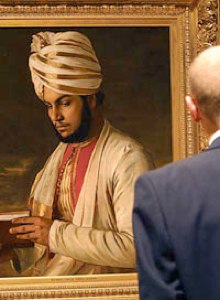
The Munshi Abdul Karim
The Munshi Abdul Karim by Rudolph Swoboda, 1888, shows a handsome, if romanticised portrait of one of Queen Victoria’s Indian servants. Munshi is Hindustani for teacher. She much admired this man who taught her Hindustani and who was promoted to the Queen’s Indian Secretary. His portrait is one of a series, now hanging at Osborne House.
Many paintings depicted the servant in distress from discrimination, or in a state of exhaustion after working the long hours expected of them. Elsewhere, a butler is shown helping himself to the port and other servants taking time off to rest.
Most, if not all, carry messages for the viewer, but some were direct messages for the servants themselves.
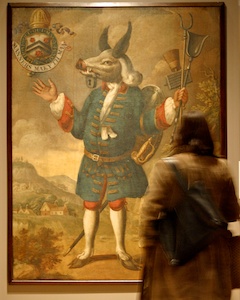 This version of the Trusty Servant was painted by William Cave. The concept is old and international, going back to medieval literary sources. It epitomises the aspirations of masters and mistresses over the centuries to find the perfect servant and the qualities required. It shows the Windsor uniform designed by George III for members of the Royal Household.
This painting hangs next to the kitchens at Winchester College together with a panel with this explanatory verse.
A trusty servant’s picture would you see,
This figure well survey, who’ever you be.
The porker’s snout not nice in diet shows;
The padlock shut, no secret he’ll disclose;
Patient, to angry lords the ass gives ear;
Swiftness on errand, the stag’s feet declare;
Laden his left hand, apt to labour saith;
The coat his neatness; the open hand his faith;
Girt with his sword, his shield upon his arm,
Himself and master he’ll protect from harm
The concept is old and international, going back to medieval literary sources. Versions were reproduced during the nineteenth century in prints, china, glass, wood, textiles and inn signs.
Val Reynolds Brown, Editor
 In Balance