
Blockbuster Art Exhibitions – London UK

Absinthe, Toulouse Lautrec
When it comes to art exhibitions, the term ‘blockbuster’ is somewhat overused these days, but it surely must apply to Tate Britain’s offerings
The Degas, Sickert and Toulouse-Lautrec exhibition ran until 15 January 2006 and was filled with accessible, beautifully executed paintings. It drew on works from the eponymous painters as well as gems from lesser known or even scarcely known artists such as Bonnard, Vuillard and Warrener.
Arranged more or less in chronological order, from the 1880s to the 1900s, the works on display marked the beginning of modern art, particularly in form and composition. Some are extremely well-known, such as several of the ballet scenes by Degas, but the visitor was encouraged to see the very modernist concepts that were introduced by the artist, such as the cutting off a figure at the edge of the canvas or the horse’s head divided by a pole in the foreground of his Jockeys before the Start. These innovations give an almost photographic feel and were much tut-tutted over at the time.
The subject matter too marked a move to the modern era. The centrepiece of the exhibition is undoubtedly Degas’ L’Absinthe. Incredibly this familiar work was exhibited in London for the first time since 1893 when it caused a tremendous stir, with its two main figures drawn from Parisian lowlife looking drab, despondent and decadent. A whole room was devoted to this and just one other painting, with facsimiles for the visitor to read which draw on the ‘shock-horror’ responses of the nineteenth century critics.
The exhibition also highlighted the cross-fertilization between England and France during this period, and although it seems mainly the English that have benefited from the ideas of French artists, the influence of the somewhat underrated Walter Sickert across the Channel is well illustrated. He is often criticized for his use of dark colours, but there is a wide variety of styles in evidence here and this exhibition surely enhanced his reputation.
You may well recall another ‘trio’ of painters at Tate Britain in 2005, Turner, Whistler and Monet. It seems an exhibition of more than one great master is not a pre-requisite of gallery exhibitions (there was an exhibition devoted entirely to Constable in 2007) but they have all shown successfully the influences across borders and between styles in exhibitions that are both informative and enlightening.
This exhibition really was a feast for the eyes.
Degas, Sickert and Toulouse-Lautrec, London and Paris 1870 – 1910 ran at Tate Britain and sponsored by British Land Company PLC
Review of Toulouse Lautrec and Avril: Beyond the Moulin Rouge at the Courtauld, London UK 2011
Jeannette Nelson, Art Critic
Toulouse-Lautrec and Jane Avril at the Courtauld Gallery

Henri de Toulouse-Lautrec, Jane Avril, 1899, colour lithograph, 56x38 cm
For me, small is most definitely beautiful when it comes to art exhibitions. That’s not to say that I give the blockbusters of the National Gallery or the Tates a wide berth; on the contrary, the current exhibition of the art of Joan Miro at Tate Modern is one of the best days out in a gallery I’ve had for a long time. But perhaps that’s the point; it really needs a day out to do it justice, and it’s not helped by the fact that once you’ve bought your ticket you’re not allowed to leave for a breather and come back again. There really ought to be more thought given to this as the art would be appreciated all the more if it didn’t have to be swallowed in one gulp.
But back to the Courtauld, set in a wing of Somerset House. The temporary exhibitions are hung on the top floor and occupy a mere two rooms. Consequently, the number of artworks is limited but as befits such a prestigious institution, they are most judiciously chosen.

Original sketch for the Jardin de Paris poster next image
A few months ago I was bewitched by various depictions of Cezanne’s Card Players, and now it’s the turn of Toulouse-Lautrec to capture my imagination and the spirit of the Belle Epoque with his compositions of his friend Jane Avril.

Jean Avril at the Jardin de Paris 1893, colour lithograph
I, like so many of my student friend in the sixties, had various posters of Jane Avril and other dancers from Paris’s Moulin Rouge adorning my walls. So I was expecting the work to be familiar and indeed it was. Some of you may also remember the Athena representations of Jane Avril and also of Mlle Eglantine’s troupe.
But the exhibition is more than just an evocation of the familiar. It shows up the strong bond between artist and subject, a fact borne out by the accompanying notes which tell of their friendship and also hint at the closeness which developed because they both had to endure a physical disability. The painter had dysfunctional legs, a condition that his family took a long time to come to terms with. Jane Avril, it is believed, suffered from St Vitus’ Dance, as it was called then, which caused involuntary movements of the limbs; she found that dancing could keep this under control and so took up the profession.

At the Moulin Rouge 1892-3, oil on canvas
The real fascination of the exhibition lies in those works that are not of her as a professional but instead show her, in sketches and in fully painted works, as a rather solemn, gaunt young woman away from the stage. And the viewer is also struck by the striking modernity of Toulouse-Lautrec’s fin-de-siecle oeuvre, particularly in the effect achieved by simple lines and brush-strokes.
In the smaller of the two rooms are works by contemporary artists and more information about the professional and private life of Jane Avril. This complements Toulouse-Lautrec’s work well and helps make the whole exhibition easier to appreciate and enjoy. It runs until 18 September 2011 and the entrance ticket also includes the permanent works in the gallery, which include some stunning impressionist greats. It all makes for a delectable treat.
Opening hours: Daily 10am to 6 pm, last admission 5.30 pm
Admission Adult £6, concessions £4.50, free admission Mondays 10 am to 2 pm except public holidays, at all times for under 18s, full time UK students and unwaged. Information on Gallery Talks and Study Day see www.courtauld.ac.uk
See our review of blockbuster exhibition in 2006 Degas, Sickert and Toulouse-Lautrec
 Jeannette Nelson, Arts Critic A bit of a culture vulture, Jeannette enjoys art exhibitions, cinema and classical music, but her main interest is the theatre. For several years she ran theatre discussion groups for which her MA in Modern Drama together with teaching skills stood her in good stead. She prefers to concentrate on the many off West End and fringe productions as well as that real treasure of the London theatre scene, the National.
Photography Pintail Media

Section of At the Moulin Rouge 1892-3, oil on canvasDetail of At the Moulin Rouge 1892-3, oil on canvas

Detail of At the Moulin Rouge 1892-3, oil on canvas

Bourdelle, Porcelain mask cast from bronze of Jane Avril 1861-1929
Art in Clay Outdoor Exhibition – Hatfield House, Hertfordshire
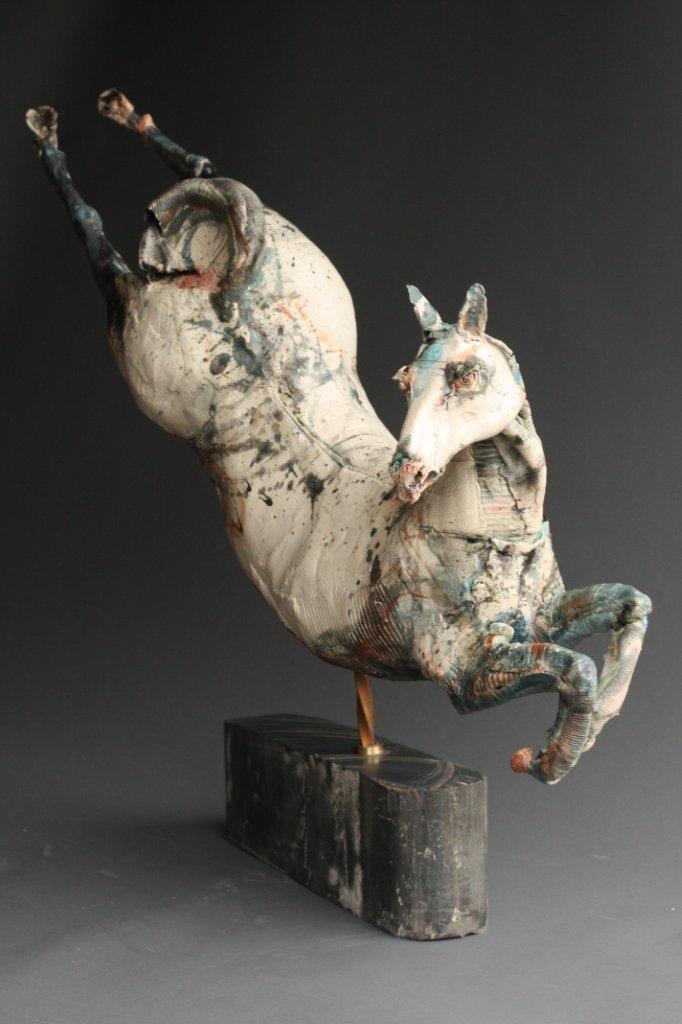
Ostinelli & Priest
This has to be one of the most interesting and fun outdoor art exhibitions we have visited. There is always a really friendly atmosphere – all the potters and ceramicists are very approachable and interested to talk to visitors.
Details for the 2013 show are on http://www.artinclay.co.uk/
The range and diversity of the work of British potters is well known and this show always has lots to admire and be attracted to. Some work is just so out of the box it’s a joy to behold!
Children are of course very welcome, there is plenty of space for them to run around and enjoy themselves and the opportunity to make clay pots.

- A young boy tries his hand at making a pot on the wheel
We put together a slideshow of the 2008 show – if you would like to have a look click here.
The 2011 exhibition underlined The Japanese Earthquake which had a disastrous effect on the world famous pottery town in Japan called Mashiko. The town had over 400 pottery workshops many of which have collapsed together with kilns, houses and the town’s museums. Bernard Leach met Shoji Hamada when he was studying pottery in Japan and became lifelong friends. They helped each other with the development of their potteries.
Catherine Thom, daughter of a Northern Ireland potter whose work was strongly influenced by Bernard Leach and Japanese pottery, is an international classical guitarist, and recorded a cd to raise funds for the Japanese Disaster Fund. Catherine gave three concerts on each of the three days of the Art in Clay exhibition – all non-ticket donation events.
Art in Clay is a great event for pottery lovers and the organisers are offering Two for the Price of One entry fee on all three days of the show.
For even more information and regular up-dates see the News page.
Val Reynolds, Editor
…………………………………………………………………………………………………………………..
Authorised by Andy McInnes, Exhibition Organiser
Henry Moore Exhibition 2011

Moore's signature on sculpture plinth
Henry Moore at Hatfield and at Home
Could Moore be compared to Marmite? His work is so huge, so enigmatic, so smooth, so in your face, that many find it too much. Others love just those features. It seems you either love it or hate it. That was the concensus when I did a quick verbal survey before a visit to the Moore at Hatfield open air exhibition that has attracted thousands of visitors this summer.
Some of the questions I asked:
Are you familiar with Moore’s work – About 70% had seen at least one sculpture, many abroad
How would you describe his work – Chunky, smooth, fun, weird, creepy, ugly
Do you know how he made some of the work – Most didn’t but were interested to hear about Perry Green where you can join in free workshops for children, young people, adults and families.

Hill Arches, 1973 Bronze Length 550 cm
When I visited the exhibition I asked several visitors Is there any one piece you like best of all? My favourite answer was the child who said she loved Hill Arches because it was smooth and she liked lying on it, not something encouraged by the exhibition organisers, but inevitable I guess!
A reclining Toltec–Maya figure was the original influence on Moore’s sculpture – Chac Mool stone statue at Chichen Itza site, Yucatan Peninsula, Mexico which you can see in his very early work.
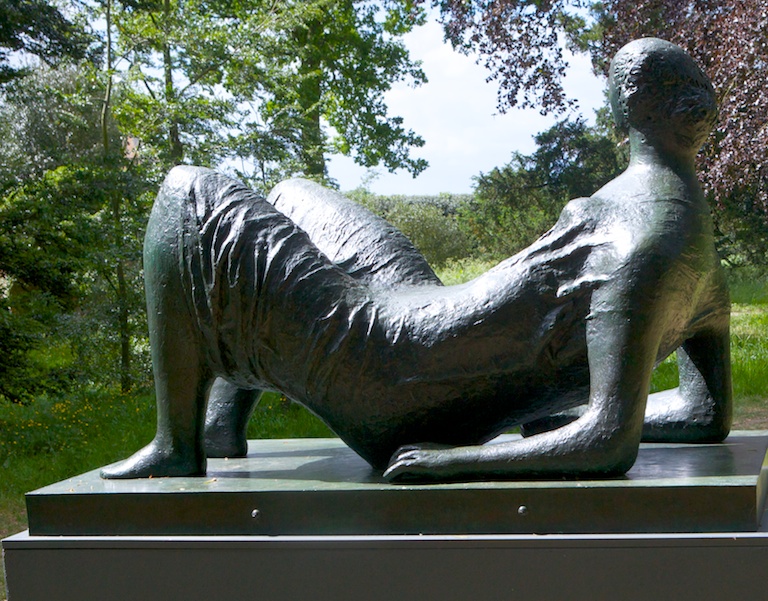
Draped Reclining Figure 1952-3 Bronze Height 157.5 cm
The Hatfield setting is big enough to take fifteen massive pieces. Every piece has at least one seat to sit and contemplate the work, just as Moore always wanted.
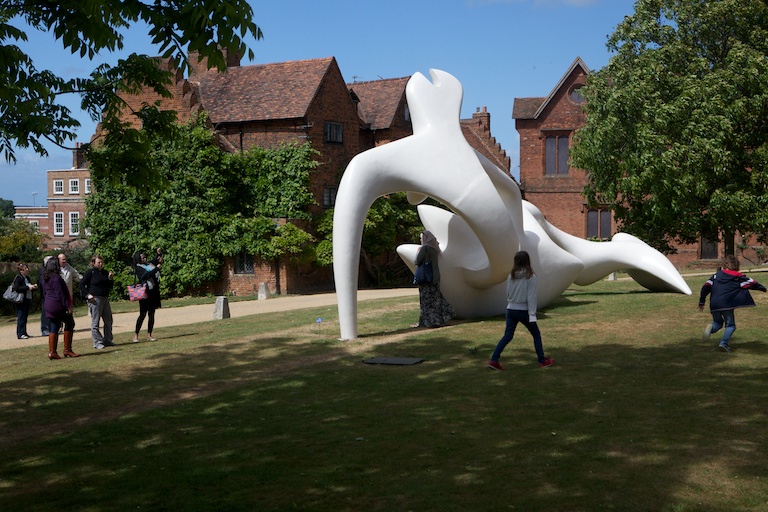
Large Reclining Figure, 1984 Fibreglass Length 900 cm
The huge historic buildings at Hatfield are certainly big enough to contain the work rather than be overwhelmed.
He was especially pleased with the siting of the Two-Piece Knife Edge next to the House of Lords, placed right next to a path and seats.
He was once asked by his niece why his works had such simple titles and he replied: All art should have a certain mystery and should make demands on the spectator. Giving a sculpture or a drawing too explicit a title takes away part of that mystery so that the spectator moves on to the next object, making no effort to ponder the meaning of what he has just seen. Everyone thinks that he or she looks but they don’t really, you know.
There is an excellent Wiki page about Moore that includes many well known pieces. One photograph shows the panorama created in the Ontario Museum.

Locking Piece, 1963-4 Bronze Height 290 cm
A visiting teacher from Vancouver said it was not possible to take photographs or touch the exhibits in Ontario and was delighted to be able to have the opportunity to get a real feel for Moore’s work at Hatfield and excited about visiting the Perry Green permanent exhibition.
Although interest in Moore has diminished since his death, Perry Green, his home in Hertfordshire, has a popular outdoor exhibition with 25 outdoor works on display. When I visited everyone seemed to be loving the whole experience, I certainly smiled at some of the pieces. The children especially liked some hollow copper pieces that made satisfying noises and big enough to play hide and seek in.
This hugely successful sculptor – he was paying million in tax in 1970s – left a legacy that continues to delight and intrigue.
One suggestion I have is to make available for sale small reproductions – to scale – I would love a collection of miniatures to handle, admire and contemplate.
Moore at Hatfield is open until 30 September – ideal for picnics and lots of room for children to run and play in!
Hatfield House is just 20 miles from central London and only 16 miles from Moore’s former home at Perry Green, Herts – The Henry Moore Foundation.
Moore at Perry Green visitor season runs from 1 April 2011 – 30 October 2011. It has a newly-refurbished pub dining room, The Hoops Inn, and a new exhibition in its gallery, Henry Moore Plasters. There are 70 acres of outdoor sculpture as well as the artist’s house and studios, carefully restored.
Val Reynolds Brown, Editor
Fashion in Motion – Fantastic Free Catwalk Event – Yohji Yamamoto – Book Your Seat!

Jean Paul Gaultier at Fashion in Motion Show
What a fantastic FREE
High Fashion Catwalk Event! & anyone can attend! The Yohji Yamamoto Show is on 1 July 2011 at the V&A but booking is essential – details below
Me? Go to a fashion show with impossibly proportioned models wearing impractical clothes? Never! And yet … I was there! At the V&A, watching the amazingly outrageous designs of Jean Paul Gaultier. It was one of five shows of the day put on as part of the Fashion in Motion series of free catwalk shows. This was the first time Jean Paul’s work, from his early collections to his most recent, had been shown in the UK.
All the Gaultier iconic items were there, from underwear worn as outwear, the corset dresses, the Aran pullover dress, the patchworked mermaid dress, the silver anatomic dress.
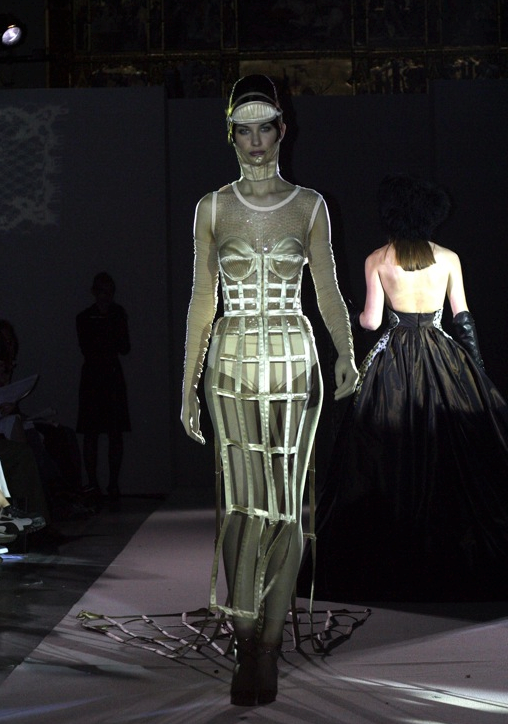
Jean Paul Gaultier iconic corset design
My favourites were the most outrageous, the Divine Jacqueline, the ballet costumer for Regine Chopiot, Sacre Coeur and the black lace capelin dress.
An inspirational experience – it was half an hour of sheer entertainment with a very excited and appreciative audience: young, old, male and female, fashionistas, the wealthy, students, admirers. All wildly applauding Jean Paul when he appeared at the end of each show. And what a friendly chap! He mingled happily with the crowd, willingly signing anything offered to him. He took a real interest in the questions from fashion students and young people – where did he find inspiration (everywhere), what he was most proud of (the most popular designs!)
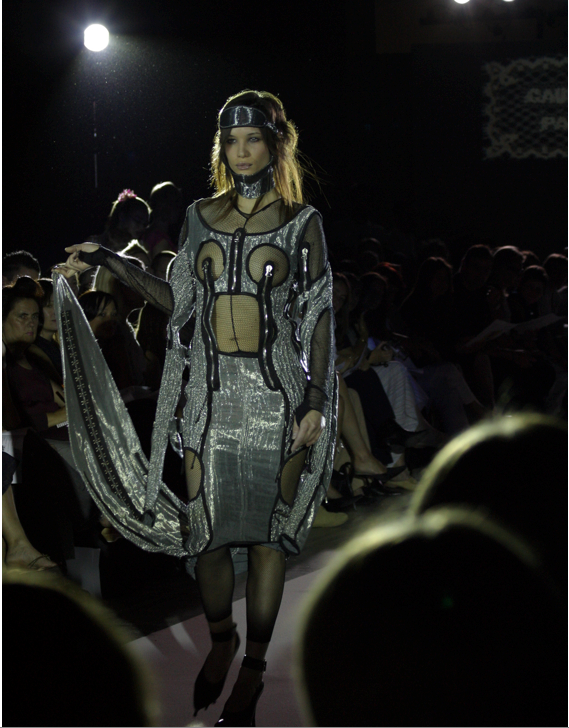
Jean Paul Gaultier iconic design
Two young women who work in the accessories trade were ecstatic at having the chance to attend the show, very well aware they would never normally have access to a couturier fashion show such as this. Others were knocked out by the clothes, the models, the atmosphere and energised by the sheer excitement of the event. That clothes such as these are inspirational is clear and elements do filter down to high street fashion.

Jean Paul Gaultier iconic design
Attending the show made me appreciate how successful the V&A is at working to make art forms accessible to the general public. Their aim is to show fashion as it is meant to be seen – in movement. Previous designers featured in the series include Ozwald Boateng, Giles Deacon, Roksanda Ilincic, Christian Lacroix, Stella McCartney, Alexander McQueen, Gareth Pugh, Vivienne Westwood and Erdem. Absolutely everyone I spoke to agreed it was an absolutely fantastic event and couldn’t wait for the next one! Must say I felt the same way myself!
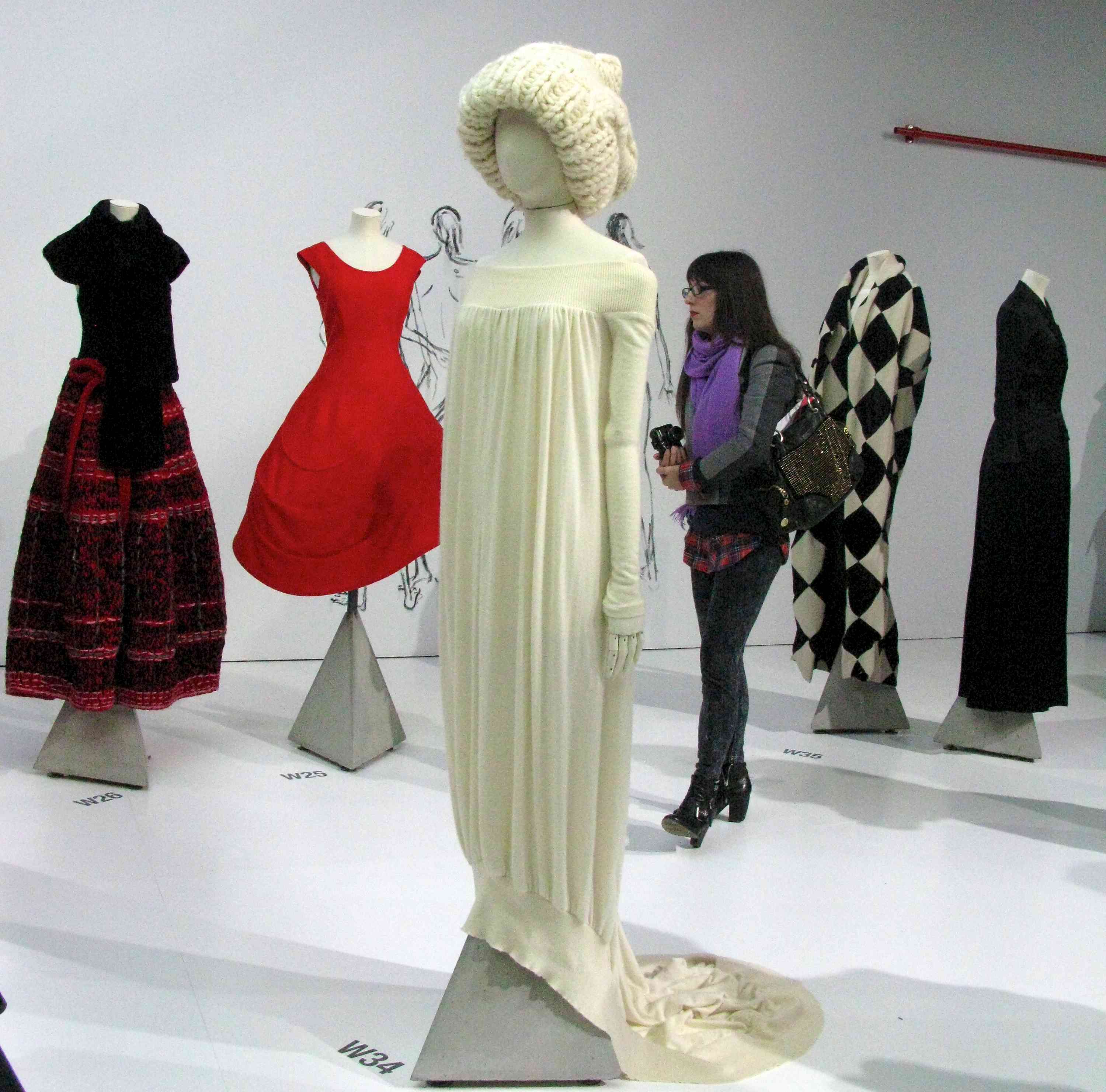
Yohji Yamamoto retrospective exhibition at V&A 2011
If you would like to go to the next show on 1 July 2011, featuring the work of Yohji Yamamoto admission is free but booking is essential.
Tickets will be available to book from 20 June on 020 7942 2820.
If there is absolutely no chance of you being able to attend you might like to know Fashion in Motion: Yohji Yamamoto will be broadcast live from the V&A website www.vam.ac.uk/channel/live
Val Reynolds Brown, Editor
Rare Picasso Lithographs in London
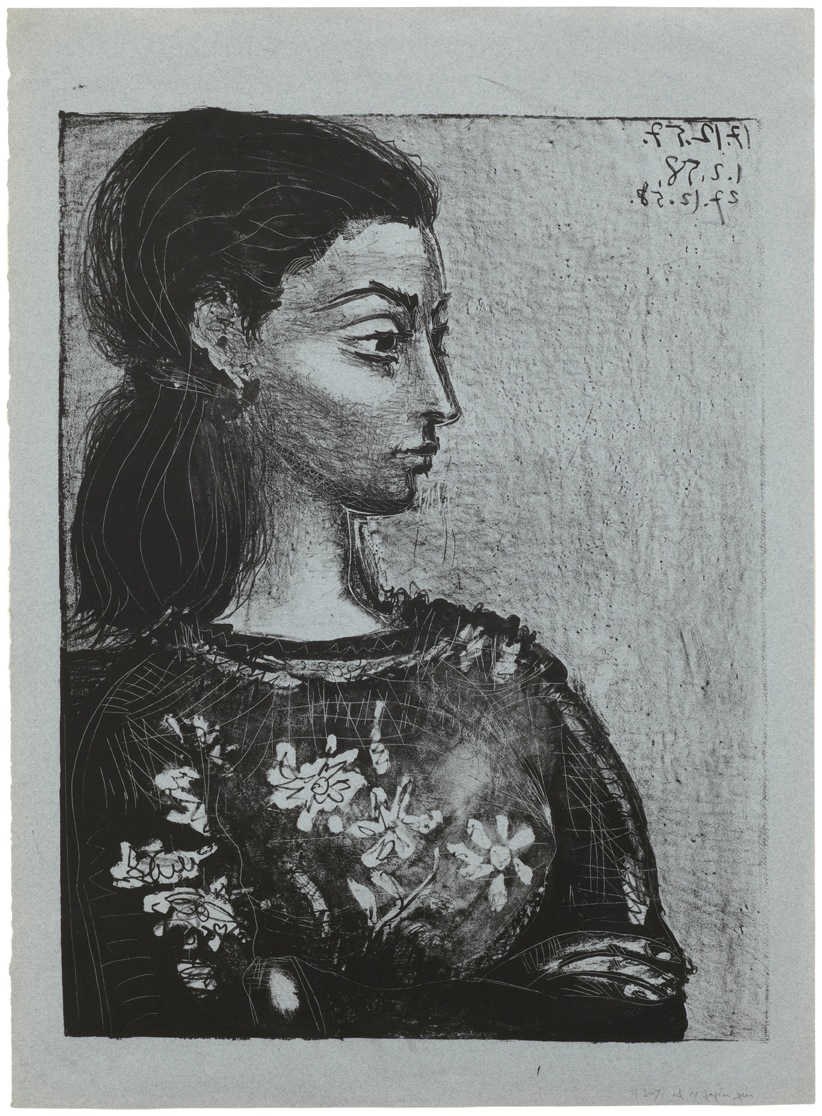 Lithograph making fascinated Picasso and you can see a few of the prints, some of which were never intended for sale, at a London Gallery for the next few weeks.
Paper 74.3 x 54.9 cm / Plate 63.0 x 47.0 cm to 64.5 x 48.6 cm
Third and final state
Unique impression on grey Arches wove paper aside from the edition of 50 and six proofs reserved for the artist and printer
Mourlot catalogue reference 307
Bloch catalogue reference 847La Femme au Fauteuil No. 1 (d’après le rouge) 2e état, 13 December 1948
 The Woman in the Armchair No. 1 (from the red) 2nd State
Lithograph using sandpaper, needle, pen, crayon and brush on zinc on the red plate of Woman in the Armchair, Mourlot catalogue reference 133, on Arches wove paper
Paper 76.2 x 56.0 / Plate 69.8 x 54.5 cm
One of six proofs reserved for the artist and printer
Initialled by Fernand Mourlot, inscribed 2e état (2nd state) and numbered 6/6 verso
There was no edition of this state
Mourlot catalogue reference 134
Bloch catalogue reference 586

La Femme au Fauteuil No. 1 (d’après le rouge) 9 e état, Le Manteau Polonais, 30 December 1948
The Woman in the Armchair No. 1 (from the red) 9th State, The Polish Coat
Lithograph printed in black and blue-grey from the red plate of Woman in the Armchair, Mourlot catalogue reference 133, on Arches wove paper
Paper 76.0 x 56.2 cm / Plate 69.5 x 54.5 cm
One of six proofs reserved for the artist and printer
Initialled by Fernand Mourlot, inscribed avec un gris (with a grey) and numbered 6/6 verso
Aside from the edition of 50, which did not include the background colour
Blue-grey is one of two colour versions, the other being grey-green
Mourlot catalogue reference 134 (grey-green version illustrated)
Bloch catalogue reference 587
Below Stairs Art
Watching the recently resurrected Upstairs Downstairs tv production I was reminded of the National Portrait Gallery exhibition Below Stairs: 400 Years of Servants’ Portraits held 2003/2004.

Staff portraits
The exhibition clearly showed some servants were highly regarded and valued enough to have their portraits painted. Many portraits were of senior staff, from gardeners and cooks to nurses or nannies close to their employers. Often commissioned to show wealth, through the livery, pastoral or interior surroundings of the sitter, a fair proportion of portraits were painted by amateurs or naive painters, having little or no extensive expertise.

Joseph Florance
Interestingly, the celebrated French chef, Joseph Florance, to three Dukes of Buccleuch earned about two and half times as much as the steward of the whole estate – he was painted by John Ainslie in 1817.
The exhibition was organised chronologically with the earliest British servant portraits, dating from around 1615, featuring the personal entertainers of the crown or aristrocracy. The sitters were descendants of medieval servants in the lord’s retinue such as minstrels and jesters, who had been his close personal servants in an age before literacy, the printed book and professional actors.
Some of most remarkable paintings were painted in isolated parts of the country, where the continuation of feudal patterns of service meant that servants such as jesters, pipers or champions survived long enough to be recorded in paint.
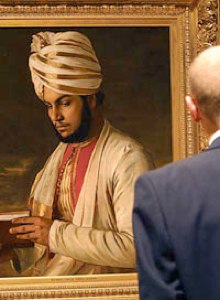
The Munshi Abdul Karim
The Munshi Abdul Karim by Rudolph Swoboda, 1888, shows a handsome, if romanticised portrait of one of Queen Victoria’s Indian servants. Munshi is Hindustani for teacher. She much admired this man who taught her Hindustani and who was promoted to the Queen’s Indian Secretary. His portrait is one of a series, now hanging at Osborne House.
Many paintings depicted the servant in distress from discrimination, or in a state of exhaustion after working the long hours expected of them. Elsewhere, a butler is shown helping himself to the port and other servants taking time off to rest.
Most, if not all, carry messages for the viewer, but some were direct messages for the servants themselves.
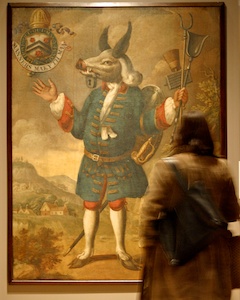 This version of the Trusty Servant was painted by William Cave. The concept is old and international, going back to medieval literary sources. It epitomises the aspirations of masters and mistresses over the centuries to find the perfect servant and the qualities required. It shows the Windsor uniform designed by George III for members of the Royal Household.
This painting hangs next to the kitchens at Winchester College together with a panel with this explanatory verse.
A trusty servant’s picture would you see,
This figure well survey, who’ever you be.
The porker’s snout not nice in diet shows;
The padlock shut, no secret he’ll disclose;
Patient, to angry lords the ass gives ear;
Swiftness on errand, the stag’s feet declare;
Laden his left hand, apt to labour saith;
The coat his neatness; the open hand his faith;
Girt with his sword, his shield upon his arm,
Himself and master he’ll protect from harm
The concept is old and international, going back to medieval literary sources. Versions were reproduced during the nineteenth century in prints, china, glass, wood, textiles and inn signs.
Val Reynolds Brown, Editor
 In Balance