
David Bowie, That boy from Brixton
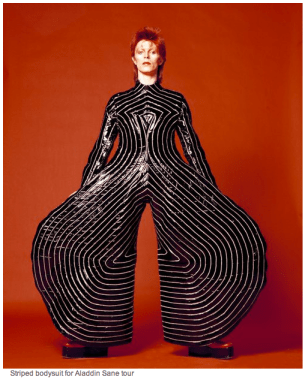 The new V&A exhibition, David Bowie Is, shows the fantastic imagination and creations of David Bowie spanning five decades.
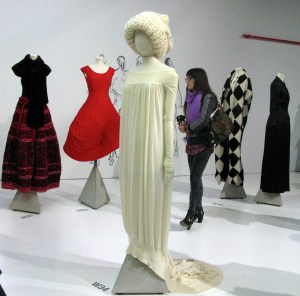
Exciting, dark and theatrical it is bursting with material, providing an insight into Bowie’s mind through a multitude of collaborations with artists and designers. A spectacular and multi-sensory show bordering on immersive theatre, mirrored and faceted projection, sound installations, videos, preparative drawings, sketches, scribbles, lyrics, and models for his staging and costumes.
The sound-scape is rich and experiential, tuning into zones and exhibits, as we move around the exhibition, designed by the company 59 Productions (of the Olympic opening ceremony) and innovative sound technology from Sennheiser.
Bowie’s clear vision and hands-on approach, is apparent, influenced by a varied host of artists, culture and politics ranging from Marlene Dietrich, Kabuki Theatre, Lindsay Kemp (from whom he mastered the art of theatrical tension), Kubrick, Kraftwerk, Mao, Jung, German Expressionism and Berlin life.
 At the beginning we read:
“All art is unstable. Its meaning is not necessarily that implied by the author. There is no authoritative voice. There are only multiple readings” signed David Bowie
Indeed – Bowie is a master in borrowing and deriving art-works from everywhere!
Bowie’s collaborators affirm he was a perfectionist, yet easy to work alongside, confident to entrust his team with creative freedom. His costume designers such as Burretti and Yamamoto were delighted to work on an androgynous model such as Bowie with chiselled features and the ideal tall angular figure to carry avant gard silhouettes and flamboyant suits.
 Kathryn Johnson – young assistant curator reveals she was most encouraged and relieved to discover Bowie had been supported by a range of talented individuals, support and teams rather than producing his projects alone and that his creations were not all the product of one mind. The range of characters Bowie creates, explores and plays out to entertain us is amazing. Although the exhibition is densely packed with over 300 exhibits, Kathryn says it was hard to whittle down the content from so much available. Bowie supplied most of it, although he had no wish to be involved in the curating.
 BE WHO YOU WANT TO BE !
Of the Bowie movement, many people say “It spoke to me “ – he gave us the license to be ourselves, be individual, be liberated. In the context of the 1960s and 70s he challenged gender convention and gave a voice to gay liberation (which had only been legalised 4 or 5 years prior to Bowie’s emergence onto the pop scene)
I believe Howard Burrell compared Bowie’s influence today, to that of Mozart or to Bach in their time – the bad boy popular appeal.
Bowie deliberately remains elusive and mysterious (very Dietrich) with an edginess and perhaps strategic recklessness derived from Iggy Pop.
The new album is already a best-seller – Bowie at sixty-six in the Sinatra spot … and why not celebrate age?
The exhibition embraces every technology, projection, stills, sound, installation fabric, manuscripts and scraps – small booths and large staged exhibits against black space.
The exhibition is packed with an extensive amount of material, a sensory overload – there is too much to decipher – but yet something for everyone, be you a fashion student, designer, musician, anthropologist, a fan, or a dreamer.
I defy you not be inspired.
“AND THERE HE IS MESSING WITH OUR MINDS AGAIN …” but that is the job of the artist – to evoke otherworldly feelings*.
Curators: Victoria Broach and Geoffrey Marsh
David Bowie Is – at the Victoria and Albert Museum, London 23rd March – 11th August 2013
Anne Tilby: Film, tv and theatre production designer and mixed media artist Clients include Julian Clary, Ken Russell, Spitting Image and Father Ted, opera design for Covent Garden Royal Opera House, Chicago Lyric, Moscow, ENO, Madrid … Trash Factory bubbles alongside other activities and is symbiotic – a social enterprise for creative recycling in the community and schools. Trash Factory needs for other interested eco-centrics – so do contact us via www.trashfactory.co.uk
Photography provided by V&A Museum archive
Want to Brush up on your History? Visit the Theatre!
 Some plays have an obvious historical content, Shakespeare’s histories for example. But currently showing in London are some whose titles belie the history lesson you’re about to receive. And here are some examples.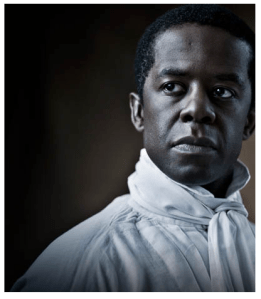
Adrian Lester
Move forward a couple of centuries and, for the next play, the audience finds itself in 19th century London, bookended by two short scenes that take place in Poland some 30 years later. Red Velvet is currently playing at the Tricycle Theatre in Kilburn. Written by Lolita Chakrabarti and starring her husband Adrian Lester (Mickey of Hustle fame) it tells the story when the legendary English actor Edmund Kean is taken ill and his role as Othello is taken over by a black American actor, Ira Aldridge; his style is considerably more avant garde than that of the English cast, with their ‘teapot’ acting techniques (imagine the item and then the comparable actor’s stance), with the majority of the cast using this as a ready-made excuse to display their prejudices. And all this is set against the background of the Abolition of Slavery Act. Despite the efforts of the radical French producer of the play, the English press is clearly not ready for this, and as a result of damning criticism of the play and his acting style, Aldridge never appears on the London stage again. A final note: Lester will be taking on the role of Othello at London’s National Theatre next spring.

Charles Edwards and Julian Wadham Photo by Johan Persson
The final play I’m writing about is This House at the National Theatre. It’s currently showing at the flexible Cottesloe space with the downstairs seats arranged as in the House of Commons. The play tells of the five years of knife-edge Labour government between 1974 and 1979 – knife-edge because with wafer thin majorities, they only hung on by the skin of their teeth and by ferrying in ‘walking wounded’ and those almost at death’s door for crucial votes. The main focus is on the whips’ office, a topical subject in the ‘pleb-gate’ context, and the wheeler-dealer shennanigans necessary to retain power. As with so many productions at the Cottesloe, it’s currently sold out; however, the good news is that it’s transferring to the large Olivier stage at the National in the new year.
 Jeannette Nelson, Arts Critic A bit of a culture vulture, Jeannette enjoys art exhibitions, cinema and classical music, but her main interest is the theatre. For several years she ran theatre discussion groups for which her MA in Modern Drama together with teaching skills stood her in good stead. She prefers to concentrate on the many off West End and fringe productions as well as that real treasure of the London theatre scene, the National.
Hollywood Costume opens Saturday at the V&A!
The world of costume according to Tilby:

The Queen starring Helen Mirren in the title role
This show is a stupendous retrospective and archive of costume memorabilia from one early film to the present day. A “must” for film and theatre makers and buffs … there are over 130 outfits displayed which have taken five years to gather.
The montage and audio visuals are stunning and innovative – collating interviews, discussions, anecdotes and drawings as well as the outfits. The curators and their team have used everything creatively to bring the exhibition to life – projection, screens, montage, props, drawings , lighting fx, interviews and script experts, emotive film scores heighten the experience.
(I “did” the exhibition backwards as the press were spilling out into the corridor so I had a good view of everything!)
I have worked as a designer for film, opera and tv for several decades, and enjoyed the reaffirmation that the design is about creating character and helping to bring that character to life.
It is very different to the world of fashion.

Spielberg sketch
Ultimately the two worlds overlap when the audiences fall love with or are moved by the characters in a story and that character becomes a symbol or is iconic and influences the world of fashion.
The interpretation of period costume in films is often combined with the spirit of the time in which it is made giving a twist to the genre. Yet the overall result should be to advance the drama.
That is the motivation and the raison d’etre of design for stage and film.
The story is paramount and the starting point of any movie and so unfolds the characters and the humanity.

Charlie Chaplin’s suit
A curator told me that she was moved to tears when she saw Charlie Chaplin’s suit.
When I am researching a design or costume project I often go and look at garments to see how they were made and to study the tailoring but for me this exhibition is not about the technique and the tailoring of the costumes but about the characters and the motivations – the association is far more important.
The associations and emotions from the memory and iconography in these films have become so closely entwined … I defy you not to be moved by seeing and experiencing many of these characters and “revisiting” them !
A very enjoyable and experiential exhibition.
Anne Tilby Jones, Contributing author, film, opera and tv designer
Networking Actors’ Club

Christopher Parker and Elliot Jordon
The acting profession has always been a precarious one, but such is the passion for it that many youngsters embark on this career path despite knowing, or perhaps ignoring the fact, that any success at all let alone mega-stardom may never be attained.
I recently attended the launch of the So & So Arts Club, whose aim is to help and support aspiring and established actors and others involved in the theatre business. It’s basically a networking club which for a modest annual fee of £30 also offers free advertising for shows, professional workshops and seminars and concessions on tickets and rehearsal and performance spaces.
But the networking is the main thing and this was clearly manifested at the launch. The room positively buzzed with the ‘hi’s’, ‘how are you’s’ and shrieks of recognition as the mostly young crowd met and greeted non-stop. Fuelled by the bar (and a welcoming free drink), the optimism and confidence was palpable. Many were dressed up to the nines and no-one was more enthusiastic than the club’s founder, Sarah Berger. In her welcoming speech she gave the answers to so many dreams, outlining what the club was designed to do and what it already has done.

Sean Baker, Daniel Casey and Jean Marsh
I engaged in conversation with a few obviously talented members. One, a guy called Nathan, had come from Malta to study at a drama school in West London. He must have had talent at his auditions because he also had been offered a place at a school in New York. Since graduating, he had done some radio work, some adverts and a number of performances, but confessed that to keep body and soul together his main occupation was that of a waiter. This must have been true of so many of the bright young things in the room. Those actors that make it big are such a tiny proportion of the profession, and although acting in modern times is no longer restricted to the stage, with television, radio and the internet offering more outlets for talent, the increase in numbers competing for jobs has probably meant that there is still around 80% out of work at any one time.
Yet how many become disillusioned? Not many, I’ll warrant. There are not many professions where there’s such determination to carry on despite all the knockbacks. And thank goodness for that, as my life like so many others would be much the poorer without theatre and those that create it. Some might argue that in a time of recession the arts are not a top priority. I would disagree with that. When life’s hard, there’s a real need for its more esoteric side, and the pleasure theatre and the related arts give is immeasurable.

Dwina Gibb and Sarah Berger
I wish Sarah Berger and her new venture, the So & So Arts Club, every success, its aims are laudable and should, in many practical ways, help those struggling to find their way to the top – or even the middle! In a currently rather dreary and pessimistic Britain (with the exception of course of the life-affirming Olympics) it would be nice to think that all the enthusiasm that manifested itself at the club’s launch will continue unabated throughout many of the potential theatrical careers.
 Jeannette Nelson, Arts Critic A bit of a culture vulture, Jeannette enjoys art exhibitions, cinema and classical music, but her main interest is the theatre. For several years she ran theatre discussion groups for which her MA in Modern Drama together with teaching skills stood her in good stead. She prefers to concentrate on the many off West End and fringe productions as well as that real treasure of the London theatre scene, the National.
Get your Culture Fix – London UK Summer 2012

Welcome break, Trafalgar Square
As I type, two major forces are in the frame for affecting traditional summer cultural activities: the Olympics and the Para Olympics, and the good old British weather! Though, of course, the effect up to a million predicted tourists per day in the capital will have on the transport systems is yet to be witnessed and may well show the cries of chaos to be exaggerated. And as for the weather, well, it may be wetter and greyer so far this spring and summer than in living memory, but the resilience of the British character keeps shining through – the rain-sodden Thames Pageant to mark the Queen’s Jubilee showed that!

Oxford Street, London
Three Day Arts Event in Hertfordshire – Childwickbury Arts Fair
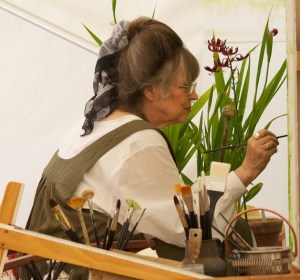
Christiane Kubrick 2011
I first met Christiane Kubrick when she took part in the Open Studio event in 2003 and since then I have made a point of going to her annual Arts Fair at Childwickbury, near St Albans.
Christiane has painted since she was a child, creating theatre sets, some even with electric lighting which nearly killed her!
In 2011 she used backdrops she designed for the set of Hansel and Gretel for the production at the National Theatre, in the area devoted to children working on their own painting. The backdrop included a mysterious eye and a witch that appealed to many children and whose paintings had a mysterious bent.

The witch and the Eye
I interviewed Christiane about her life of art and theatre in 2008 when she spoke of her work, her husband Stanley and her background.
At 80+ she continues working daily on her painting and you will be able to to watch her working on her latest work at the Fair.
Her daughter Katharina is also a prolific artist with a figurative style of her own who will also be painting at the event as will many artists and craftspeople.
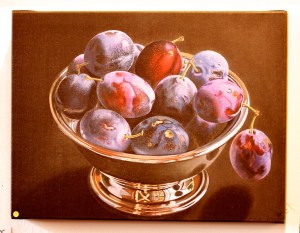
The work of Katharina Kubrick
I’m looking forward to the next Arts Fair 6-7-8-July 2012 where it will be possible to watch crafts people at work … fascinating for all concerned. And there is a programme of events specially focussed on children’s interests, juggling, felt making, face painting and concerts in the evening. A three day event it is something of a celebration of creativity as well as a great day out.
Fashion in Motion V&A Fashion Shows – Open to the public and free of charge
Yohji Yamamoto V&A Exhibition
The work of Yohji Yamamoto, the influential and enigmatic fashion designer, was exhibited at the V&A earlier this year, here is a link. The exhibition made it possible to get up close to the exhibits, view from all anglers, examine at the detail, the variety of fabrics, the unusual pattern cutting and then compare other examples of work, a fascinating experience. We spent a happy couple of hours in the various galleries where the work located.
Then a fashion show in the Fashion in Motion series open to the public and free of charge, was put on by the Victoria and Albert Museum in July and we had the opportunity to see Yamamoto garments in motion, which is so much more interesting than static models.
Laura McClelland, our fashion editor, comments: The show revealed the typically edgy Yamamoto style – both the fashion and the models who were “ordinary” couples taken from the street but far from ordinary once having had a catwalk training session, perfectly complimenting the Yamamoto neo-goth/punk styling of his clothing.
I loved the idea of the couples who were so suited for it, whispering to each other as they came down the catwalk.
The womenswear pieces shown were a selection of beautifully de-constructed fabrics and shapes that have a fluid movement once in motion. Although Yamamoto is well known for his androgynous look I felt many of the pieces were very feminine with their effortless, subtle tailoring.
 The men’s pieces were a selection of over-sized tailored styles with some intricate embroidery detailing.
The latest Fashion in Motion show was on 18 November that showed the work of London-based label, Peter Jensen.
We will let you know when the next show is to be held. The tickets are in great demand so you need to be quick to get one. If you don’t manage to get a ticket the show will be broadcast live on the day. Again we will let you know the link in due course.
Val Reynolds Brown, Editor
London Theatre – Culture in Cash-strapped Times
 Autumn feels like it’s well and truly here, and for many, leisure time turns from the great outdoors and holidays to more cultural pursuits. But in an age of cutbacks and belt-tightening, the question is, are the supermarket price wars and the constant sales in the high streets mirrored in the world of the arts? The answer in the main is, I’m afraid, no.

The Palladium
True, the usual theatre discount outlets are still in place. The half-price ticket booth, tkts, in Leicester Square and also now at Brent Cross is a good source for some productions, as are the online sellers www.whatonstage.com and www.lastminute.com/theatre. But they generally only offer reductions on the top-price seats, plus a fairly hefty commission.
And as has been the case for the last few years, the West End is dominated with blockbuster musicals offering seats at eyewatering prices while providing the feel-good factor that comes with an escapist night out. But that feeling of elation is soon quashed when the credit card bill comes.
The top-price seats for mainstream drama in the West End are now also in some cases what I would call prohibitively expensive.
 I was tempted to go to see Driving Miss Daisy, a two-hander starring Vanessa Redgrave and James Earl Jones, wonderfully reviewed but not, in my opinion, worth £58.50.
A Long Day’s Journey Into Night by Eugene O’Neill and starring David Suchet is scheduled to start well into 2012 with top-price seats at £68.50, and is, to my mind surprisingly, selling well already.
 True, you don’t have to buy the top-price seats. But as I get older I find it difficult to hear anywhere but quite near the stage and face-on – dare I suggest others might be in the same boat. So we’re caught in a bit of a bind: is it worth paying less for a less than satisfactory night out? But it’s also true that you don’t have to go to the West End for your theatrical entertainment. As I’ve written in these pages before, the National Theatre probably offers the best value for money and the best theatrical content; with many of its plays still part of the wonderful Travelex season, you have the opportunity to see great drama for as little as £12.
Then there are the off-West End productions at theatres such as the Almeida in Islington and the Donmar in Covent Garden which offer seats at much lower prices. But here’s another grumble: both theatres are quite small and invite you to become a member at various levels, which entitles you to priority booking. The cheapest form of membership at the Almeida, for example, is £50. Suffice it to say that if you’re not a member of these theatres, by the time you’re allowed to make your booking many of the productions, especially at the Donmar, are completely sold out. You can’t win!
Luckily, the fringe usually offers wonderful value for money and generally a more unusual night out. Check out the fringe theatres near you, don’t forget the upstairs rooms of local pubs. And of course, there’s always the cinema. Many have now been refurbished and the quality of the image and sound has been greatly enhanced. But, and I’m sure you can guess at what’s coming next, the prices at some cinemas are really quite exhorbitant.
Please allow me just one more rant! My local cinema, the Swiss Cottage Odeon, was shut for a number of months for refurbishment and reopened in September with great fanfare as the new north London Imax venue. It still shows a good variety of films and I must say I was pleasantly surprised on going there during the first week to find that the ticket prices had only risen marginally. That, I’m afraid, didn’t last long – I checked online the other day and they have now nearly doubled less than a month later! They won’t be seeing me there much again. However, the Curzon cinema chain (including the Renoir, the Mayfair, the Soho and the Richmond Curzon) show the best films in London at a very reasonable price in a popcorn free environment. That’s for me!
 Jeannette Nelson, Arts Critic
A bit of a culture vulture, Jeannette enjoys art exhibitions, cinema and classical music, but her main interest is the theatre. For several years she ran theatre discussion groups for which her MA in Modern Drama together with teaching skills stood her in good stead. She prefers to concentrate on the many off West End and fringe productions as well as that real treasure of the London theatre scene, the National.
Miró the Surrealist – Major Retrospective 2011

Approach to Miró the Surrealist - Major Retrospective Tate Modern 2011
The major retrospective of Joan Miró the Surrealist at Tate Modern 2011 comes to an end on Sunday, 11 September.
Renowned as one of the greatest Surrealist painters, working in luxuriant colour, Miró worked in a rich variety of styles. This is a rare opportunity to enjoy more than 150 paintings, drawings, sculptures and prints created across six decades of an extraordinary career.
Give yourself at least two hours to take in this exhibition, I went round twice, using the audio commentary. I came out rather over ‘Miróed’ but completely in awe of his range of artistic styles. Overall I looked at The Farm for the longest. It has such a story to tell, I could have looked at it for hours and even then found something new to see.
This really was intended as a must-see exhibition by Tate Modern and for once I agree. If you can squeeze in a visit this weekend I think you won’t regret it.
The last exhibition tour on Saturday is at 12.15 for just 15 visitors. This costs £5 plus of ticket £15.50, concessions £13.50. The exhibition closes on Sunday. You can Book online or call 020 7887 8888.
Christiane Kubrick Wife of the late Stanley Kubrick Exclusive Interview + Book Giveaway

Christiane Kubrick at her easel
Last century, there were a few film directors who rewrote cinema. Apart from London-born Alfred Hitchcock, geographically the closest to South East film buffs was Stanley Kubrick, New York born but happily settled in Childwickbury, just north of St Albans, for many years before his death.
Known as an obsessive who valued his own privacy and space above all else – his classic A Clockwork Orange was withdrawn from circulation for many years in the UK because he didn’t want to engage in discussion about its potential for social harm – it’s hardly surprising that this silent iceberg of a talent had the potential to overshadow his talented wife, German-born Christiane.
Life is always hard for the lesser-known partner in a well-known relationship. Whatever their achievement, they always face the danger of being just a footnote to a more famous life. However, Christiane Kubrick has always done her own thing and has gained an international reputation as an artist to boot.
Descended from a melange of theatre directors, actors, writers and musicians, Christiane’s parents were opera singers and encouraged her into a career in the theatre, although her impulse was always to paint. However, she found early success as a dancer and actress – this included leading roles in theatre, radio, TV and film productions, when she was seen by Stanley who cast her in the only female part in the film Paths of Glory.
But the desire to paint never left her. Despite family commitments, she continued painting, studying at UCLA, the Art Students League in New York and at St Martin’s School of Art in London.
Then, following a family move to the UK in the 1960s, she began to exhibit – the Cork Street Galleries the Grosvenor Gallery, the Drian Gallery and the Mercury Gallery. Later, Christiane was elected Chair of the Women’s International Art Club, founded with a legacy from suffragette and artist Sylvia Pankhurst to defy a law that prohibited women from exhibiting their paintings. And she was also chosen four times for the Royal Academy Summer Exhibition.
At the same time, her work appeared in her husband’s films – in a curious mirror image of wardrobe designer Shirley Russell’s contribution to her husband Ken – as well as in works by Steven Spielberg, on a CD cover design for cellist Alexander Baillie and the cover for a novel by Gabriel García Márquez. Her paintings have been widely collected in the USA and Europe, with both prints and posters published, first by Athena Fine Art Posters and latterly by the Bentley Publishing Group. Many are reproduced in a series of fine art books in Japan and in 1990 a selection was published by Warner Books in a book Christiane Kubrick Paintings* selected as Art Book of the Year on American television.
Enough? No, there’s more! In keeping with the theatrical tradition in her family, she designed the sets for the Palace Opera’s successful production of Hansel and Gretel which was chosen by the Queen Elizabeth Hall in London to be its Christmas Show for two consecutive years.
That experience of theatre design led her to use an Apple Macintosh computer and the computer program ‘Painter’. She now uses these as a complement to her painting and also as a tool in her multimedia projects. Her recent activities include exhibitions for Art in Action at Waterperry (Oxon) and Open Studios (Herts).
She teaches regularly at workshops in Hertfordshire and Shropshire, as well as exhibiting and selling her work over the web.

Remembering Stanley
So, that’s Christiane Kubrick – artist, creator, woman, mother. Ask her about Stanley and you get the stock response: “As and when the time comes that I feel I must say more, I will.” But that’s no problem – she’s a fascinating force in her own right. And she demands, in the nicest possible way, her own identity as an artist. “I don’t know whether Stanley wrote anything about my painting,” she says. “He might have mentioned it when he used my work in his films, but I’m afraid that’d be too long a search!”
Let us then take Christiane Kubrick as her own person, an artist of substance – ironic, humorous, whimsical but full of substance.
Here she is in conversation with In Balance magazine in 2007
IB: Have you always painted?
CK: I have painted all my life, I have painted professionally, from the age of 25 – before that I needed to learn how to draw. I come from an extremely theatrical family, so that’s all I ever really knew, opera and stuff. And I had a puppet theatre from day one it seems to me and I repainted the puppets and I learnt how to sew, I really learned painting, sculpture and sewing and all that in my wish to build the theatre and I made sets – sadly I don’t have them any more because the early ones must have been very funny.
IB: That was important to you?
CK: I know I gave it everything I had and I started to play with electric lights and water – nearly killed myself!
When I think hard, because the children have asked me about these things, I think it was when I had all the childhood diseases. When I had scarlet fever I remember just doing the theatre for weeks – that’s why I think I was better in class at drawing than the other children, just simply by doing it all the time.
Later I studied at St Martin’s School of Art and wherever I could in between babies and stuff!
IB: You’re German. What’s your background?
CK: I was born in 1932 in Braunschweig, a town in North Germany. I then lived in many different places as my parents were opera singers. Later, I was evacuated and I lived in my Nan’s relatives house in a brickworks, in the countryside. Then I lived with lots of other people after the war and went to boarding school.
I was 23 when I met Stanley and we got married a year or so later. I had been married before – criminally young – and had my eldest daughter, Katherine, in Germany before I went to the US. Stanley and I had Vivien who lives in California and Anya**.
IB: Moving to your paintings, the colours you use are very vivid, strong. Are they what you see or what you’d prefer them to be?
CK: I tend to see the world in bright colours, but now I’m longing to use more muted versions. I hope it comes not from growing older but from being more sensitive.
IB: So your style changes …
CK: Yes, it goes in phases. It’s a bit like handwriting – one day you write and it looks okay and another day you think how beautiful and neat it looks. Seems to be true of painting too.
IB: Do you sell most of your work?
CK: Well, it goes in waves, I sold very well at first on the Internet but that was because I was riding on Stanley’s coat tails and when he died lots more people looked me up, otherwise I think I wouldn’t be looked up that much. So that was good for sad reasons. It seems to have evened out. I sell at ‘Art in Action’, I sell to people who collect my work – overall I have sold a little over half my work. Of course, when I was young I sold them very cheap and I sold lots!
IB: Away from art, what makes you angry?
CK: The war in Iraq, but it’s not something I want to speak publicly about …
IB: What don’t you want to talk about when you’re asked for interviews?
CK: Some journalists are very clever and they surprise you. I hate that perplexed moment when you gush out the first thing that comes to your mind, or you are dumbfounded and you say nothing. Either way you look a fool.
IB: What sort of things?
CK: There were a lot questions about whether Stanley minded my being German – that kind of thing. People just assume that you’re a kiss and tell person – that’s insulting. I didn’t want to appear to be an idiot – it was that very thing that Stanley was afraid of with the press. He said that you do your very best, you work very hard and you only show the stuff you think is really good and then in an interview it’s undermined by nervous babble. He only wanted to talk about things he had considered carefully. He didn’t think he was quick witted enough to cope with intense interviews.
IB: Of course, you were married to Stanley and supported him. But what did you personally think of his films?
CK: I liked all his films, each one in its own way as they were very different from each other. As a painter I liked very much Barry Lyndon and 2001 – I liked the last one very much. Perhaps I felt the least connection with Full Metal Jacket where the topic was more alien, but I thought that was a good film as well.
So much time was spent on each one they represent whole periods of my life and I don’t have a favourite film. It depends on my mood at the time.
IB: He worked at home, though? So you were involved?
CK: He worked at home and prepared the film at home. It usually started when he read a story he really liked and he would talk about that particular story and how he could make it. Then, if it was really something he thought would work, he would make a budget and work out the casting. It took a long time to do it carefully and he enjoyed the preparation enormously. The driving force was a longing to see the story on screen.
IB: So you knew everything that was going on with his films while he was making them?
CK: Yes, because it happened at home.
IB: What did you learn from him?
CK: I learned from Stanley that you had to be thorough and patient, not self indulgent. He was good at putting different hats on. He was producer, business man, director. One instance I can remember was where he really liked a particularly long scene. He said “I think it’s particularly wonderful but it’s too long. It doesn’t help the whole enough for me to put it in.” And he whittled away at it. Often it was very painful to let go of something he thought was really good and he’d put it in, take it out, suffer in other words, but he also expected to do that. Paintings are slightly more protected because they will be there no matter what. The worst thing that could happen is I don’t sell but there are no other people pulled in, no one else suffers and the whole thing doesn’t collapse because I do a lousy painting. Film is different, it is so big and expensive. It needs ability and endurance to succeed, only a few people can do it, and Stanley did.
Val Reynolds Brown & Dave Reeder
1. Christiane Kubrick at her easel © Pintail Media
2. Remembering Stanley © Christiane Kubrick
** Died 1999
August 2011:
I met Christiane recently when she generously offered a copy of her book to give away to an In Balance reader
If you would like to enter the prize draw send an email to editorinbalance@me.com with Christiane Kubrick Paintings in the subject box and your full contact details in the text box.
Last day of entry 10 November 2011. One entry per household.
 In Balance