
Borage: Excellent Culinary Herb – Tried and tested recipes

Borage biscuits
Borage is an excellent culinary herb and can be used in a variety of ways. Borage is far better used fresh, as the flavour and colour deteriorate when dried and some essential oils lost.
The leaves taste of oil and cucumber and together with the flowers (say three leaves and three flowers) can be added to 500ml (1pt) of homemade lemonade.
To make lemonade combine the juice of a lemon with 30ml (2 tbsp) of sugar or honey dissolved in 500ml (1pt) of boiling water, and then chill. For a different refreshing drink, add borage flowers and lemon balm leaves to apple or pear juice.

Borage seed packet Thompson & Morgan
Young leaves can be boiled as a spinach substitute or cooked with cabbage (two parts cabbage to one part borage). Chopped leaves can be added, for the last few minutes of cooking, to pea or bean soup and to stews, or finely shredded in salads (before the hairs on the leaves become stiff with age).
Traditional recipes recommend borage leaves and seeds, together with fennel in salads for increasing the milk supply in nursing mothers. The leaves and flowers are still added for flavour and garnish to wine cups, Pimms and gin-based summer cocktails and the flowers are still candied for confectionary as cake and ice cream decorations.

Borage seed packet Thompson & Morgan
A delicious herb butter can be made by finely chopping young borage leaves, parsley and dill, producing one 15ml (1 tbsp) of each herb, blending them into 150g (5oz) of butter and then adding a little lemon juice, one 5ml spoon (1tsp) of chopped onion plus salt and pepper. For a sandwich filling or party dip, try blending 15ml (1tbsp) of finely chopped young leaves into 100g (4oz) of cream or cottage cheese and a squeeze of lemon juice.
Here is a recipe for biscuits, adding the flowers for decoration.
VANILLA BISCUITS
225g (8oz) self-raising flour
110g (4oz) sugar
160g (6oz) butter or margarine
Pinch of salt
One beaten egg
12 drops vanilla essence
Runny preserve for brushing eg homemade redcurrant, apple or raspberry jelly.
Sift the flour into a bowl, add the salt and then rub in the fat until the mixture is like breadcrumbs. Stir in the sugar. Add the beaten egg and the vanilla essence and mix to a stiff paste. Roll out, cut into shapes and place onto a greased baking sheet. Brush the tops with jelly. Place a borage flower on top of each biscuit, pressing down the petals so they adhere to the jelly. Gently drizzle and brush jelly onto the flowers. Bake in an oven preheated to 190C (375F) Gas mark 5 for about 20 minutes, until the biscuits have a good warm colour. Remove from the oven but leave on the tray for a few minutes before transferring them to a wire rack to cool.
Alternatively, for a darker, crisper effect, bake the biscuits without the flowers. Once removed from the oven, brush over more jelly, add the flowers as before and then, instead of jelly, sieve icing sugar over the flowers and biscuits. Place them on the wire rack of a grill pan and grill for one minute.
For a good all-round read about herbs, try Leslie Kenton’s Healing Herbs: Transform Your Life with Plant Power. You have only to look at the front cover of the dust jacket to know the author acknowledges the beauty of the borage flower. It has some excellent reviews.
Photography Sine Chesterman ®
Sine Chesterman, Contributing author
NB At this time of year it’s possible to sow some seeds that will still give flowers and seeds for cooking in about two months. You can freeze the flowers in an ice tray and use them to brighten up drinks in the winter months. Thompson & Morgan sell an excellent variety. Editor
www.ourfrontgarden.com is the website we write about the ongoing renovation and care of a front garden in a garden city
Interested in Gardening? Like some seeds?

Gazania Tiger Stripes
I attended the annual Thompson & Morgan press event this week when we were shown 33 new flower seeds, 54 new vegetable seed introductions, many new young plants – including a massively flowered dahlia ideal for both borders and patio pots – and fruit plants … 2012 is going to be a great year!
I was impressed by the vegetable planting in containers, it’s amazing what they have grown in pouches – imagine a full grown courgette plant hanging on a wall or a post! Dwarf beans, the list goes on and all so easy to harvest. You can have a kitchen garden on your patio! There were good frame supports for patio containers so you could grow peas, mangetout, beans, whatever … Very exciting.

Growing beans in a pouch!
We were given numerous packets of seeds of the new introductions and as I have many duplicates I am happy to send them to our readers free of charge. Just send a stamped addressed envelope to
In Balance Magazine, 50 Parkway, Welwyn Garden City, Herts AL8 6HH
with either Veg or Flower, or both if you would like either, written on the back and we’ll forward them on a first come first served basis. You’ll have to be quick though!
Here are just some of the new flower and vegetable seeds that caught my eye and I will be trying next year. They will all be available online from September and in the Thompson & Morgan 2012 Autumn catalogue.
Lettuce Lettony – a ball of a lettuce, mildew resistant, sweet tasting
Herb Basil Crimson King, special trial price 99p a packet
Cucumber Crystal Apple – incredible taste, golfball size, absolutely no bitterness
Swiss Chard Fantasy F1 Hybrid – excellent taste, spring and summer harvesting
Tomato Bajaja – this is prolific plant, capable of producing up to 700 fruits! Small juicy red fruit 8-10 grams in weight No sideshoots Broad bean de Monica – looked fab and gives high yield
Courgette Sunstripe F1 Hybrid, eager to try this, has a good pedigree
Dwarf french bean Laguna – a new one to try, we love these beans

Calendula Fruit Twist
Calendula Fruit Twist – a range of citrus colours
Hollyhock Halo Mixed good against a wall
Poppy Pink Fizz – this is so pretty with its frilled petals and seeds are edible
Chrysanthemum Polar Star – strikingly attractive
Californian Poppy Peach Sorbet – gorgeous

Phlox Moody Blues
Phlox Moody Blues – this will be a good filler for the borders
Some of the plants available include two really stunning verbascums, blue lagoon and Clementine – a gold blossom, they will look fabulous together. Do explore the plants T&M offer, there will be some real stunners for next year.
And the fruit … We were knocked out by the apricot and patio trees, and dare I say a new strawberry – Sweetheart. I tasted the fruit – excellent … Will have to have some of those. And the raspberry Valentina – unusual apricot pink coloured – heavy cropper, upright canes, virtually spinefree, again must have some!
If you are keen on gardening and want some inspiration do try to get to the Open Days this weekend – open 10 to 4pm both Saturday and Sunday – I’m certain you will not be disappointed.
Val Reynolds Brown Editor
www.ourfrontgarden.com is the website we write about the ongoing renovation and care of a front garden in a garden city
Lost in the Forest of my Garden

Bronze fennel, mallow, lavender
Every winter I study gardening books and magazines, determined that the coming summer will be different from previous ones. The area which I like to think of as my herb garden will be recognisable as such, and the remainder of the garden will be in cunningly designed drifts of planting, colours and shapes artfully selected so as to complement each other. While still maintaining the unstructured look that I prefer, I’ll ensure that each plant knows its place and stays there, leaving me room to get between them for essential weeding and maintenance. This year, I’ll be in charge.

Fennel, eryngium and verbascum
And every year the same thing happens all over again. In March, desperate for spring to begin, I stand outside staring at the ground, brown, bare and depressing – even worse than usual this time due to the extreme cold of last winter. I remind myself that nature will perform its usual tricks and perennials will appear as if by magic out of nowhere, while other plants will suddenly double in volume. But even so, there needs to be some selective new planting to fill these huge gaps. So, very disciplined, I plant just a few small plants and sigh when I see how large the gaps around them are still. In April, seeing that not much appears to have grown, I conclude that my memory has played me false, and desperately move clumps of the tougher perennials from elsewhere to hide the gaps.
But then when I pay my usual early morning trip to inspect the garden, I see that at last things are happening; plants which I’d thought had died off during the winter are putting out new growth. Amazingly, a couple of things which had “died” two years ago have been reincarnated with amazing vigour, and I spot several plants which have just arrived, apparently overnight and by their own volition; I certainly didn’t plant them as I haven’t a clue what they are! And a few days later there are more, and then even more.

Rosemary, lavatera, verbascum, hard geranium
And now in July you could almost get lost in my tiny garden. Self-seeded bamboos, golden angelica, bronze fennel and mauve verbena bonariensis have taken over and form a thicket standing six feet high. Marjoram and mint have grown into bushes, joining large clumps of prickly eryngium to form an almost impenetrable barrier, behind which lavender, rosemary and pink lavatera romp away. A solitary runner bean plant is growing into the overhanging ceanothus, raising the prospect of the sight of bean pods suspended among blue flowers. On a sunny day, bees are everywhere; at night it feels and smells like being in a wood.
Tidy it most certainly is not, in fact you could describe it with justification as messy. A friend kindly pronounced it “very lively”, and it’s undeniably full of life but who’s in charge this year? Not me, that’s for sure … maybe next year …
Janet Harmer Contributing author
www.ourfrontgarden.com is the website we write about the ongoing renovation and care of a front garden in a garden city
Keeping Wasps under Control in Your Garden

Common wasp on allium flower
It’s the season of picnics, eating outside, with jam sandwiches, lollies, ice cream … and wasps!
Now we like wasps, they do an excellent job of hunting out grubs on our garden plants, especially the cabbages. However they are a real menace by the end of July onwards. As the supply of grubs dries up when they metamorphose the wasps are suddenly are more interested in sweet things. They also forage for pollen and nectar and specially like the onion flowers.
We solved the problem with a Waspinator in our garden a couple of years ago and thought it might be useful to give the details again this summer.
It all started with the Victorians who thought of hanging up a dark grey bag that wasps see as a wasp nest and they keep away – they know they will be attacked by the occupants.

Waspinator handing from pergola beam
Instead of making our own bag, we bought a Waspinator and it is now very seldom we have a wasp in the vicinity of our patio table – we hang the Waspinator in the pergola beams over the table. The manufacturer claims the Waspinator clears an area of around 6 metre radius.
When the plums and greengages are coming up for picking we hang the Waspinator nearby which seems to keep the wasps away and there is less chance of our grasping an unseen wasp on a plum, which we have done and don’t want to repeat the experience. The nearest we can come to describing the sensation is like that of having a red hot needle stuck into you. Not at all nice and worrying if you have an allergic reaction.

Honey bee on allium flower
We take the Waspinator with us when we go on picnics, holiday, anywhere we eat or drink outside. We filled it with bubble wrap to keep its shape – we could have used a balloon! Easy to put up, easy to take down and store ready for next year.
The Waspinator is available from Amazon
… And here’s a link to the Waspinator website that gives real insights into the nature and habits of wasps, very informative.
Val Reynolds Brown, Editor
www.ourfrontgarden.com is the website we write about the ongoing renovation and care of a front garden in a garden city
Turtle Watching in The Oman

Turtle tracks in sand
Based in Singapore-style city Dubai in the Arabia Gulf, Dave Reeder took advantage of a quick trip into the more relaxed and green Oman, specifically to watch the centuries old story of giant turtles coming ashore to lay their eggs
Was it a good trip?” my friends all asked, the week after I’d had three days out of Dubai. Yes, it was a great trip. Oman is stunningly beautiful, even though we only saw a hint of it!
So I escaped the steel and glass city of Dubai, thanks to the local natural history club. A team of about 12 of us went in convoy, from one side of the Arabian peninsula to the other – from, if you look at an atlas, the Gulf to the ocean facing East Africa.
Anyway, this late-40s New Zealander turned up in her giant V8 Landcruiser and we set off, to rendezvous with the rest later. In the way of expats, she was easy to talk to and she drove us to the Omani border where I took over the driving of this 2-ton monster.
Fast down the coast, we turned inland about 30km before the capital Muscat, rising up through the mountains on great roads. Because it was the Islamic festival of Eid, most locals were with friends and so the traffic was light. We then ended up late afternoon on the edge of the Wahaybah desert – which stretches across to Saudi Arabia and is serious Bedouin country – looking for the desert camp. Seems, however, that there is a political battle between Bedouins and government on the ‘proper’ name of this part of the desert, with the Bedouin destroying signs that have the ‘wrong’ name on them!
Of course, the supplied map was dreadful and our mobiles didn’t work. Finally, with sunset approaching we found a rough track into the desert and, after about five miles, found the camp – up a hillside in deep desert sand, which somehow I got the Landcruiser up!
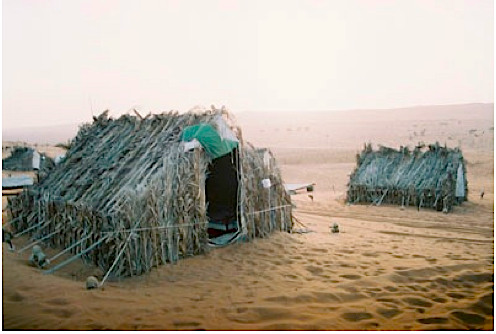
Frame tents covered in fronds and branches of Barasti
Simple place. A-frame tents covered in barasti (a kind of interlocking frond and branch arrangement), with hard metal beds inside – memories of school! – with a communal eating area and a shower/toilet block. The whole group then assembled piles of drinks and nibbles on the back of a 4×4 and we drank our way through to the dinner bell at 7pm. Food was simple, buffet style, with rice and dhal, boiled eggs and sausages, bread and salad. Breakfast much the same.
Plus a small Bedouin troup of musicians who, sadly, didn’t speak any English but tried to help me understand the oud – the Arabian lute – and how to play it.
An early night for all, as we were tired and wanted an early start. Next day we went in convoy to a serious wadi (a dry channel that floods after rain) way up in the mountains – five miles up rough tracks, some 20 miles off the main road. Up and up we went, finally reaching the end of the road and the start of rolling over giant boulders and the like. But so green! And, when we reached the end of the road, there was a walk up through falaj (irrigation) systems and, finally, two enormous pools of clear water – about the size of two Olympic swimming pools! Unfortunately, because of the holiday, it was stuffed with more people than you can imagine – many brought up first in taxis and then, after decamping, on the back of small trucks.
But it was a magical place and the peace and beauty of it out of season must be amazing. So unspoilt. Wonderful.
Then, a drama. A German family with us had twisted their front wheel coming up, so it was at a serious angle to the vertical. With far too many cars on this twisty road, they somehow got it out, with us taking the luggage and a mother/daughter combo. Serious 4×4 guys made light of it – they were ready to drag it out of there, if necessary!
Anyway, they set off for the nearest town (some 90km away) and we headed for camp two about 150km south of Muscat. The coast there is stunning and we ran between it and the mountains across a kind of lunar landscape with the sun low in the sky and the most amazing colours everywhere. Finally we found the camp – similar to the others but with wooden-sided tents. Same kind of food and then, at 9.30pm, we set off in convoy to the beach.

Turtle tracks on the beach
This area has some 20,000 green turtles laying every year which means, despite the remoteness, that it gets popular. The night before, at the main beach, there had been some 1,000 visitors! So our guide took us to a smaller, more remote beach. Serious instructions in the car park – no lights, no shouting, no flash – and we set off following the three Omanis who found the most suitable turtles on the beach.
The beach is dark but you get used to the light, until a crowd of dumb people keep turning the lights on and off. Seems their children were scared and so started bawling and shouting and demanding to be taken home. Talk about destroying the atmosphere … But we could see the tracks up the beach, the mounds that the cover the eggs and then, by magic, a turtle in its self-dug pit laying eggs the size of golf balls. Maybe 120 of them.
Once they’re at work, they’re very placid and didn’t seem to mind us. Even co-operating when the guides unwound a fishing net that had got caught around a flipper of one busy laying.
The moment was incredible. Such a privilege to see, under a black sky filled with more stars than I’ve ever seen – no ambient light, of course. So we went on and they showed us other nests and other turtles. Apparently they take about three hours to climb the beach above high water mark and dig three holes, the first two as decoys to fool the foxes that come at night for the eggs. About the same amount of time to lay and then the same again to rest before hauling back down to the water. The hole is about two feet deep and bigger than the turtle, obviously; then, when covered over, the mound is about a foot above the surface.
After an hour or so, we went back to camp and to bed, woken at 4.30am to go back down again. This time, with the faintest hints of dawn in the sky, we were told it was a “free beach” and we split up, watching the last couple of turtles make their way back to the water. And then the treat of seeing tiny hatched turtles emerging from earlier mounds – they take five or six weeks to incubate. They’re tough! About the size of a cigarette packet, they had to be held really tightly else they’d squirm away. We spent maybe half an hour gathering up any we could find and putting them into the water – with dawn, seabirds were starting to gather for this feast …
And that was the most amazing thing. Out of every hundred, maybe two survive and to know that I helped, in whatever small way, to try and improve those odds was such a wonderful feeling. And then to watch the sun come up over the ocean and the colours of the cliffs behind changing. Wow!
After breakfast, a couple of cars set off on convoy up the coast on a rough road – here an ancient tomb visited by Marco Polo on his way back from China, there a giant sinkhole. Finally, we got to Muscat and hotel apartments. After welcome long hot showers, we were ready for more exploring. We went round the old part of Muscat with its 16th century Portuguese forts.
 Then, next morning, a run up the coast through tiny fishing villages. Part of the Eid celebration involves new clothes and everywhere we saw small children rushing towards the car in their new finery, faces full of smiles. Omanis are so friendly. Then we cut in land and headed for the Emirates border at Al Ain – a stunning run through the mountains with loads of fertile little oases and beautiful small villages. Lunch in Al Ain in an archaeological site of bronze age settlements and then home.
What a trip! For those who imagine that the Middle East is all desert and no wildlife, this kind of trip could be such an eye-opener. Traditional ways of life. Loads of greenery, often in the most unexpected places. And wildlife from birds and camels, to turtles and whales – strangely, the whales off the Oman coast never migrate, like all other whales. Why would they want to? It’s a paradise …
Dave Reeder Consultant Editor
Were you a Giveaway Winner? Supa Drippa Taps
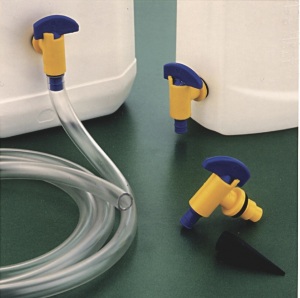
Supa Drippa Taps
Of all the gardening gadgets, products, equipment we have come across so far, these taps are the most useful. We are really happy we had some to giveaway. They saved our plants in the drought because we could target the tender and precious ones, right where they needed water, next to the stem in the case of the tomatoes. And those tomato plants are looking very good.
Leaving the milk containers in place means when we want to feed the tomatoes, generally once a fortnight – we just remove the cap, pour in the fertiliser mix and away they go!
Simple, time saving and effective, see our feature SOS – Save Your Plants.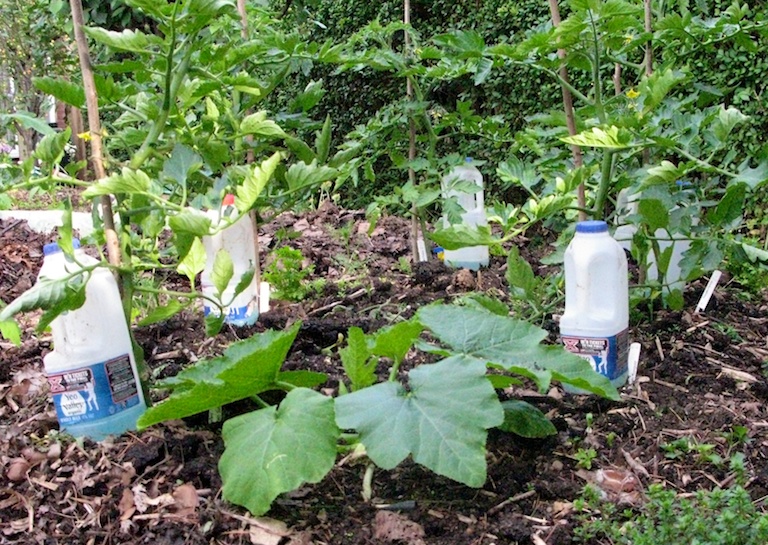
So the lucky In Balance readers who have won a pack of 10 taps sponsored by The Organic Catalogue are:
- A Westley, Chesham
- V Brown Chichester
- T Karweni, Aldershot
Happy watering!
By the way www.ourfrontgarden.com is the website we write about the ongoing renovation and care of a front garden in a garden city
Val Reynolds Brown, Editor
Grow your Own Veg in a Town Garden
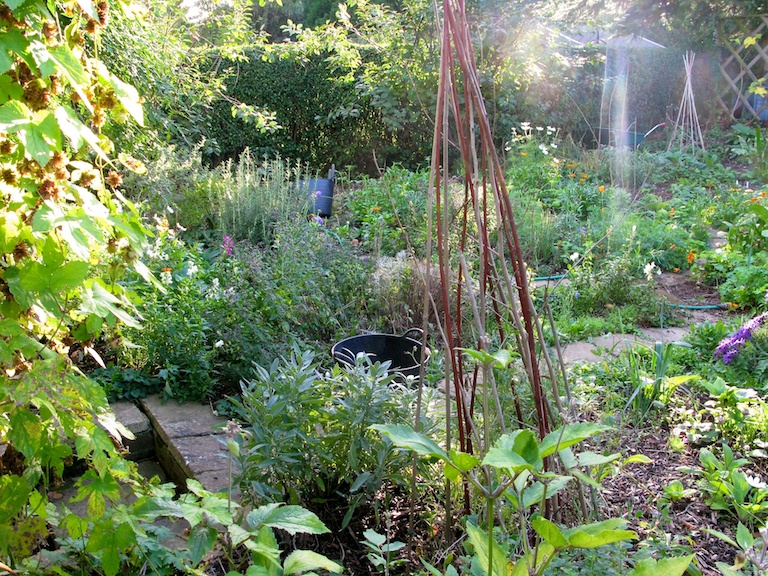
Growing veg in a town garden - my mixture
It isn’t difficult to grow your own veg in a town garden but you do need to have a realistic expectation of success and ways of avoiding disaster. So where do you go to get really reliable information on how to grow veg?
I think tv programmes don’t always provide the real picture and give a false expectation to the whole subject. Do you remember Jo Swift transforming an allotment into a perfect vegetable plot on that top viewing show Gardeners’ World? What they didn’t tell you there was an army of helpers to clear and weed the plot. I reckon they must have used some kind of weed killer to destroy the horsetail, a plant that is usually very, very hard to eradicate. Then there was GroundForce – just how did they get rid of those serious weeds in such a short time before planting up? What I want is reality and how problems are overcome, not a smooth, problem free entertainment show with perfect results. Having said that I have found a whole load of excellent short BBC videos. The one about growing potatoes in bags on your patio is particularly good.
More realistic are books giving reliable advice from experience and two gardeners I both admire and respect are Carole Klein and Anna Pavord. Both write in a most accessible way.
 But for me the most inspirational book is The Edible Garden by Alys Fowler. I find her down to earth approach to growing veg in her tv programmes and books very appealing and resonates with my own experience.
My failures include newly planted cabbage and lettuce seedlings decimated within a day of planting by voracious slugs. Yes I used organic slug pellets and the dreaded beer traps, but somehow there was always a wayward specimen on the prowl and we never did get to eat any lettuce or cabbage that wet summer. My husband used to collect the slugs and throw them into the hedge across the road reasoning that the hedge was better cover for them and if they did venture across the road the chances were they would be run over. Well that was the theory although the slug numbers didn’t seem to drop.
The only solution that has ever worked for me is to use self adhesive copper strip attached to plastic bottles with the tops and bottoms cut off. It does mean a lot of work to begin with, but the containers can be used for years if you use reasonably thick plastic. If mine break up I remove the copper strip and reuse it as it is fairly expensive.
I have had great success with brassicas for the first time ever. In the past I have given up on growing any kind of cabbage because pigeons systematically stripped the cabbage seedlings. So this year I covered the area with fleece. Then as the plants grew I removed that and put netting over them, which works. I forgot to cover this one.

Kale decimated by pigeon
What has worked well for me so far this year
Seeds that germinated easily, that is to say fast and profusely!
- Leeks & Onions – not having sown these before I wasn’t sure what to expect. They germinated quite quickly and came up ‘broken’ but gradually straightened out. They were quite floppy though as seedlings.
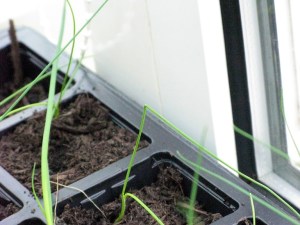
Leek seedlings
- Parsley – I add the leaves to veg/fruit when I use the juice extractor as parsley has such a good reputation for providing valuable vitamins. It is an annual though so be prepared to resow every year and don’t rely on seed from those plants, the growers are really good at making them sterile so you have to buy new every year. However I do let some plants go to seed and add them to stews for flavour in winter
- Par-cel – a cross between parsley and celery, the plants are doing well, good to add to salads, stir fries, even stews

Par-cel, excellent garnish and addition to veggie smoothies
-

Mizuna, used in salads and stir fries
Mizuna – can be used in salads and stir fries
- Kale – the purple leafy kind

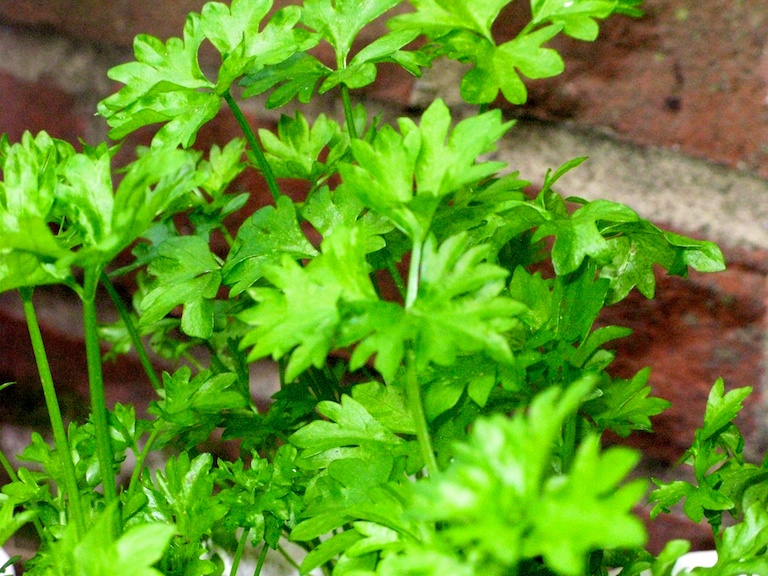

The broad beans have been very successful. I received this advice from Sine Chesterman, our gardening guru:
Pinch off the tops once you see the first beans forming on the lower stem. This stops blackfly colonising the tops of the beans and hence working their way down and ruining the crop. We used to give the tops to our goats (who love the whole plant) but when our last goat died and we didn’t replenish, we ate the leaves ourselves. Boiled with a little salt, strained and warmed with a little pepper and butter – superb.
Another tip I received was to be sure to water the beans regularly – just at the base. I added mulch thickly round them as well to retain moisture and to keep the plants from going through the stress of drought which results in stunted/slow growth and poorer crops.
One new herb I sowed from Suttons is Stevia. The seeds germinated quickly. Once the plants are about 4 inches high the leaves can be used to sweeten drinks – one leaf per cup. I will be experimenting with the leaves in baking and cooking. The seed packet came with recipes.
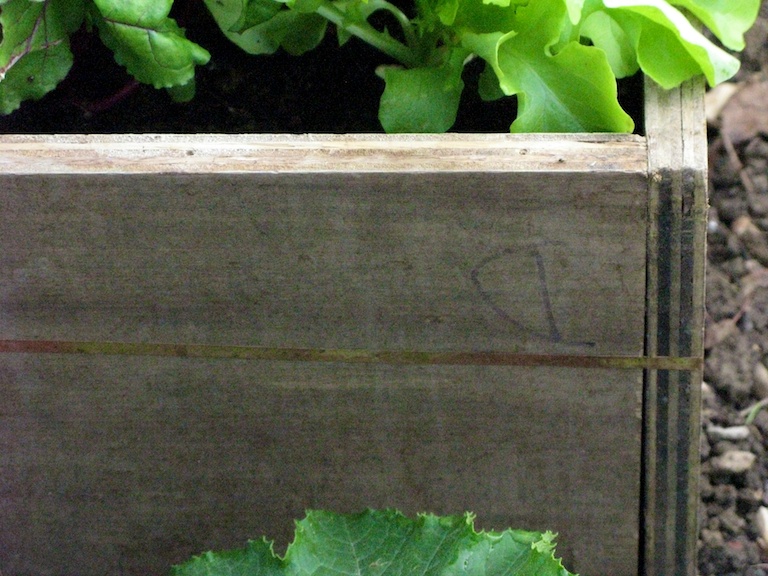
Copper strip used to deter slugs - it works
I put some wooden frames together and sowed carrots, beetroot, spring onions and large onions with a fleece cover, a system that has worked very well. I like the frames, they give protection from wind and put off insects. On the outside of the frame containing the salad stuff I’ve added copper strip to deter the slugs.
I’ve sown some climbing beans in the same way as from experience slugs absolutely love them. I like to see the flowers moving in the wind on the bamboo wigwams. When the beans were first introduced to Europe in the 1400s they were grown just for their flowers, I’m not sure how quickly the beans were found to be good to eat. A big advantage of purple beans I found is they are highly visible and quick to pick.
Poor results
The only real disappointment were the first purple dwarf french beans sown. Out of four rows only three beans germinated, I assume mice got the rest. To reduce the risk of mice getting the seed I sowed more beans in loo roll centres in the conservatory, like I did for the broad beans. They quickly germinated in the warm weather.
I have had a lot more success this year by spot targetting plants reusing milk containers with an adjustable tap. See article
To encourage germination of my fruit I deliberately sow seeds of plants attractive to bees and other pollinating insects throughout the garden:
- borage
- pot marigolds
- love in the mist
- cosmos
- foxgloves
- daises
- violas
- thyme
- pansies
- forget me nots
My seed suppliers:
By the way www.ourfrontgarden.com is the website we write about the ongoing renovation and care of a front garden in a garden city
Val Reynolds Brown, Editor
Chelsea Flower Show 2011

Sculpture of Chelsea Pensioner a welcome sight!
The Chelsea Flower Show is always an exciting and fascinating experience and now with the emphasis on environmental concern this year’s event will highlight the many ways we can take more care of and care for our gardens and open spaces, especially in view of the ongoing drought.
Some of the trends and concerns of the general public include moving to non-powered lawn mowers and planting specifically to encourage wildlife and there will be much to see and take inspiration from this year. Many garden designers have chosen the environment and the responsibility of garden owners to help protect our green spaces.
Ringo and his wife
Anyway, all being well I’ll be there on Press Day when I get to meet and interview some of the celebs who usually attend. Some are really approachable, Gloria Hunniford is always good for a quote, Ringo is usually so popular I don’t get to speak to him, Kim Wilde has always been helpful. Some are not friendly at all, surprisingly I’ve been given the brush off by Chris Tarrant and Martin Clunes. And yet one of the most friendly and surprisingly knowledgeable was David Spinks who played Keith Miller in East Enders.
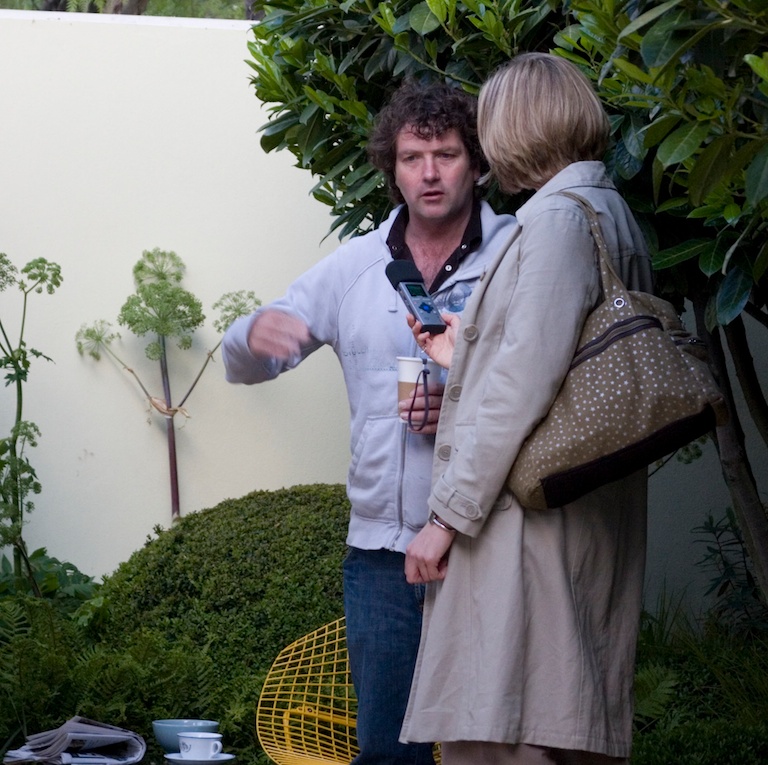
Dairmud Gavin is always friendly and willing to talk
Dairmuid Gavin is always willing to talk gardening and good for a laugh and joke.

Rachel de Thame
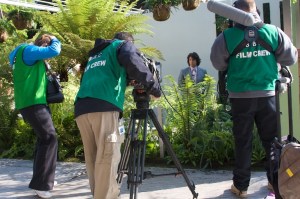
Filming Laurence Llewelyn-Bowen for the day's programme
The one celeb who is always aloof and not at all approachable is the great man himself Alan Titchmarsh, he has purposefully looked the other way whenever I have tried to take his photograph, not sure why, never been able to ask him! Maybe this year I’ll be luckier.
Press Day is a bit a slog really, we are admitted to the showground really early, it used to be 5 am, these days it’s a bit later. We have to leave by 3 pm when the Queen arrives for her personal visit, by which time I’m just about keeping upright … not the wine … just sheer exhaustion from being on my feet for ten hours without a break!
Many of you of course will be able to follow the show on BBC tv and will get a better view of many features than the visitors on foot! There is so much to see that I always seem to miss something really interesting – I get to catch up in tv programmes in the week. Even better, I’ll be able to go to BBC iPlayer for those programmes I missed, what joy! I never could fathom the CD and the DVD recorders, now I don’t have to worry, all can be viewed on my laptop, when I like and for free!
Val Reynolds Brown, Editor
By the way www.ourfrontgarden.com is the website we write about the ongoing renovation and care of a front garden in a garden city
Get bug-eyed about minibeasts – Join in a UK survey
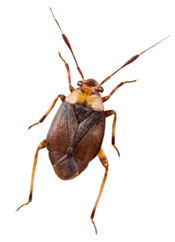
Capsid Bug
Bugs Count is a chance to better understand how and where bugs live. Hunt for bugs in soil and short grass; look on paving and the outsides of buildings; and search on plants and shrubs. Anyone can take part in this national study, led by Open Air Laboratories.
John Tweddle, Natural History Museum, commented, ‘We want everyone to get outside and discover the nature on their doorstep – look in your streets, playgrounds and local parks. With our towns and cities expanding, it’s vital we get a better understanding of how our wildlife is being affected by these changes, Taking part is great fun too!’
But why are bugs so important? They may be tiny, but bugs play a crucial role in pollinating our plants, recycling nutrients by breaking down waste, controlling pests and providing food for birds and other animals.

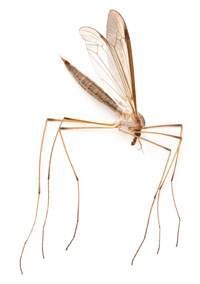
Cranefly
Val Reynolds Brown, Editor
Easy Potato Growing – A Delicious Treat
What a waste it felt to put the plastic bags used for the potting compost we had bought
in the dustbin, correction – plastic recycling bin. This year we are growing potatoes re-using those plastic compost bags – an idea we picked up from one of Monty Don’s Gardener’s World videos on the BBC website.
We have been keeping the bags back as they are heavy duty plastic – each bag only needs three potatoes to grow a crop – and the results are so delicious and so economical. We turn the bags inside out so they are less obtrusive and they are behind an open fence as they are not the most beautiful sight to behold. 
Here’s the latest bag we have used that contained peat-free compost. We have added some polystyrene pieces that seem to give plants added vigour. Not sure why, but it is true.
Another suggestion is to use several rubbish or gardening sacks one inside the other, more than one to get extra strength, a bit like carrying wine bottles using more than one plastic carry bags.
We’ll be experimenting with hessian sacks to see what we can grow – we got this idea from the charity Send A Cow who promote bag gardens – see the video.
Do you have an economical tip to pass on?
Val Reynolds Brown, editor
By the way www.ourfrontgarden.com is the website we write about the ongoing renovation and care of a front garden in a garden city
 In Balance