
Forced Rhubarb – First fruit of the year
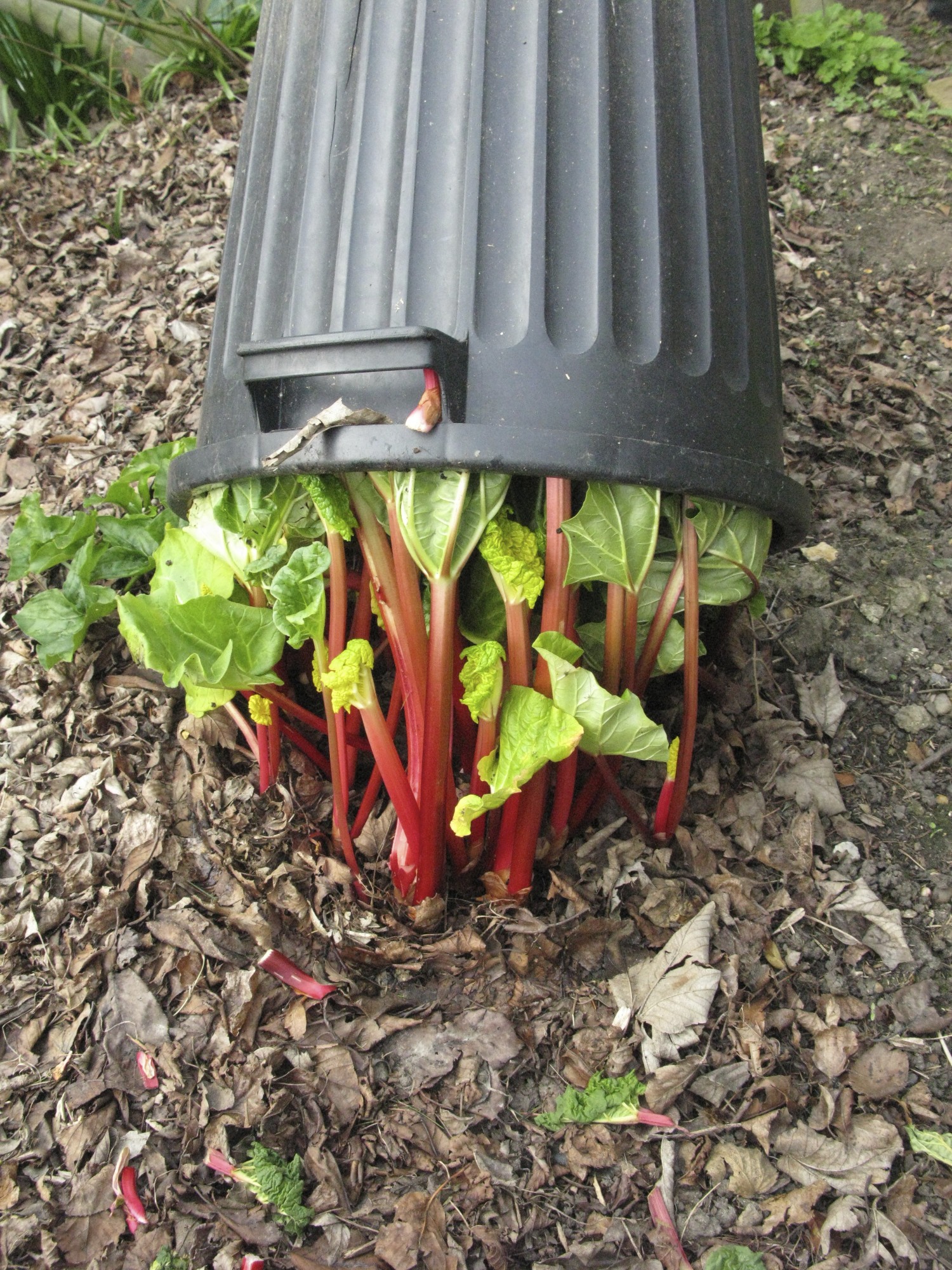
Forced rhubarb ready to cut
It’s so unbelievably easy to get juicy, sweet rhubarb so early in the year. And yet we do it, every year. We just place an old plastic dustbin over the new shoots when they appear in early spring and a few weeks later hey presto there’s rhubarb to pick.
We generally get too much at a time so it is cooked with a little sugar and stored in the freezer ready for later use. Great with yogurt, on cereal, with ice cream. We made some delicious wine one year, it was a beautiful pink colour. We do bottle some, best for us in the smaller jars, a whole kilo jar tends to languish in the fridge for far too long. Anyway as it has a high oxalic acid content it’s best not to eat rhubarb for extended periods. Once a week is probably wiser. We generally go for crumble or pies, with a generous amount of ground ginger to give it that little extra zing.
We have no idea which variety of rhubarb we have, we think it’s been in this garden since the 1930s. But good plants can be purchased from Thompson & Morgan, here is a link to their comprehensive rhubarb catalogue page.
Val Reynolds Brown, Editor
The Sun is Shining in the Sky …
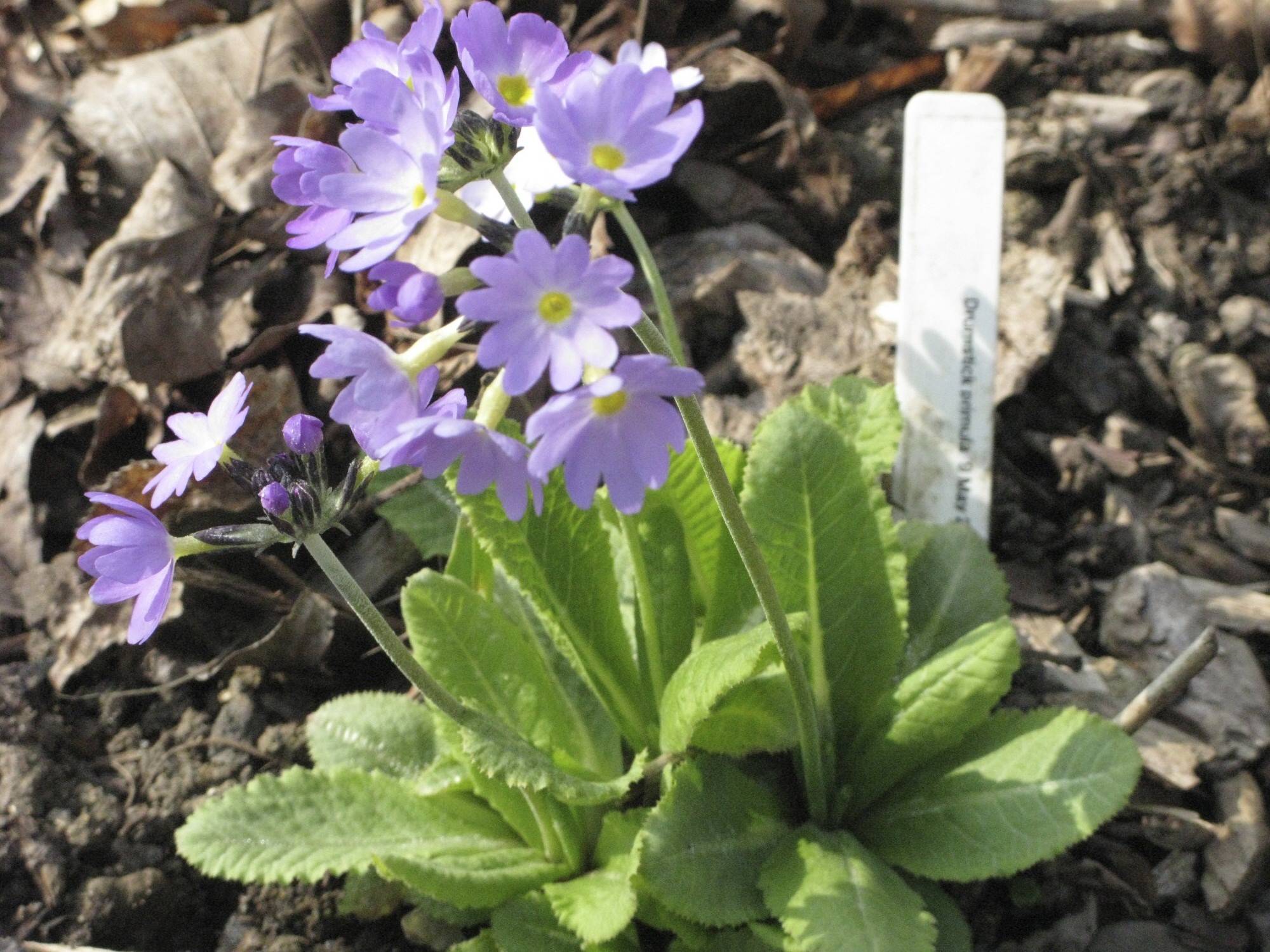
Drumstick primula, sown May 2010
The sun is shining in the sky and it’s seed time! The most exciting time in my gardening year. The anticipation, the joy, the expectation. But then there is the labelling … I have so often sown the seed and not bothered to write a label thinking I won’t forget that particular tray.
Wrong! I have often forgotten and some seeds haven’t received the attention they need, especially those that take more than a month to germinate.
That’s all in the past. This year I have a labelling machine. A Brother P-touch GL200 and a wondrous machine it is too!
A dream machine it is a computerised, battery run labeller. Lightweight and so portable I can do the labelling in the garden if I want. In fact though, I generally print out the labels before I go into the garden, much easier to prepare the labels before I get my fingers muddy.
I can’t say enough good things about it, and so far, touch wood, I can’t think of anything negative. The labels are rainproof, humidity proof, fade proof, heat and frost resistant, can be on coloured tape. I can choose the typeface which can be small, medium or large, on a long or short strip. It has a built in date and time clock. You get to see the text before you print on a small screen, and it can be neatly cut. All I do is make sure I have enough plant sticks to add the label to! Easy. If you’re interested in the specification go to www.brother.co.uk/gl200
Actually I can think of a negative, the price of the replacement tape is a bit steep. But honestly the machine is so useful I can tolerate that, just.
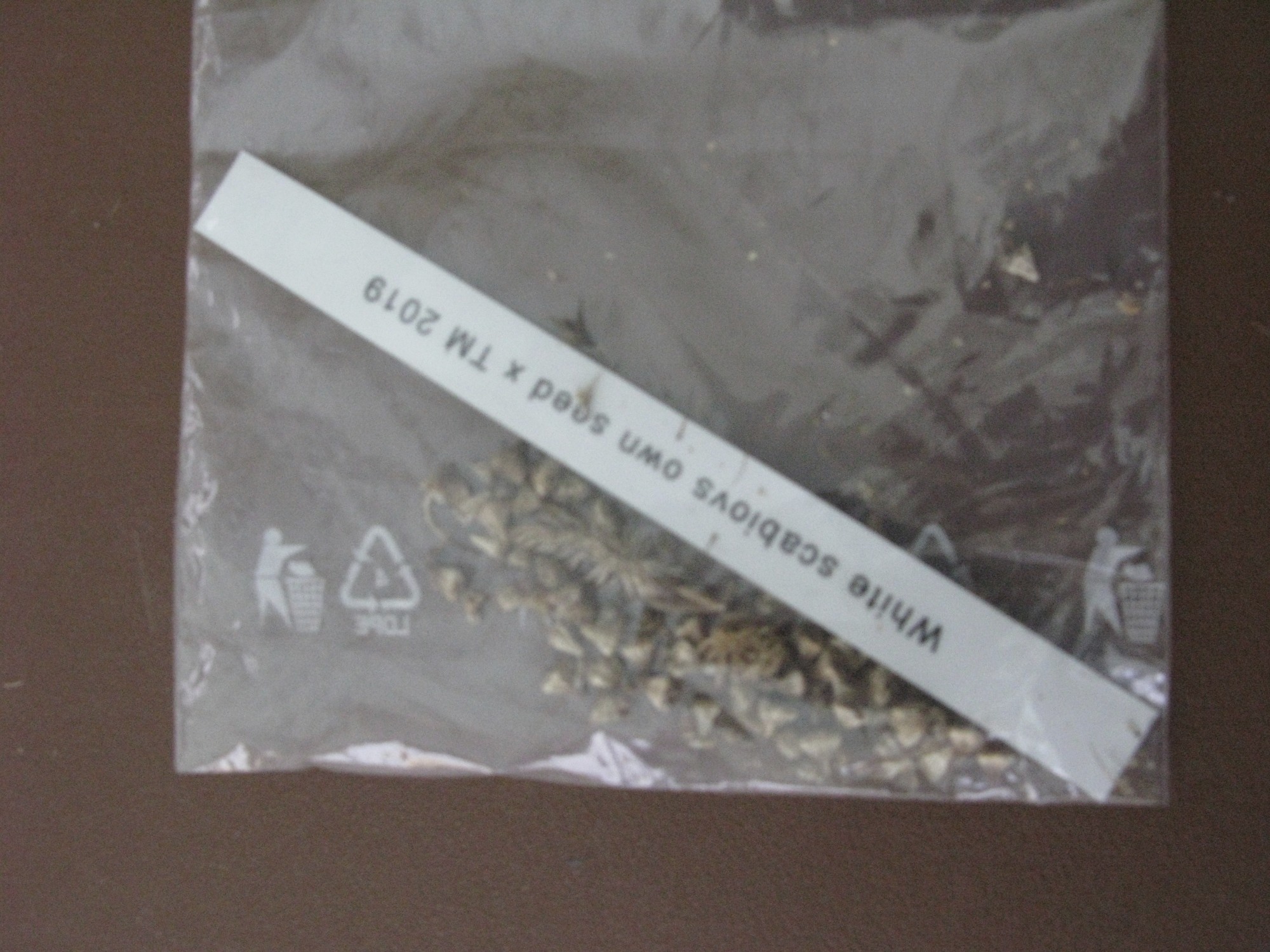
Seed collected 2011
One of the uses I have put it to is to add an appropriate label inside the numerous plastic bags of seed I have collected last year. That way I know what those funny looking seeds really are this year and the label is ready to go. What joy!
My husband uses it for labelling his filing folders and I have used it for all kinds of jobs around the house and elsewhere – even the little plaque on a fence post giving the website address for our front garden!

Label weathering well
It is one of those gadgets I really wouldn’t be without.
RRP £27.55, available on Amazon Brother P-Touch Label Printer

Kate Campbell, Gardening editor
We have a Brother P-touch GL200 to GIVEAWAY to an In Balance reader. To enter the draw send an email to editorinbalance@me.com with Brother P-touch GL200 in the subject box and your full contact details in the text box. Entries to reach by latest 25 April 2011. One entry per household.
How to Grow Gladiolus Callianthus or Acidanthera – Beautiful Scent Beautiful Flowers
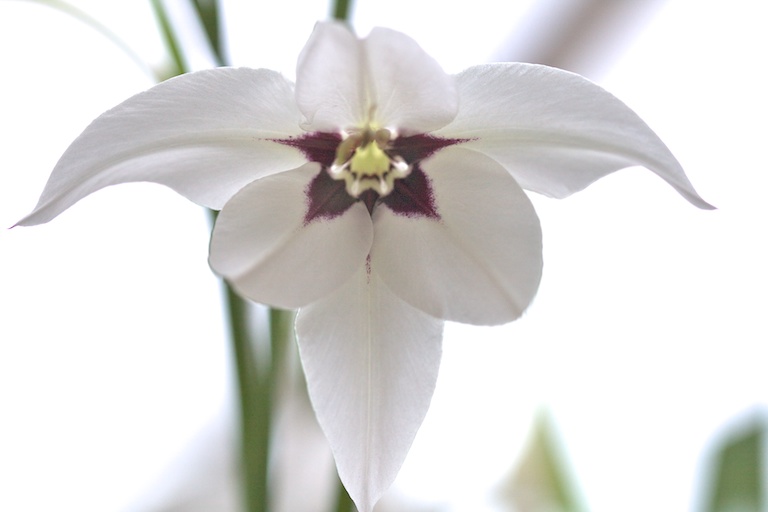
Last summer we were delighted and surprised with the beautiful scent and beautiful flowers of the gladiolus callianthus, now more usually referred to as acidanthera. Also known as Abyssinian gladiola and sword lily, acidanthera, pronounced ass-ih-dan-ther-ah, plants are tender and grown from corms.
We planted ours in April in a pot. If you want to plant Acidanthera in the ground choose a site that gets the afternoon sun and near a path, that way you will notice the scent as you pass.

Hoverfly drinking Gladiolus Callianthus nectar
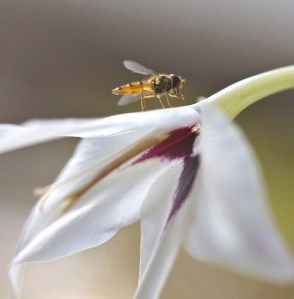
Hoverfly resting on Gladiolus Callianthus
When ours flowered in mid July we brought the pot into the conservatory out of the wind and strong rain. Each long leafed plant produced about ten white flowers, each with a beautiful scent that filled the room. They attracted innumerable hoverflies who fought for a place on the long perfumed stamens. Once there they were very reluctant to move and other hoverflies darted and hovered waiting for their turn, or not, when there was an amusing dogfight to watch.
The swordlike leaves are about 24 inches tall with blossoms that filled the conservatory with a beautiful scent.
Growing these bulbs really didn’t take much effort, we put 6 corms to a depth of about 5 inches in a clay pot in a soilless compost for the conservatory. The plants are low maintenance, to produce the most flowers the plants do appreciate a regular feed.
Next year we’ll put some in pots for the conservatory and others in the front garden in pots but plunged in the soil. They will need support of some kind, we’ll probably use some unobtrusive metal rings you can buy from any garden centre or even B&Q. The pots will be easy to remove once the flowers have gone over and later when the leaves have died away the bulbs can be dried and stored in a paper bag in a cool but not frosty place during the winter with a note in the diary to get them out and planted by latest mid April*. I have read some gardeners successfully leave the bulbs in the pot kept in a frost free greenhouse, bringing the pot out once the danger of frost has passed.
These plants originate from East African mountains, between 4,000-8,000 ft, mainly found in grassy areas and amongst rocks, which perhaps give them the protection from frost they need.
The gladiolus callianthus bulbs, generally available in the spring, were supplied by Avon Bulbs, Avon Bulbs Ltd, Burnt House Farm, Mid Lambrook, South Petherton, Somerset, TA13 5HE, Tel: (01460) 242177
*By the way, we completely forgot to lift and store them last autumn … luckily Avon Bulbs still have some of sale so we’ll plant some more in April.
March 2015 Just been to Aldi where they are selling packets of 30 bulbs for 99p – what a bargain! Was so excited I bought 3 packs … can’t wait for the summer and their heavenly scent. I have to say everything I have bought in the plant and seed sections has always gone well for me, from olive trees to lavender bushes, from wild flower mixtures to bonsai plants. Would love to hear if that has been your experience.
Val Reynolds Brown, Editor
Why Bees Collect Pollen in Baskets
A visit to a local fifteenth century churchyard on the first sunny day that enticed us out of the house, reminded me of the uniqueness of pollen colours. For years I was completely unaware of how each plant produces a different pollen colour and that because honeybees collect pollen from only one source at a time it is easy to see the colours. The bee adds a tiny amount of nectar to the pollen as it collects it which makes the pollen stay on the bee’s pollen basket, which is in fact on just one strand on each rear leg.
 For instance in this picture of a bee in the churchyard on a white anemone blanda – usually a purply/blue colour – you can see the pollen is a creamy white. Snowdrops provide a red pollen and dandelions a reddish yellow. There is a fascinating page on the Bristol Beekeepers website showing pollen colours for a variety of plants.
This fantastic image by Dave – see his website – is clearer, the bee is on plum blossom. 
So why do bees collect pollen? It is a source of protein, fat, starch and vitamins and fed to bee larvae along with honey and a little of what is called queen jelly, a secretion from the glands in the heads of worker bees. A well written Wikipedia page gives more in depth information.
You might this website of artist Valerie Littlewood, interesting, she is fascinated by all things bee, who now lives in Florida.
You may wonder why bumblebees’ pollen baskets don’t have similar colours, it’s because they are gather pollen from a variety of plants so the colours are all mixed up.
Interestingly Anna Pavord writes in The Independent Magazine about the historical daffodils she has in her garden that were collected from churchyards and abandoned gardens by Alan Street of Avon Bulbs and are now available on their website. Sadly they are now completely sold out … but will be ready to order in May to plant in the autumn.
I’d quite like to grow some dwarf narcissi under the cherry trees and have made a another note in the diary to get in touch with the Yorkshire growers Miniature Bulbs later this year. I’ll have a hard job deciding on which ones to plant, they are all utterly gorgeous!
Val Reynolds Brown, Editor
Spring Flowers in our Front Garden
March 17, 2011
Of the three hellebore plants planted two years ago one is growing well with the most beautiful white blooms.

Because hellebores are a very important pollen and nectar source in early spring bees and other pollinating insects are attracted to them in large numbers. Cross pollination occurs and the resulting seed can often produce really unappealing colours, from a dirty grey to a dirty green. So the best plan for propagation is to split the plants.
Looking up how to do that on the web it seems that dividing the plants once the flowers have been pollinated is the best time. However as our plant has only been in the ground for two years we’ll not divide it for another year or two. Maybe we’ll look for another plant/s in the meantime. The other point to consider is to remove the seed pods before they ripen so you avoid any unwanted plants from germinating. Some people like to sow some of the seed just to discover what cross they do get, sometimes with interesting results. It is of course possible to purchase seed and/or buy plants from growers. We might just get some seed – Thompson & Morgan are selling 40 seeds for 66p! Or 5 bare root plants at £9.99.
 Some of the buds on the magnolia stellata were encouraged to emerge in the recent warm day/s. Now we’re fearful of a hard frost damaging them – you can see some flowers were caught lightly a few days ago. I think it was 2005 when the whole tree was frosted one night and it was heartbreaking to see next day the glorious display of blossom all tinged with brown. So we will just have to keep our fingers crossed, or make the decision to put a covering on if we get a forecast of frost.
 We really would love some snowdrops next year and have found a website that sells bulbs ‘in the green’, that is bulbs that are dug up after flowering, sorted and sent out. This happens in February and March so if you would like some this is a good time to get in touch. Here are the details of Tweedbank Bulbs It’s a very interesting website explaining lots about planting and the quality of the bulbs.
At the moment you can buy 100 bulbs for £12.50, inc p&p, with 50 extra for free. This super offer really is likely to finish TODAY 17 March 2011, but do go to the website – they may well have extended the date.
Please do mention you found their website through In Balance Magazine – every little bit of publicity helps!
You might also find our other website of interest www.ourfrontgarden.com
Victorian Rosebud Lobelia for that Wow Factor!
Our front garden has a most ad hoc group of plants with no semblance of tidiness or order. Although in my defence I have to say there is an element of careful selection! Up to now bedding plants haven’t played a part in the scheme of things.
However, just what do you think this plant is? Double click to see larger image.

It is Lobelia erinus ‘Kathleen Mallard’, an old fashioned double rosebud flower grown by the Victorians, ideal for hanging baskets, patio containers, window boxes and front bedding as it has a close knit habit and forms a perfect ball. Its height and spread is 15cm/6 inches. I fell in love with it instantly, picturing it sitting on the outside edge of the front garden.
We reckon this plant will be very popular, it is so beautiful. Should add quite a wow factor! We’re impressed, so much so we are ordering ten plants for bedding and another ten for our hanging baskets and bedding in the back garden from Thompson & Morgan who are offering them at a really good price.
Suitable for sun or semi shade 5 jumbo plugs cost of £3.49, or 10 jumbo plugs £5.99 and will be despatched by end of April 2011.
To order some now go to the Thompson & Morgan website where you will find all the growing and other information you may need. It’s not a difficult plant to grow.
GIVEAWAYS
Lobelia erinus ‘Kathleen Mallard’
We have FIVE Thompson & Morgan sets of 10 jumbo plugs to give away to In Balance readers. To enter the draw send an email with Kathleen Mallard in the subject box to: editorinbalance@me.com with all your contact details by latest 31 March 2011. One entry per household.
You might also find our other website of interest www.ourfrontgarden.com
Secateurs – searching for a good pair
Over the past couple of years I have tried out several pairs of secateurs, here they are:
The first pair was so designed that when I was cutting a particularly thick stem it somehow managed to nip the space between my thumb and first finger. Very painful.
The second one had a very simple closing device with no special features. I like this one but would like one with a larger blade.
The third one had a ratchet system that fell apart within a couple of months, and the last one has a yellow closing device that is loose and when I am cutting it in a downward direction the yellow tab falls down and locks the blades. There is no way of tightening the yellow tab. So really that latest pair is totally useless, unless I unscrew the yellow tab or tape it into the open position. However, this was the only pair I could attach a coloured tape to in an attempt to avoid leaving them in the garden to rust.
I’m sorry to say none of them had all the features I wanted and I’m now looking for one that will give a good strong cut, reliable, a long life and simple to operate with a hole in one of the arms to thread through a brightly coloured tape. Do you have any suggestions?
You might also find our other website of interest www.ourfrontgarden.com
Our Front Garden now has its own website
Last year we added Our Front Garden as a new feature in In Balance Magazine. As interest has since grown significantly we have now created its own website.
We will be providing monthly tips from experts and the opportunity for readers to send in their queries and problems.
We will continue to write about our front garden, how our plants are faring, raising plants from seed and our push for a no-dig plot as well as comment on weather and growing conditions.

We really enjoy receiving your emails so do keep sending them to ourfrontgarden@me.com or editorinbalance@me.com.
Val & John Reynolds
Signs of spring
A short sortie into the countryside showed plants are on the move!

Eranthis, winter aconite
Eranthis, a member of the buttercup family, known as winter aconite, were well out in a friend’s garden.
I rather like them and will get some for next year. They are available from Thompson & Morgan, my favourite plant and seed supplier.
The catkins were shaking their tails in the wind

Catkins
and the snowdrops are more advanced than a couple of weeks ago.
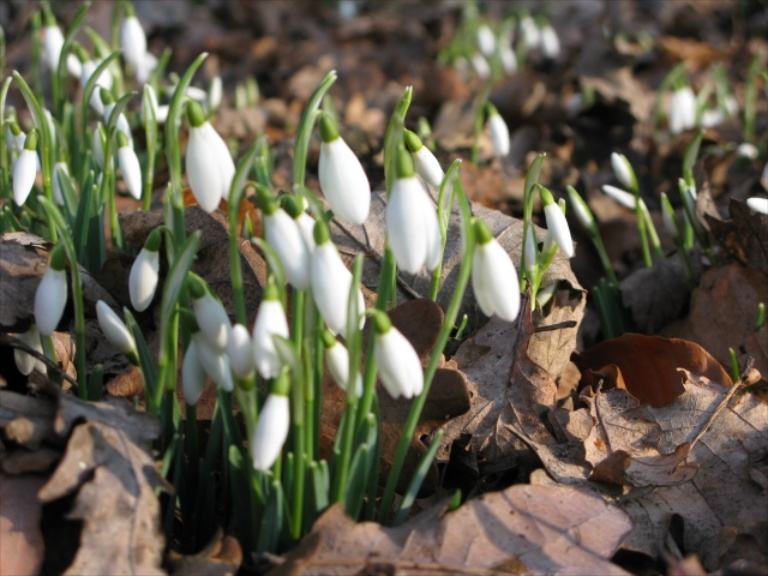
Snowdrops
Plants Galore!

Lemon Basil
Some years ago I came across a packet of Lemon Basil seeds from Thompson and Morgan – my favourite seed supplier since 1970! – that I have to confess had been ‘loitering’ in my seed box for some time, four years in fact! As I had a bit of space in my tiny greenhouse, I thought I would see if they germinated, expecting a few to come up which would be very useful for salads. To my great surprise the whole seed tray bounced into life and I had so much basil I had to give much of it away! Recipes and more information is here.
With that experience in mind I decided to go through the T&M catalogue looking for herbs that I could grow to add to salads, even if they didn’t grow to full size they would add a variety of flavours. Most herbs are available at very reasonable prices and with germination rates generally pretty high it’s a win win situation!
Most recently I have successfuly sown

Basil
Outdoor Basil This gave an excellent germination and again found I had so much I had to give many plants away. I kept some indoors and others in the kitchen garden. I love picking a leaf or two and eating it when I’m wandering around looking for weeds to pull up.
Borage, the young leaves have a cucumber taste and widely used in salads and the bright blue flowers look wonderful in drinks, or salads. At the end of the season the plant can be added to your compost. It does get a bit untidy but I can forgive that characteristic as it attracts so many bees and other insects, it is a joy to see it thriving.
Coriander This can be sown direct in the ground. However it is useful to sow some in pots to keep indoors for year round fresh leaves to add to salads, salsas and Asian cuisine. Another flavour indispensable TO the adventurous cook.

Chervil
Chervil Used in French cooking to flavour fish dishes, sauces and soups, is a familiar taste of France. Can be grown in pot on the windowsill for all year fresh leaves.
Summer Savory this comes highly recommended from Bob Flowerdew who waxes lyrical about its effect on broad beans! Try it chopped and mixed with melted butter. Thompson & Morgan suggest adding it to breadcrumbs to coat fish, added to soups and stew – said to be magnificent!
Endive not often found on sale here in the UK, is easy to grow from seed. Easy too to grow it as salad leaves.
Other seeds I have successfully grown for the kitchen garden this year are globe artichokes, beetroot, parsnips, carrots, lettuce, sugar snaps, french beans, courgettes, leeks, pumpkin, outdoor melons – the jury is out on these they are not growing very quickly and I wonder whether they will flower and produce mature fruit, they are protected by a cloche to keep the heat in and the wind out.
I have grown many plants to attract insects. French marigolds, calendula, I have allowed the parsley to go to seed for insects to feed on, poached egg plant, nigella, and alfalfa to dig in as a green manure. Red clover has been sown for the same reason.
I have also used odd spaces to grow flowering plants for the main garden, for instance escholtzia, chrysanthemum daisies, scabious, sweet peas and I have experimented with unusual plants, for instance cucumelon.
It will be some weeks before I know which plants are worth keeping and which seeds are worth sowing next year. As always the gardener in me is constantly adding, subtracting and repeating plants, always aiming at perfection. Ever hopeful!
Val Reynolds, Editor In Balance Magazine
 In Balance