
Grow your Own Veg in a Town Garden
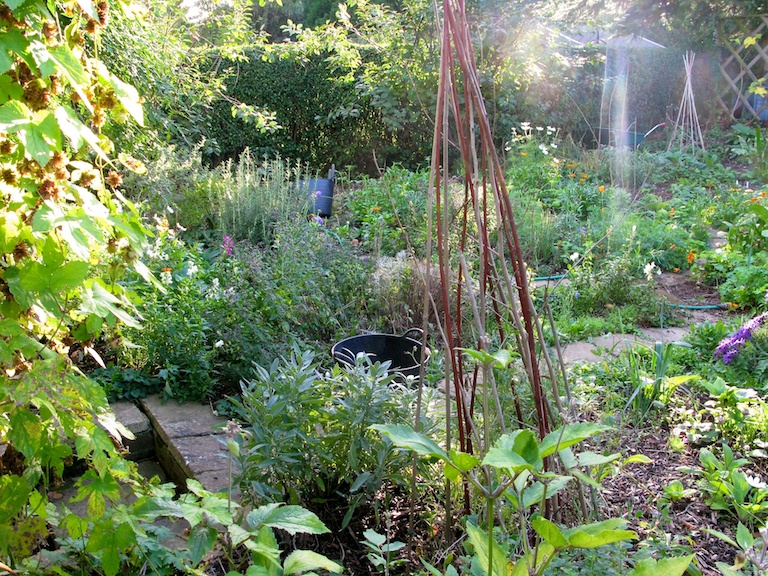
Growing veg in a town garden - my mixture
It isn’t difficult to grow your own veg in a town garden but you do need to have a realistic expectation of success and ways of avoiding disaster. So where do you go to get really reliable information on how to grow veg?
I think tv programmes don’t always provide the real picture and give a false expectation to the whole subject. Do you remember Jo Swift transforming an allotment into a perfect vegetable plot on that top viewing show Gardeners’ World? What they didn’t tell you there was an army of helpers to clear and weed the plot. I reckon they must have used some kind of weed killer to destroy the horsetail, a plant that is usually very, very hard to eradicate. Then there was GroundForce – just how did they get rid of those serious weeds in such a short time before planting up? What I want is reality and how problems are overcome, not a smooth, problem free entertainment show with perfect results. Having said that I have found a whole load of excellent short BBC videos. The one about growing potatoes in bags on your patio is particularly good.
More realistic are books giving reliable advice from experience and two gardeners I both admire and respect are Carole Klein and Anna Pavord. Both write in a most accessible way.
 But for me the most inspirational book is The Edible Garden by Alys Fowler. I find her down to earth approach to growing veg in her tv programmes and books very appealing and resonates with my own experience.
My failures include newly planted cabbage and lettuce seedlings decimated within a day of planting by voracious slugs. Yes I used organic slug pellets and the dreaded beer traps, but somehow there was always a wayward specimen on the prowl and we never did get to eat any lettuce or cabbage that wet summer. My husband used to collect the slugs and throw them into the hedge across the road reasoning that the hedge was better cover for them and if they did venture across the road the chances were they would be run over. Well that was the theory although the slug numbers didn’t seem to drop.
The only solution that has ever worked for me is to use self adhesive copper strip attached to plastic bottles with the tops and bottoms cut off. It does mean a lot of work to begin with, but the containers can be used for years if you use reasonably thick plastic. If mine break up I remove the copper strip and reuse it as it is fairly expensive.
I have had great success with brassicas for the first time ever. In the past I have given up on growing any kind of cabbage because pigeons systematically stripped the cabbage seedlings. So this year I covered the area with fleece. Then as the plants grew I removed that and put netting over them, which works. I forgot to cover this one.

Kale decimated by pigeon
What has worked well for me so far this year
Seeds that germinated easily, that is to say fast and profusely!
- Leeks & Onions – not having sown these before I wasn’t sure what to expect. They germinated quite quickly and came up ‘broken’ but gradually straightened out. They were quite floppy though as seedlings.
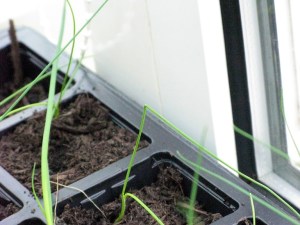
Leek seedlings
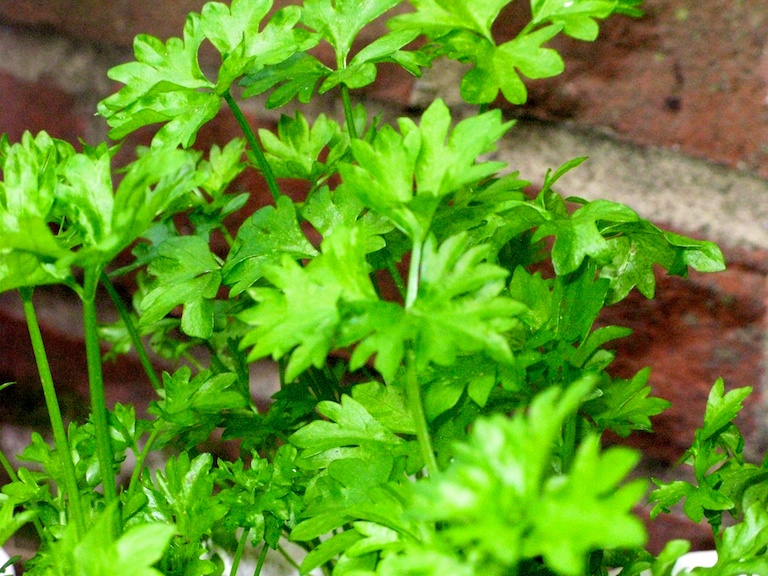
- Parsley – I add the leaves to veg/fruit when I use the juice extractor as parsley has such a good reputation for providing valuable vitamins. It is an annual though so be prepared to resow every year and don’t rely on seed from those plants, the growers are really good at making them sterile so you have to buy new every year. However I do let some plants go to seed and add them to stews for flavour in winter
- Par-cel – a cross between parsley and celery, the plants are doing well, good to add to salads, stir fries, even stews

Par-cel, excellent garnish and addition to veggie smoothies
-

Mizuna, used in salads and stir fries
Mizuna – can be used in salads and stir fries
- Kale – the purple leafy kind


The broad beans have been very successful. I received this advice from Sine Chesterman, our gardening guru:
Pinch off the tops once you see the first beans forming on the lower stem. This stops blackfly colonising the tops of the beans and hence working their way down and ruining the crop. We used to give the tops to our goats (who love the whole plant) but when our last goat died and we didn’t replenish, we ate the leaves ourselves. Boiled with a little salt, strained and warmed with a little pepper and butter – superb.
Another tip I received was to be sure to water the beans regularly – just at the base. I added mulch thickly round them as well to retain moisture and to keep the plants from going through the stress of drought which results in stunted/slow growth and poorer crops.
One new herb I sowed from Suttons is Stevia. The seeds germinated quickly. Once the plants are about 4 inches high the leaves can be used to sweeten drinks – one leaf per cup. I will be experimenting with the leaves in baking and cooking. The seed packet came with recipes.
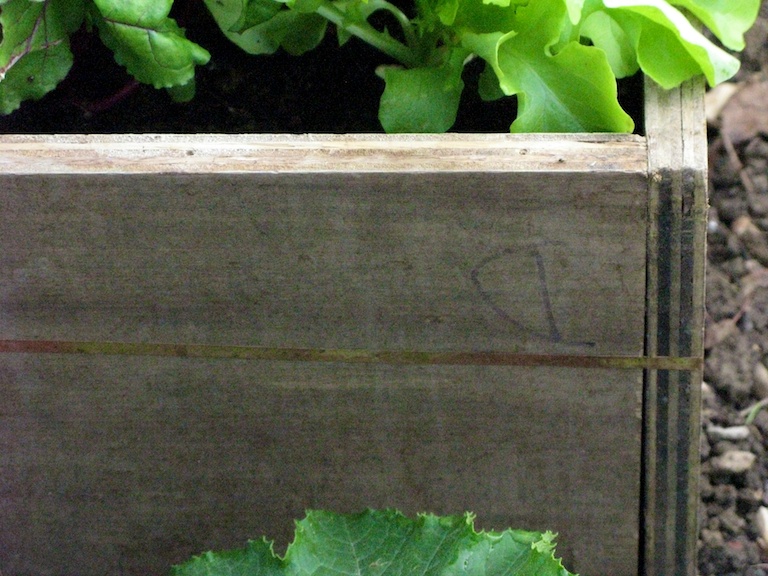
Copper strip used to deter slugs - it works
I put some wooden frames together and sowed carrots, beetroot, spring onions and large onions with a fleece cover, a system that has worked very well. I like the frames, they give protection from wind and put off insects. On the outside of the frame containing the salad stuff I’ve added copper strip to deter the slugs.
I’ve sown some climbing beans in the same way as from experience slugs absolutely love them. I like to see the flowers moving in the wind on the bamboo wigwams. When the beans were first introduced to Europe in the 1400s they were grown just for their flowers, I’m not sure how quickly the beans were found to be good to eat. A big advantage of purple beans I found is they are highly visible and quick to pick.
Poor results
The only real disappointment were the first purple dwarf french beans sown. Out of four rows only three beans germinated, I assume mice got the rest. To reduce the risk of mice getting the seed I sowed more beans in loo roll centres in the conservatory, like I did for the broad beans. They quickly germinated in the warm weather.
I have had a lot more success this year by spot targetting plants reusing milk containers with an adjustable tap. See article
To encourage germination of my fruit I deliberately sow seeds of plants attractive to bees and other pollinating insects throughout the garden:
- borage
- pot marigolds
- love in the mist
- cosmos
- foxgloves
- daises
- violas
- thyme
- pansies
- forget me nots
My seed suppliers:
By the way www.ourfrontgarden.com is the website we write about the ongoing renovation and care of a front garden in a garden city
Val Reynolds Brown, Editor
Chelsea Flower Show 2011

Sculpture of Chelsea Pensioner a welcome sight!
The Chelsea Flower Show is always an exciting and fascinating experience and now with the emphasis on environmental concern this year’s event will highlight the many ways we can take more care of and care for our gardens and open spaces, especially in view of the ongoing drought.
Some of the trends and concerns of the general public include moving to non-powered lawn mowers and planting specifically to encourage wildlife and there will be much to see and take inspiration from this year. Many garden designers have chosen the environment and the responsibility of garden owners to help protect our green spaces.
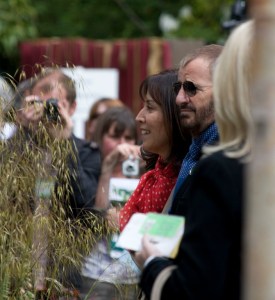
Ringo and his wife
Anyway, all being well I’ll be there on Press Day when I get to meet and interview some of the celebs who usually attend. Some are really approachable, Gloria Hunniford is always good for a quote, Ringo is usually so popular I don’t get to speak to him, Kim Wilde has always been helpful. Some are not friendly at all, surprisingly I’ve been given the brush off by Chris Tarrant and Martin Clunes. And yet one of the most friendly and surprisingly knowledgeable was David Spinks who played Keith Miller in East Enders.
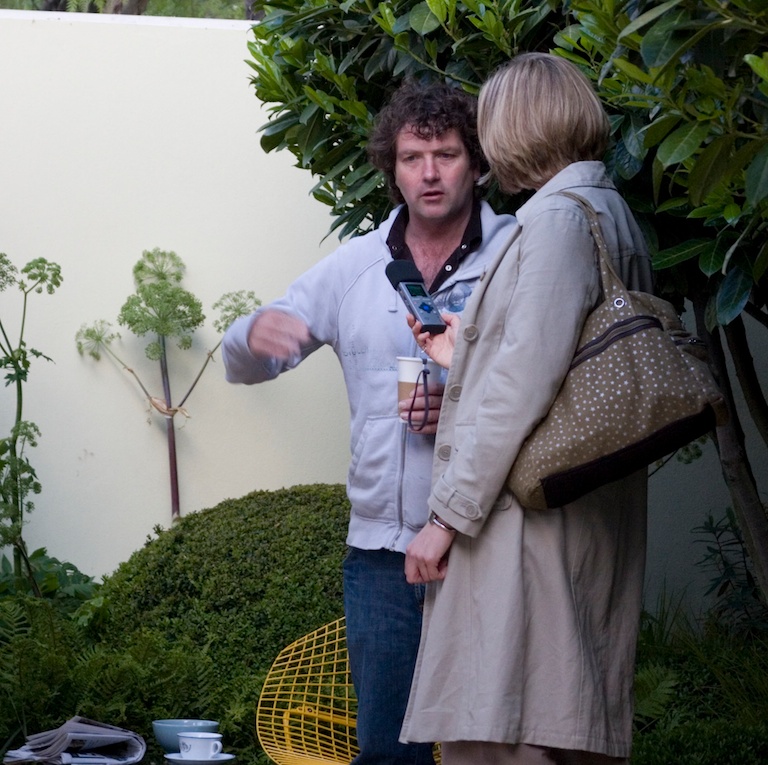
Dairmud Gavin is always friendly and willing to talk
Dairmuid Gavin is always willing to talk gardening and good for a laugh and joke.

Rachel de Thame
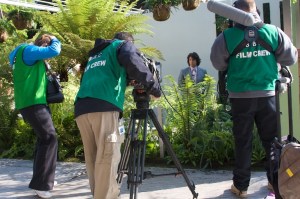
Filming Laurence Llewelyn-Bowen for the day's programme
The one celeb who is always aloof and not at all approachable is the great man himself Alan Titchmarsh, he has purposefully looked the other way whenever I have tried to take his photograph, not sure why, never been able to ask him! Maybe this year I’ll be luckier.
Press Day is a bit a slog really, we are admitted to the showground really early, it used to be 5 am, these days it’s a bit later. We have to leave by 3 pm when the Queen arrives for her personal visit, by which time I’m just about keeping upright … not the wine … just sheer exhaustion from being on my feet for ten hours without a break!
Many of you of course will be able to follow the show on BBC tv and will get a better view of many features than the visitors on foot! There is so much to see that I always seem to miss something really interesting – I get to catch up in tv programmes in the week. Even better, I’ll be able to go to BBC iPlayer for those programmes I missed, what joy! I never could fathom the CD and the DVD recorders, now I don’t have to worry, all can be viewed on my laptop, when I like and for free!
Val Reynolds Brown, Editor
By the way www.ourfrontgarden.com is the website we write about the ongoing renovation and care of a front garden in a garden city
Get bug-eyed about minibeasts – Join in a UK survey
Capsid Bug
Bugs Count is a chance to better understand how and where bugs live. Hunt for bugs in soil and short grass; look on paving and the outsides of buildings; and search on plants and shrubs. Anyone can take part in this national study, led by Open Air Laboratories.
John Tweddle, Natural History Museum, commented, ‘We want everyone to get outside and discover the nature on their doorstep – look in your streets, playgrounds and local parks. With our towns and cities expanding, it’s vital we get a better understanding of how our wildlife is being affected by these changes, Taking part is great fun too!’
But why are bugs so important? They may be tiny, but bugs play a crucial role in pollinating our plants, recycling nutrients by breaking down waste, controlling pests and providing food for birds and other animals.

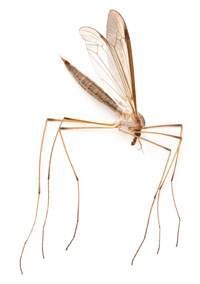
Cranefly
Val Reynolds Brown, Editor
Easy Potato Growing – A Delicious Treat
What a waste it felt to put the plastic bags used for the potting compost we had bought
in the dustbin, correction – plastic recycling bin. This year we are growing potatoes re-using those plastic compost bags – an idea we picked up from one of Monty Don’s Gardener’s World videos on the BBC website.
We have been keeping the bags back as they are heavy duty plastic – each bag only needs three potatoes to grow a crop – and the results are so delicious and so economical. We turn the bags inside out so they are less obtrusive and they are behind an open fence as they are not the most beautiful sight to behold. 
Here’s the latest bag we have used that contained peat-free compost. We have added some polystyrene pieces that seem to give plants added vigour. Not sure why, but it is true.
Another suggestion is to use several rubbish or gardening sacks one inside the other, more than one to get extra strength, a bit like carrying wine bottles using more than one plastic carry bags.
We’ll be experimenting with hessian sacks to see what we can grow – we got this idea from the charity Send A Cow who promote bag gardens – see the video.
Do you have an economical tip to pass on?
Val Reynolds Brown, editor
By the way www.ourfrontgarden.com is the website we write about the ongoing renovation and care of a front garden in a garden city
Broad bean problem – HELP needed
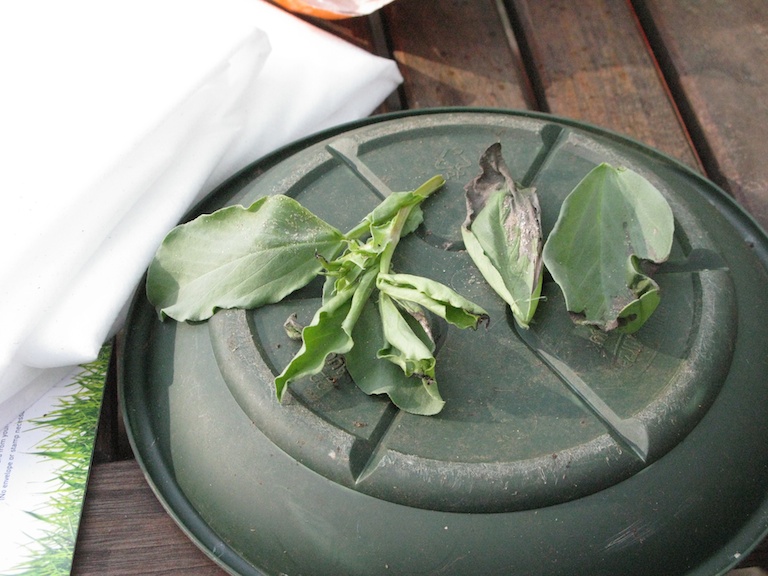
Broad bean leaf damage
A reader has emailed in with this photo – can you identify what it is. Is it a virus, fungus, insect?
The plants have been growing well until now. I hope we can help her. Editor
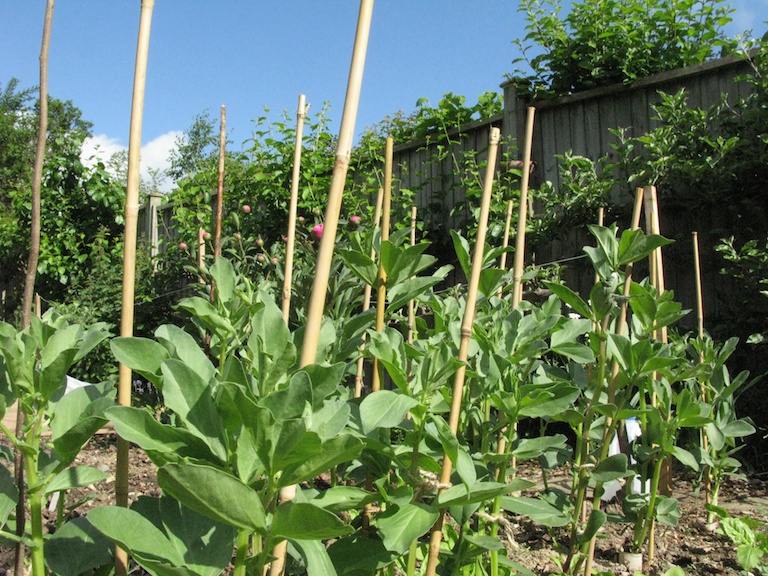 The problem has been identified as frost damage and nothing to worry about. The plants look very healthy and should produce a fine crop. A growing tip from Sine Chesterman* is to pinch out the tops once the first beans are forming on the lower stems. This stops blackfly colonising the tops of the beans and working their way down and ruining the crop. She used to give the tops to their goats who loved them. When the last goat died Sine used to cook them, boiled with a little salt, strained and warmed with a little pepper and butter – superb!
* Sine Chesterman’s interest in gardening and botany started at an early age with her own patch in her parent’s garden and learning which plants were natural healers.
Brought up with old and tested remedies and gardening methods, now termed organic, she still practises natural ways of pest control. We will be publishing a series of features about herbs written by Sine in the near future.
Editor
By the way www.ourfrontgarden.com is the website we write about the ongoing renovation and care of a front garden in a garden city
Prize Draw – Supa Drippa Taps
 We are great fans of these extremely useful devices that help the busy gardener with watering precious plants. You can control the flow of water and spread watering over a period of a week using a discarded plastic milk container and a dinky little tap.
Inexpensive, efficient and fuss free we love these Supa Drippas – see our feature.
We have three packs of ten worth £11.95 + £1 pp provided by The Organic Catalogue, to giveaway to our readers. To enter the prize draw just send an email to editorinbalance@me.com, with Supa Drippa in the subject box and full contact details in the text box.
One entry per household, closing date is 12 June 2011.
By the way www.ourfrontgarden.com is the website we write about the ongoing renovation and care of a front garden in a garden city
SOS – Save your Plants
A simple, inexpensive and no fuss solution in drought conditions
Supa Drippa taps are all that they say on the packaging!
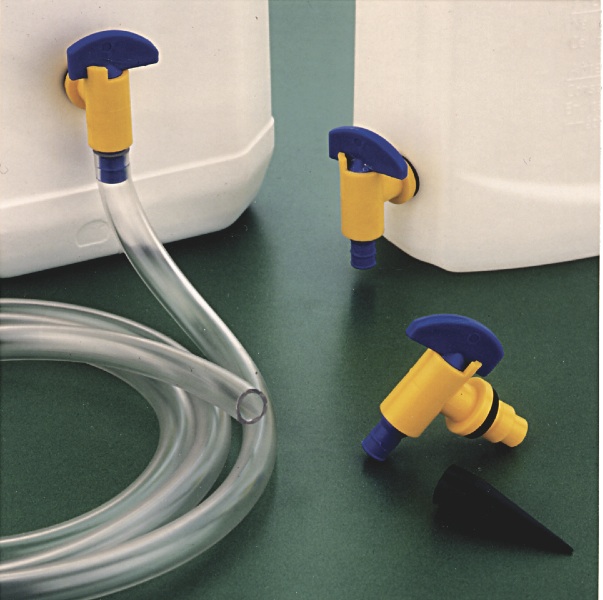 In unremitting hot weather some vulnerable plants, especially newly planted fruit trees, have needed constant attention and using discarded plastic milk bottles as water containers with a little plastic tap slowly watering plants has made a critical difference.
I’m not a huge fan of plastic milk bottles sited all over the garden but they will stay there until the weather turns to rain.
I did find the instructions a little short on detail, but got there in the end.
I had ten drippers and quickly realised why the diagram showed the bottle filled with water. Yes it means you get a bit wet when the spiker gets through the plastic, but the water gives the container much needed volume to take the pressure when piercing the plastic. The spiker gets pushed into the container and that’s when you insert the little tap.
I would like the tap to have some indication of which is the continuous flow and which is the slowest. In fact On and Off, or + and – signs would have been very helpful. As it was, I had to experiment and again got rather wet.
To relieve the pressure in the container the lid has to be left off. If you are concerned about mosquito invasion drill a couple of small holes in the lid and replace.
I found when planting out it was useful to be able to put the taps on continuous flow right next to the stems to get the plants well watered, then refilled them in situ and put the tap on very slow drip. Each plant got two litres of water, enough to carry them through for at least five days.
In the case of seedling courgettes and tomatoes the system was invaluable. It made the difference between wilting and continued growth. I also added water with fertiliser direct to the bottle when topping up. Again this is very useful for tomatoes that like lots of nutrition.
You can buy tubing to go with the Supa Drippas, useful when you want to water patio pots. I also had the idea to have a sufficiently long tube to snake round my six precious outdoor tomato plants and punch a hole where the tube meets the plant. That way I would use only one container – would have to be a two litre container, and one tap. This is an experiment in the making! I’ll try it and write about my experience.
ARE SUPA DRIPPAS WORTH THE MONEY?
Ours came from the Organic Gardening Catalogue who charge £11.95 + £1pp. At roughly a pound a tap the answer has to be yes as they are virtually indestructible and I’ll be able to use them for years. I loved the idea of reusing those plastic milk cartons too. Once I have enough 2 litre milk containers I’ll replace the 1 litre containers so when we are away for more than a few days I’ll be less reliant on the goodwill of friends and neighbours to make sure plants don’t suffer from any unexpected drought.
I have been considering using the water butts with a solar powered pump to water when we are away. The cost is fairly high and involves laying out piping with dripper attachments. Although less conspicuous than milk containers, at the moment I’m more worried about losing plants and these Supa Drippas have taken away a lot of that anxiety.
ARE THEY WORTH THE EFFORT? A resounding Yes!
1. They have made the difference between using a hose and all the economic factors that implies.
2. You can add nutrient to the water, a simple, time efficient way of adding feed direct to plants that need it. So easy to keep the water in the watering can topped up.
3. Once a plant looks like it has had enough water for a while I have moved the containers to other plants. I can see I really need about 30 containers altogether which will be a really good investment
4. The containers can be easily stored ready for reuse for the next drought.
When I put some young gerbera plants in the front garden each with its own watering container for a day they intrigued some passersby and I made some more gardening friends!
So you need more reasons to get some? OK! they are made in the UK!
We have THREE PACKS to give away. Just send an email to editorinbalance@me.com with Supa Drippa in the subject box and your contact details in the text box. Closing date 12 June 2011 – one entry per household.
Val Reynolds Brown, Editor
Giveaway Winner – Brother Labeller
 The feature we wrote about the Brother P-touch Labeller included a popular giveaway.
We are pleased to say the winner is C Farley from East Sussex.
Click on the Sign Me Up button on the right to be sure to receive details of future features and giveaways.
Val Reynolds Brown, Editor
All Over the Place!
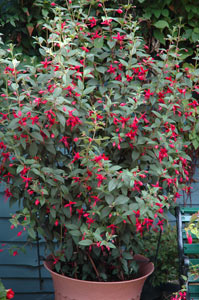
Lady Boothby
Lady Boothby, a really beautiful climbing fuschia, is on offer in a price clearance from Thompson & Morgan
The plant, with two-toned flowers on red stems, is the world’s only climbing fuchsia, suitable for pergolas, trellises, arches, walls, fences and will give years of colour. It will climb up to ten feet and spread over three feet in sun or semi shade, flowering from June to September.
The Thompson & Morgan website gives brilliant instructions on how to grow and aftercare information.
Current prices while stocks last are 3 jumbo plugs for £7.99, 5 jumbo plugs £9.99, and 15 jumbo plugs at half price £14.99. At prices like these you could afford to buy several and give some away as gifts.
Delivery will be by end May 2011, so get your order in now and look forward to a plant that’s sure to attract lots of interest!
Sowing Tips from Experts
It’s always good coming across a commonsense, straightforward account of how to do something and here are some of the books I refer to frequently for help when getting seeds and equipment together:
 Anna Pavord – Growing Food: Eminently readable, easy to digest, beautifully illustrated with line drawings, much in the style of Dorothy Hartley. Anna gives details on a raft of planting plans. One plan I was attracted to was the Potager’s Garden where she advocates some lovely combinations of flowers and vegetables. Much in the way I grow our vegetables and fruit in fact, but she gave me some ideas of companion planting I haven’t used before.
Raymond Poincelot wrote Organic No-Dig, No-weed Gardening which I read cover to cover when I came across it some years ago. It is full of great ideas, clear instructions, and gives a clear understanding of his concept.
 Allotment Gardening: An Organic Guide for Beginners by Susan Berger is another book I have by my bedside and is regularly referred to.
 Geoff Hamilton‘s Gardeners World … is a bible I refer to frequently. He was my kind of gardener, self reliant and imaginative when looking for solutions, without going too mad on devices, but using commonsense … He gives very useful and clear instructions on how to construct inexpensive cloches.
 And then I love reading Carol Klein’s Growing your own Garden. Bliss! I can hear her voice with the enthusiasm oozing out on every page! I have met her and she is just the same in real life. A great lady!
 Trawling the Net I came across Madeleine Giddens’ website where she has put a clear and concise guide to sowing herb seeds. She gives useful links to seed suppliers and books to follow up.
I hope you find these helpful – if nothing else it is a booklist for winter reading!
Val Reynolds Brown, Editor
 In Balance